Mr. Dickey One-Leg

5%

Review and Herald Publishing Assn. · Takoma Park Station, Washington, D. C. · Oct 30, 1906

FromThe Youth’s Instructor, Vol. 54, No. 44.

Read the full edition

Mr. Dickey One-Leg

He came into the world one day in late summer. He did not seem much different from any other English sparrow in the neighborhood. He was simply the same little bunch of brown feathers and business that they all are. But from among his fellows he soon came to be known by the fact that he had chosen for a roost a sheltered spot beneath the roof of the back porch.
At first he always flew out when any one came near, and as his chosen resting place was near the pump, he was often disturbed. As the days went by, and no one seemed to pay any attention to him, he sometimes stayed when any one came to the well for water. After a time he became more bold, and would even take his place at roosting time, although some of the women were chatting on the back steps but a few feet away.
There was some very cold weather that winter, and one day in February the thermometer went down to twenty-seven below zero. It would seem that all the birds out of doors would freeze to death. But Mr. Dick of the back porch did not intend to freeze, not at least when there was so much warmth inside the house.
That evening he began to realize that the weather was much colder than usual, and, when it got worse than he cared to endure, he left his perch under the porch and knocked on the window; anyway his bill did some good tapping. Whether he was knocking for entrance or only trying to fly into a place that his instincts taught him to be warmer than where he was, I can not say. I have known more than one bird to be puzzled by the mysteries of glass.
The lady within heard the noise, and being very kind and hospitable, she let down the window, and Mr. Dick flew in. He lighted on the curtain pole above the window, and looked down on his hostess in a very serious and interested way. She gently closed the window and went back to her place by the table. Woman and bird watched each other for a time, and then Mr. Dick concluded it was all right, and settled down for his night's rest. In the morning he was impatient to be away, and the lady let him out, and gave him a fine breakfast on the snow just outside.
The weather kept cold. There was nothing anywhere for a bird to eat, and no comfortable place to sleep, and the next night Mr. Dick came back and knocked once more on the window. Again the lady let him in, and he slept safely and comfortably on the curtain pole above the window.
But next day the weather grew warmer, and he seemed to think his old place under the porch was good enough, so he went back to roost on the ledge under the shelter of the roof. Sometimes he seemed afraid to stay there in the evening until it had grown somewhat dark so that the foolish little fellow thought no one would notice him. Then he would fly under when no one was looking, or at any rate he thought there was not, and there he would remain. More than once, just at bedtime, the man went out and lighted a match, to find Mr. Dick perched up in his corner, all safe and comfortable.
Restored with AI
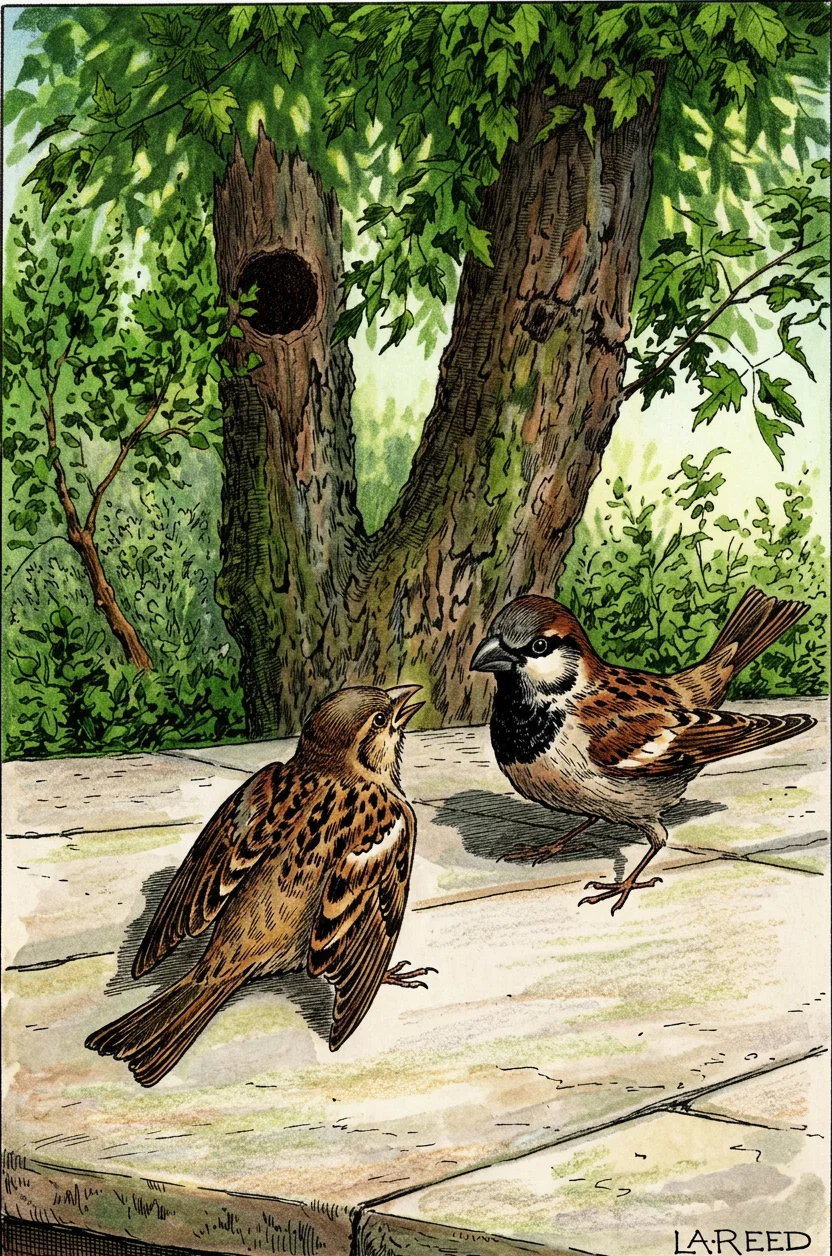
When the spring came, Mr. Dick found a mate, and they built a nest in the rotten stub of a silver maple, where a woodpecker had made his hole the previous winter. When Mrs. Sparrow settled down to the work of brooding, Mr. Sparrow was kept busy getting food for her and the babies. But sometimes he had a little leisure, and perched on the highest stub of the old maple, where he tried his best to warble the thankfulness he felt. Sometimes it seemed as if he really would manage a trill or two, and possibly a few rounds of melody, but they were mere suggestions, that failed to develop into reality. He couldn't sing, that was very evident; but he continued to persist in making the attempt. Aside from showing how he felt, he certainly failed completely.
In Morgan County, I am told, there is a royalty of two cents paid for the head of an English sparrow. The boys, consequently, are growing quite expert with their deadly sling shots in their ambitious efforts to earn spending-money. In process of time one of these ambitious youngsters passed by the old silver maple, where Mr. Sparrow was trying to sing his head off. Whiff! went the sling shot, and Mr. Sparrow flew away with one of his legs missing. It had been shot off just above the joint by the keen cutting shot of the boy's weapon.
Crutches are unknown among sparrows, and hopping on one leg is neither graceful nor easy. Mr. Sparrow came back to his tree after a time, but he was scolded severely by Mrs. Sparrow when he did. She did not seem to know what was the matter with him, or seemed to think he was merely playing lazy. She told him to be off on a hunt for food. He argued back, and tried to explain he was hurt and couldn't work any more that day.
Then Mrs. Sparrow became angry and flew at him to give him a flouncing. Lame as he was, he could fly as well as ever, and he kept out of her way. Then she coaxed him, and pleaded with him, and reminded him of the babies. He had settled on the tin roof of the back porch. He could not stand very easily on one leg, so he squatted down on his breast and closed his eyes as if he felt pretty miserable. I have no doubt he did feel so, having one of his legs chopped off. But Mrs. Sparrow did not intend to let him sleep or to give him very much peace. Every now and then she landed near him, sometimes talking to him in a quiet, earnest way, sometimes scolding him pretty thoroughly, always urging him to help about getting food. And when Mrs. Sparrow was not busy coaxing or entreating or scolding her mate, she was busy getting food for the young sparrows in the nest.
Sometimes Mr. Sparrow would rouse a little, tumble or hop about on one leg, using his wings very vigorously the while. Then he would settle down again, close his eyes, and with bill open, seemingly pant for life.
Mrs. Sparrow either could not understand what ailed him, or else thought he was a mere good-for-nothing. Anyway, she made up her mind to get a divorce from him then and there, and marry somebody who would work, instead of lying around on the roof all day.
Shortly after coming to this conclusion, she appeared with a new husband. He was a fat, smart, rather young-looking creature. He followed Mrs. Sparrow until he caught sight of Mr. Sparrow-with-the-one-leg, and then he stopped and shouted out a challenge.
Mr. One-leg answered him back. At this, Mr. New Sparrow assumed a fighting attitude and challenged again and called names. Mr. One-leg answered him back, challenge for challenge, name for name. But Mr. One-leg wouldn't leave his rest on the roof. Then Mr. New Sparrow flew a trifle nearer the nest and challenged again. Mr. One-leg brightened up a trifle, and challenged louder than his enemy. Then Mr. New Sparrow attempted to fly to the twig just in front of the stub that held the nest. That was the signal for a fight.
Mr. One-leg went at Mr. New Sparrow like a shot from a gun. Mr. New Sparrow was off with a vengeance, and kept well out of the way of Mr. One-leg, who soon came back and settled in a crotch of the maple. The next day was a repetition of what the previous day had been. Mrs. Sparrow found several mates, and brought them to the maple, only to have them all driven away again by the furious attacks of Mr. One-leg. And he not only attacked the birds she brought, but he gave her a good scolding each time into the bargain. Sometimes he remonstrated, sometimes he waxed wrathly. But she could scold, too, and they had it back and forth quite considerably.
She objected to having to do all the work herself, and he, of course, couldn't help, and wouldn't allow any other bird to do what plainly it was his duty to do. She called him a miserable, lazy good-for-nothing. He tried to explain that he wasn't lazy, but sick, and ought to be in the hospital instead of having to fight for his rights and be abused by her. But after a day or two he grew much better, seemed to get his spirits again, and managed to use his one leg quite dexterously. Once in a while he would wabble a little and have to hop some to keep his balance.
As soon as he was well enough to gather food, he found little trouble in making up with his wife, and he was soon as useful and as happy a bird as he ever had been. His mate followed him around as lovingly and dutifully as in the former days. And the young birds grew and flourished under their care, and soon went out into the world to brave their own dangers, such, for example, as boys and sling shots.
It seems to be true with birds, as well as with people, that if one only has the spirit and courage to push ahead, he can succeed in spite of great and many obstacles. A handicap does not necessarily prevent or hinder success. So it has proved with Mr. Dickey One-leg.—L. A. Reed, in “My Garden Neighbors.”