No class of development has been found to give better results with the general run of amateur negatives than what is known as Tank Development. It is a method that has been employed by those who do developing for amateurs, for many years, and the success of it has been a matter of wonder to many who did not know how the results were attained. Of its success with film photography the Eastman Kodak Company, who are the largest makers of film cameras and film in the world, say: “Tank development for film is introduced only after the most exhaustive experiments in our factory have conclusively proved that it is by far the best way of developing film ever devised.” This company has prepared a machine for carrying out the tank idea, so that no dark room is needed. The exposed film is developed in ordinary daylight. Such machines are of almost inestimable value to the tourist and traveling photographer.
Restored with AI
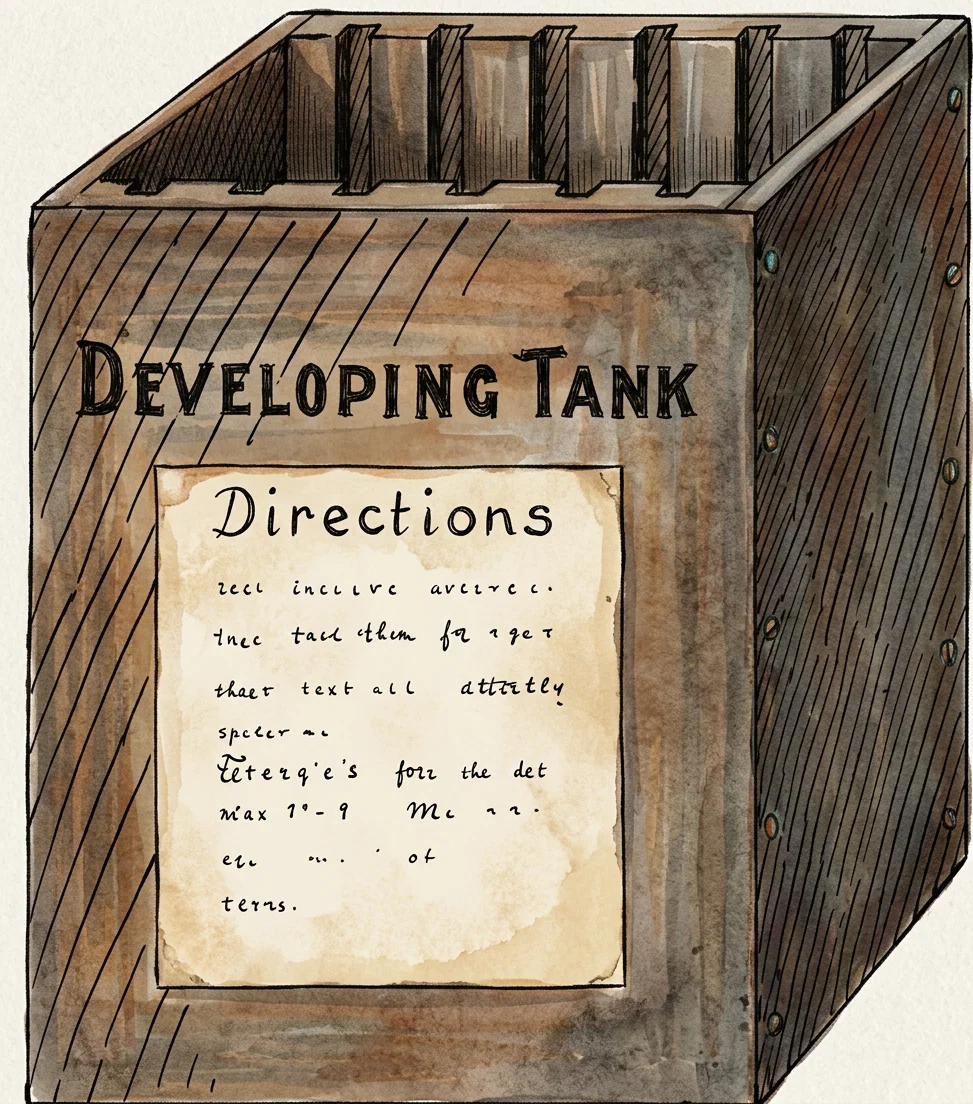
Fig. 1.
To “tank-develop” plates, the exposed plates are placed in a tank (Fig. 1) of very much diluted developer, each plate being slid down into grooves on the inside of the tank. The tank itself is generally made of hard rubber or imitation rubber, but may be of glass, aluminum, or even of wood that has been coated with some waterproofing material; for a home-made tank, bicycle or bath tub enamel of good quality, thoroughly dry, has been used successfully.
The developer may be any of the ordinary kinds, but preferably one that does not soon oxidize and discolor. The ordinary strength will be diluted five or ten times with water, or even more. Into this the plates are slid, a cover is put tightly on the tank, and the photographer can leave the dark room, and go about his other work for half an hour or more. Then he comes back, and one by one examines his exposures by the ruby light. If any are finished, he rinses and fixes them. But probably none are ready, and he waits another half hour, and another, and another, till every exposure has yielded a satisfactory plate or film. In some of the finishing houses dozens, and often hundreds, of negatives are undergoing tank development at all hours of the day.
I have no hesitation in recommending this method of negative making, because I know it will do good work. But if you do decide to practise it, don't be impatient for quick results. Allow plenty of time, or you will get thin, under-developed negatives. Give them plenty of time to gain contrast.