The “developing-machine” powders for film, as sold by all dealers, are good for plates as well. But several workers recommend the following:—
Carbonate of soda 1 ¼ oz. Sulphite of soda ¾ oz. Glycin ¼ oz. Water (hot) 16 oz.
When ready for use, add eight ounces of water to every ounce of this stock solution, or more or less, as may be desired. The more water, the longer will be the development; and the less water, the shorter.
Photography by Moonlight
Moonlight is very dim compared with sunlight. I have learned by experiment that on a bright moonlight night it requires an exposure of from five to twenty minutes or more, with the full, open lens of a common hand camera to yield a picture on a fast plate. A fairly accurate rule is to first figure out the exposure you would give the same view in broad sunlight (a snap shot with a common camera would perhaps be 1-50 of a second or less), and then multiply this by one hundred thousand, and you will have something like the correct time for the night picture.
Do not try to include the moon itself, because it will move during the exposure. If the moon is really desired, it can be retouched in afterward.
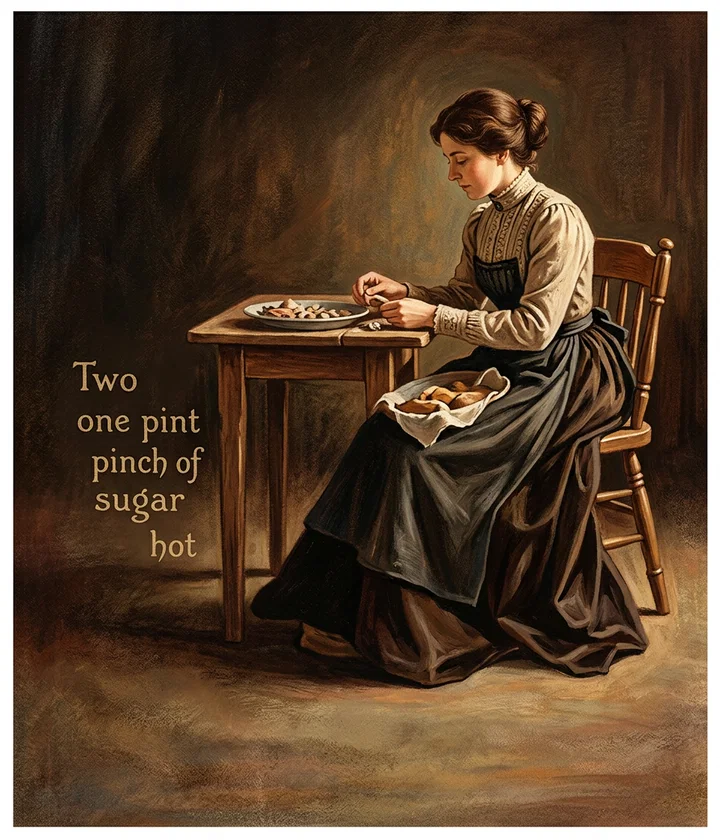
Nowadays many pictures appear in the papers and magazines, purporting to be “moonlights;” in them are rippling waters or dashing waves, which tell us plainly that the exposure could not have been more than the fiftieth of one second. These “moonlights” are not moonlights at all, and a truer, though less poetic name for them would be “sunlights.” One of these, with a moon retouched in, is shown in Fig. 2.
To make them, the camera is pointed across the water, toward the morning or evening sun, and a snap-shot exposure made. It is developed in a weak developer to make rather a thin negative. This makes “moonlight,” and, if we wish, a big round “moon” can be retouched in.
An Interesting Use of Flash-Light
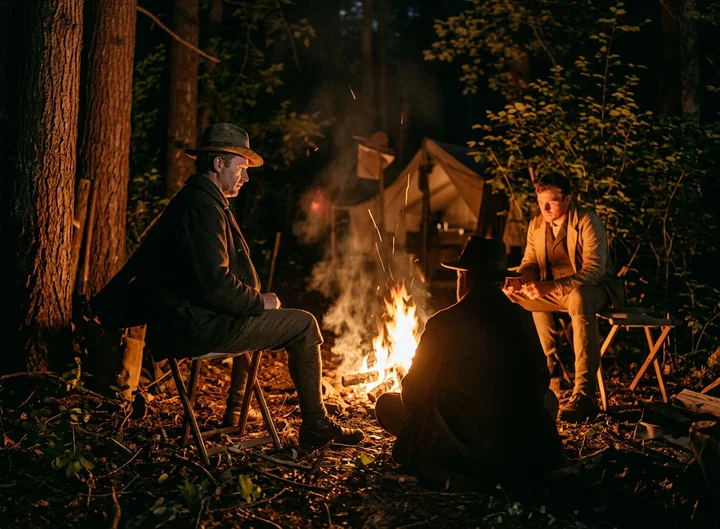
Every one is familiar with the common use of flash-light for making pictures in dark places; but I think the following way of using it will be new to most of my readers. For instance, there is a group of people seated around a camp-fire, and we wish a photograph of it. We know that firelight is red, and does not take well; it would require perhaps a quarter of an hour to make a good exposure. Now it is only necessary for some one to throw a bit of flash-light material on the fire, and the brilliant flash produced will give us our picture in an instant. It is understood, of course, that the camera shutter is to be opened before the flash, and left open until the exposure has taken place. Flash-light may thus be used in fireplaces, forges, stoves, and even lamps (if old chimneys are used) for securing quickly the effects of firelight.
Fun with Blue Print Paper
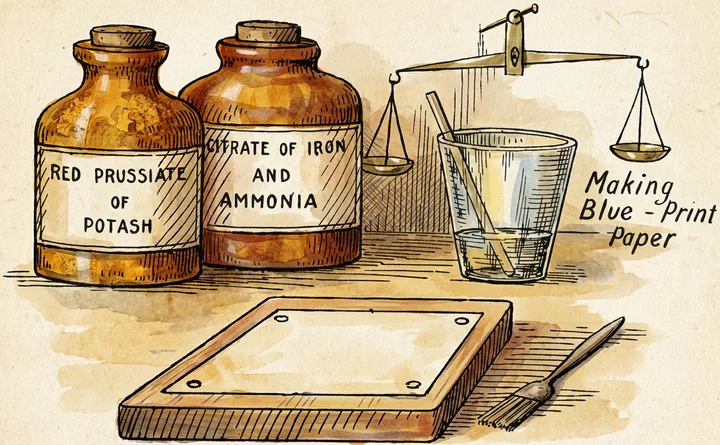
Blue print paper can be bought for fifteen cents per two dozen sheets, 4 x 5, in some places, and it can also be prepared by the user easily. To prepare it, dissolve 1⅞ ounces citrate of iron and ammonia in 8 ounces of water. Keep in a dark-colored or paper-covered bottle with a good stopper. It must not be kept in the light. In another bottle of 8 ounces of water dissolve 1¼ ounces ferricyanide (red prussiate) of potassium. Keep this tightly corked also. For use mix ½ ounce of each of these solutions, and spread the mixture thinly and evenly on white paper, cardboard, backs of postal cards, or other material on which it is desired to photograph. Dry the paper in a warm dark room.
It might be well to say right here that blue-print mixture does not keep well, and if one has a pair of scales, it is better to weigh out and mix a small amount of the chemicals at a time. An ounce of the mixture should cover a great deal of surface. It may be applied with a soft brush, a tuft of cotton, or a wad of thin white cloth.
This paper, when dry, can be printed on under a negative in sunlight. When the shadows have become slightly bronze-gray in color, wash the print, and it will immediately develop out into a beautiful blue picture. The washing makes it permanent, and when dry it is finished.
In the same way leaves and drawings can be copied, by laying them on glass in a printing frame, putting in the paper and exposing in the sunlight. Prints will, of course, be negatives of the leaves; but if one wishes, he can print from these negatives just as he would from any negatives, and thus secure positives.
Many interesting uses for the paper will suggest themselves to the boy or girl who loves to experiment. They will find that it is only necessary to write in good black ink upon any thin paper, oil the paper to make it more transparent, and a print can be made of the writing or drawing in a few moments in the printing frame. Pictures cut from the papers and magazines are easily copied in this way. Fig. 5 shows how one will look.p. 7
If there happens to be printing on both sides of the paper, it must be removed from one side in the following manner: Wet the picture in a pan of water, and lay it face down, that is, the side you wish to save, on a smooth hard surface, as on a piece of glass, tin, or a plate. Remove all the water you can by blotting with a piece of cloth or blotting-paper. Then with the finger tips carefully rub away the printing that is not desired. If care is used, it will take but a few moments to remove everything that is not wanted, and the remaining picture can be dried, oiled, and printed. Of course you can combine your own handwriting or drawing with what you find printed, and many interesting and amusing effects can be secured. You will have only to oil these blue-print negatives and print from them to make positives just like the original prints.
Another way to make a blue-print negative is to first expose a piece of blue-print paper in the sun till it is very blue, wash and dry, and then write and draw on it with a pen dipped in either a strong solution of sal-soda (carbonate of soda) or a solution of oxalic acid (poison). You will find that your pen will leave a white line behind it, just as if you had written with a fine white ink. When the drawing is made, it will be a negative, and you can print positives from it.
What Are “Magic” Photographs?
I have been asked many times what the so-called “magic” photographs really are. They come in a little envelope and appear to be squares of perfectly white paper. A little piece of blotting-paper accompanies them, and this is to be wet with water, and has the power of developing pictures on the blank papers, when they are laid upon it—much to the astonishment of the purchaser.
Any one can prepare them. First prepare a solution of bichlorid of mercury—½ ounce, water 4 ounces. Keep it in a bottle, and label it “poison.” In it bleach out any photograph you wish to convert into a “magic.” The bleached print can then be washed, dried, and kept for years. To cause the original picture to appear upon it, lay it on a piece of blotting-paper that has been once soaked in sulphite of soda solution, dried, and again moistened when wanted for use. There are other ways to make the print appear. I have not tried them, but am told that carbonate of soda, ammonia, hyposulphite of soda, or even tobacco smoke will do it.
EDISON DRIVER.