Our Field — The World

2%

Review and Herald Publishing Assn. · Takoma Park Station, Washington, D. C. · Dec 11, 1906

FromThe Youth’s Instructor, Vol. 54, No. 50.

Read the full edition

Our Field — The World

Portugal

Program

OPENING EXERCISES;—
Song.
Scripture Reading.
Prayer.
LESSON STUDY: Portugal.
General Description.
Its Cities.
The Language.
Industries.
Beginning Work in Portugal.

General Description

PORTUGAL is one of the oldest countries and one of the newest mission fields for Protestant propaganda. It is a small country in the extreme southwest of Europe. It is about 362 miles in length by 140 in width, having about 34,420 square miles, and a coast line of nearly 500 miles, with excellent harbors. To this country belong two groups of islands, the Madeira and the Azores, situated a few days’ distance by steamer from the mainland. It also has large possessions in both east and west Africa, where, including natives and Portuguese, the population is about 14,000,000. Counting the population of Portugal on the continent, and the islands, and a small possession in India as 5,500,000, the 140,000 Portuguese in the United States, and 21,000 in Brazil, we have 40,000,000 to whom we must teach the third angel’s message in a language known by a very few workers.
The government is a monarchy; though a majority of the people desire a republic, the influence of the priests of the state religion, which is Catholicism, keep under subjection freedom of thought, speech, and action. In the last few months there has been brewing a wave of revolutionary ideas, but in a country where only twenty per cent of the people can read or write, it is difficult to start a republic.
The climate is quite good, and is recognized as being healthful. The center of the country is of the same latitude as that of New York, Philadelphia, Des Moines, Denver, and San Francisco. The climate is like that of California. Nearly all the fruit grown there is produced here, although not so plentifully, and of what there is, a lack is felt of ways to preserve it. For a person in poor health there can be no better place in the world to regain his health, or at least to hold his own against the inroads of disease. Though nature’s laws are little heeded, many persons live to a ripe age.
The diet of the people is quite varied, partly from the money standpoint; that is, those that have more money, have a greater variety. For the poorer classes, it is codfish, potatoes, and bread. The majority drink wine, and many eat fish, clams, and snails. But very few among those whom we have met have eaten stewed fruit.

Its Cities

Lisbon is the capital and largest city, having a population of probably four hundred thousand. No city in Europe has a nobler position. It climbs steep hills on the north bank of the Tagus for fully five miles along the river, with a string of suburbs extending even farther. The houses, rising tier above tier, with roofs of snow-white tiles shining in the sunlight, are an imposing sight. Lisbon has an air of a modern city, but this is because of the rebuilding after the great earthquake of 1755. It was up the Tagus that the tidal wave ascended after the earthquake.
Sixteen miles northwest of Lisbon is the beautiful old town of Cintra, where wealthy families from the capital city have their summer villas. Huge oak trees, plane and cork trees, well-kept gardens and pleasure grounds, are on all sides. Mexican palms, Brazilian shrubs, groves of orange, lemon, and fig fill the air with perfume.
Oporto, situated at the mouth of a large river, is next in size, with about two hundred thousand inhabitants. Coimbra is another town, where is located a large university. Setubal, to the southern part, is situated among large groves of almond, walnut, orange, and lemon trees.
The capital city contains many edifices of a historic nature, such as convents and churches. On many churches are seen the marks of the great earthquake. After the expulsion of the Jesuits by the Marquez de Pombal in September, 1759, the religious orders were suppressed; that is, no more persons could become nuns or monks, but those already existing were allowed to remain until the last one died, when the property was to be turned over to the state. By such sales, old paintings were thus collected, and exposed to view in an art museum, with privilege given to certain ones to copy. Old books, manuscripts, and relics in general, in the same manner were collected and exhibited.
Lisbon was the seat of the Inquisition in Portugal. The building in which this terrible work was carried on is now a theater, and many of the convents are used as public buildings, such as libraries, government offices, schools, storage rooms, etc. In one convent is the British and Foreign Bible Society’s office and storage rooms. In the dark rooms of the monks, Bibles are piled to the ceiling. In another part is a hotel, in another is a Protestant chapel with a day-school near by. Thus God’s Word overthrows the machinations of evil hearts, bringing to light the hidden things, and knowledge to the ignorant.

The Language

The Portuguese language is a modification of the Latin. While it is known that formerly the language was a mixture of that used by the barbarian tribes, the Roman rule gave it its Latin construction. It seems to be more closely akin to the Spanish and Italian, although many grammatical constructions and nasal sounds are similar to the French. I would like to suggest to our young people who are planning for foreign missionary work, that in lieu of not having the Portuguese language in our schools the next best thing is the Spanish, and I hope some student will be impressed to prepare for the work among the forty million Portuguese. The construction of this language is very similar to the Spanish, and in many words there is only an extra letter or two. For an example, John 1:1, 2: “No principio era o Verbo, e o Verbo estava com Deus, e o Verbo era Deus. Este estava no principio com Deus.” Spanish, “En el principio ya era el Verbo; y el Verbo era con Dios, y Dios era el Verbo. Este era en el principio con Dios.”
The Portuguese pronounce the c as in English, a as in hat, e as in jet, i as in machine. The consonants are the same.

Industries

The farms are poorly tilled; large tracts of land are left as waste land; mines are not thoroughly worked; manufactories are few, and most of the industries which do flourish are conducted by Englishmen or Brazilians. Wine making is one of the principal industries. In and around the cities many have small gardens to raise vegetables for city consumption. These are taken to a large open market, whence they are bought by men and women hawkers, who carry large baskets full, either on the shoulders or on the head, about the street, supplying those who can not go to the market to buy.
Fishing occupies the attention of quite an army. A very pretty sight it is to see the fishing fleet of small sailboats standing out to sea, where they catch the finny tribe. These fish are unloaded at the fish market, to be in turn bought by retailers, who are men, women, and children. The retailer sells from house to house, or in small shops. Many in these parts are in the trades, or work as servants for the rich and the foreigners. Some of the rich are called “Fidalgos,” or “men of leisure.” These may or may not have a title; they perhaps own a small farm with an income sufficient to allow them plenty of leisure.
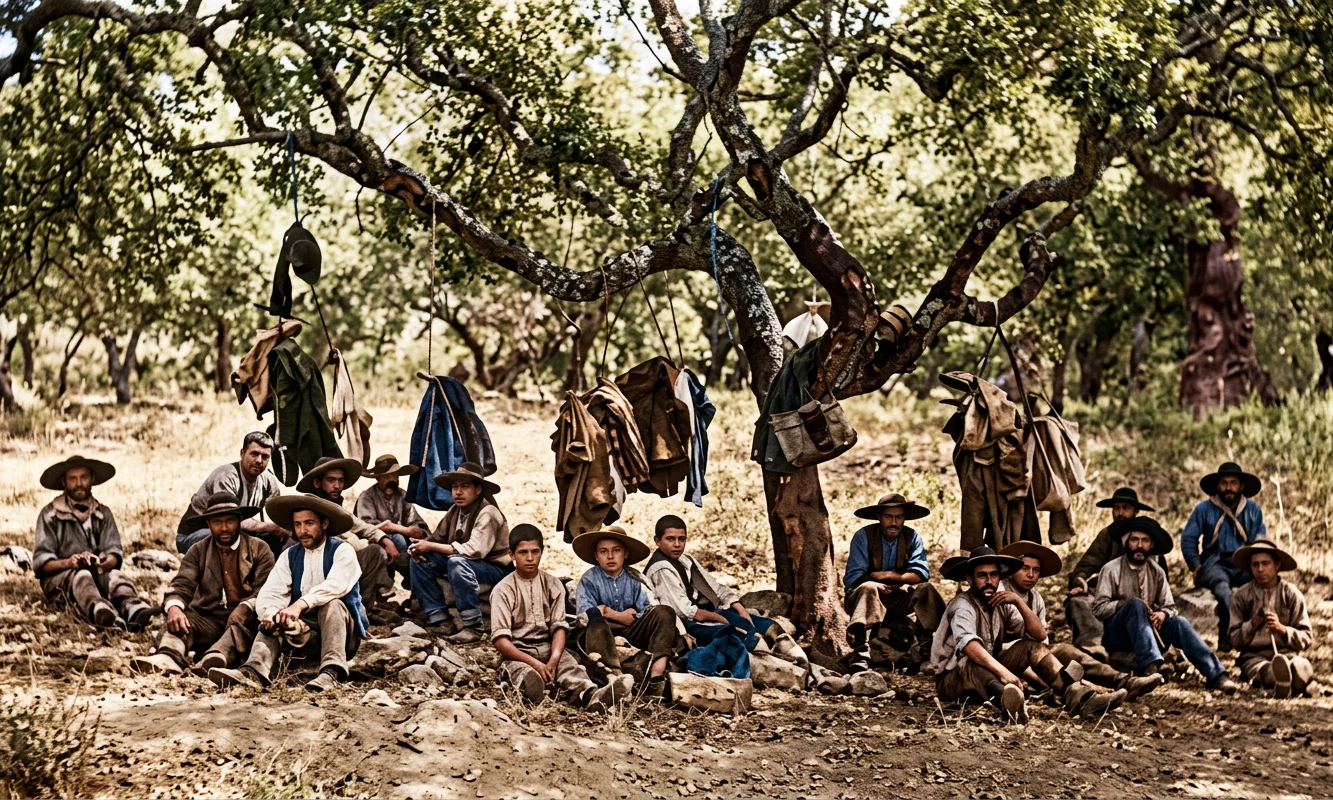
Another interesting thing is the cork industry. In the latter part of July and August this valuable product is gathered. When the bark is taken from the tree, no more can be gathered for seven years. It is piled and loaded on cars to be shipped to some place for cutting. From this bark comes our corks for bottles, cork limbs, insoles for shoes, life-preservers, and many other useful articles. The illustration of the cork workers shows them as they gathered at midday for lunch. Their traveling blankets, a necessary thing to the Portuguese, are hanging on poles strung to the limbs of a cork tree. Almost any time on the beach, one can see blocks of cork which have floated down the river Tagus, and finally landed on the shore. This reminds me of the stream of literature which is, and should be, flowing out to the great sea of humanity, where some here and there finds lodgment in a secure place,—an honest heart.
CORK WORKERS OF PORTUGALRestored with AI
CORK WORKERS OF PORTUGAL

Beginning Work in Portugal

The twenty-sixth of September, 1904, we landed at Lisbon from the steamer “Magdalena” coming from Southampton, bound for Brazil. Our first work was to learn the language. Beginning with a teacher, we studied for five months. Not making the progress we desired, we changed location as well as teacher. The second knew how to adapt herself to our circumstances, and we made progress so that by November, 1905, we began to conduct Bible studies in homes of friends. By the beginning of 1906 I began to preach in our own house to an audience of from ten to twenty-five persons, besides having singing once a week for the purpose of attracting some to the gospel.
Having been able to translate some readings from The Family Bible Teacher, helped by kind friends and authorized by our Latin Union Committee, with funds supplied by friends of the cause living in California, I published two of three thousand copies each. Of these and some English tracts I distributed about seven thousand pages.
One day, while distributing in a neighboring village, I handed a copy to a gentleman, who directed me to some working men, saying to them, “Accept, accept, this is very good. It is from the Bible.” As I was about to depart, he called, saying, “Is this Catholic?” I replied, “No.” He then said, “If it had been Catholic, I would not have anything to do with it.” After a conversation, I learned that he had never talked with a Protestant, but for years he had known that the Catholic religion was false. He had practically left the church, and is desirous of something better. He bought a Bible and a copy of “Gospel Primer,” and has the Portuguese paper to read, also a number of tracts. We pray that this man may lose his fear of the Jesuits and walk in the light.
From Lisbon, a young man wrote me, asking for literature, saying that maybe the Lord would shed new light on his life. Another man bought copies of everything we have printed in the language, and is desirous of still more when ready. He is also selling “Gospel Primer” and “Steps to Christ” as he has opportunity. Because of seeming obstacles, I have not been able to hold continued Bible studies with either, partly owing to the work of one, and the illness of the other’s wife. These are hopeful cases.
About seven or eight months ago I began sending The Signs of the Times, a club of which was supplied by a dear old sister in Grinnell, Iowa, and a Portuguese brother in California, to an English lady in Lisbon. Once I sent a number of Present Truth, and finally a set of the Signs of the Times leaflets. One day while in the city I called at her place to see how she liked the papers. Of course, she liked them very much, and especially those on the Sabbath. After a short study and prayer, I left her, after asking her to study carefully and seriously the importance of keeping holy God’s day. During the week, I received a card in response to a letter I wrote, saying that we were welcome to spend Sabbath afternoon in study at her house. Then, during a study on “Who Changed the Sabbath?” she said, “Well, I shall try to keep the Sabbath.” How we did rejoice to hear this, the first fruit of the truth in Portugal! Will not those who furnished the papers receive their reward?
A usual thing seen in converts to this truth is a readiness to spread this message. This lady is a widow, and has one son of twenty-three years, who was reared a Catholic, while she was an Episcopalian. She has two nieces, young ladies, whom she says will keep the Sabbath, for she has told them of her change, and the reasons for it. They are Catholics, yet this truth about the Sabbath appeals to them strongly.
You would all have enjoyed a social service which we had last Sabbath. After a Bible study on confessing Christ before the world, in which a family of Portuguese engaged,—father, mother, two sons, one married son with his wife,—together with our English sister, opportunity was given to testify. The oldest and youngest sons spoke of their thankfulness to God for this blessed truth, and desired to spread a knowledge of it among their countrymen. The young woman who came out of Catholicism, said her husband had begged her to attend Protestant meetings, but she never desired to go. Now she thanked God for this truth that had attracted her.
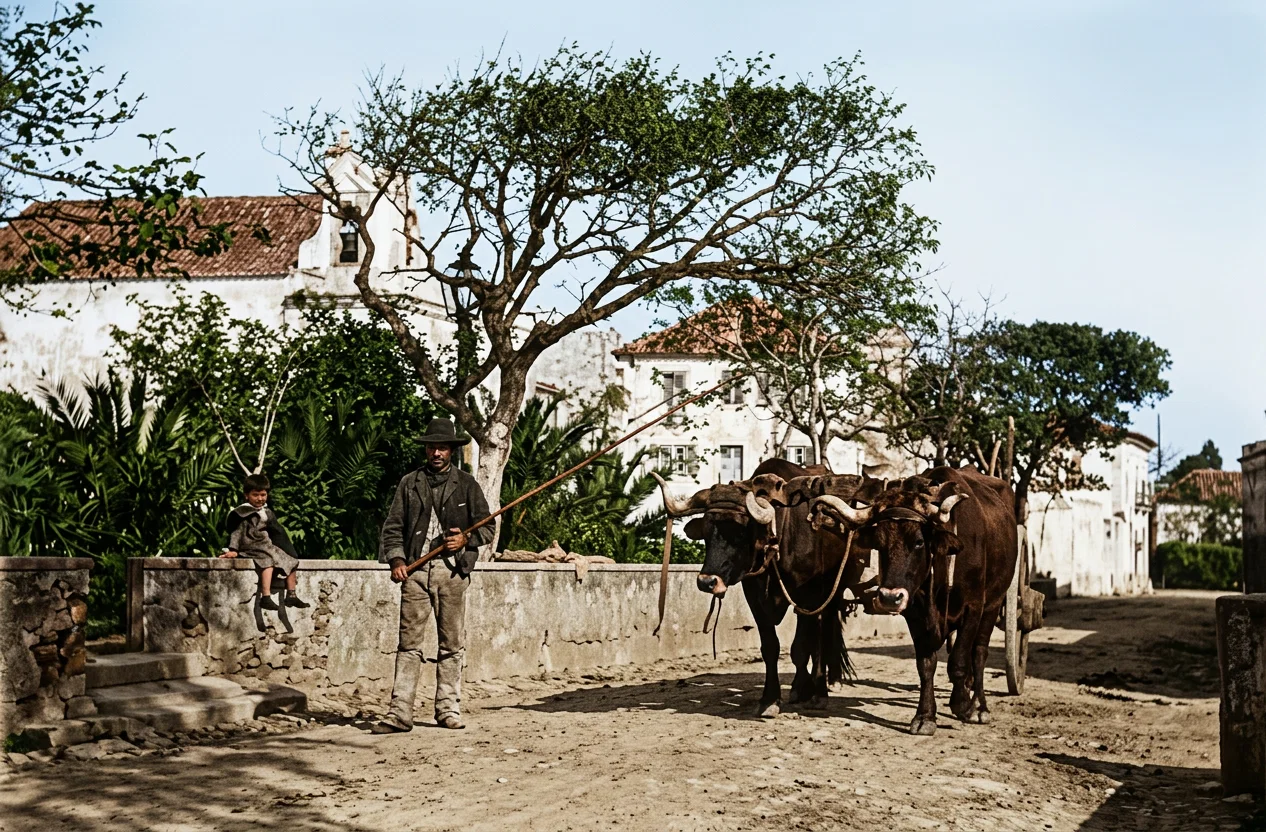
MAIN STREET IN CARCAVELLOS, PORTUGALRestored with AI
MAIN STREET IN CARCAVELLOS, PORTUGAL
The father, who just lately accepted the truth, told how he had been bowing down to images of wood, stone, gold, and silver, which have ears, but do not hear; eyes, but do not see; mouths, but do not speak; but now he was thankful he could worship the true God, and keep his law and the Sabbath. One son has said, “This Christian life is good, but in the work I have chosen, I can not keep the Sabbath.” His desire and ambition is to be a pilot. The father is a furniture maker, and his shop is closed on the Sabbath. The youngest son is working in the Department of Justice, but so far has the Sabbath free. We desire to educate this young man of eighteen years and his older brother to be workers. In this family, of which only one was a Protestant, we have seen the special working of God’s power. Some time ago the father did not care to know anything of Protestantism, but now he is all aglow with the truth.
Now, let me appeal to our young people, students, Young People’s Societies, Society leaders, and others young and old, to please remember the mother country of the Portuguese language and people. In remembering the fountainhead of the people, the branches will receive their share of attention. If there is a Society that wants to assist in educating Portuguese workers, please open correspondence with the Mission Board.
Our need here is literature published in the country. For this, money is required, of course. Who will take to heart the needs of the natives in Portugal, in East and West Africa, and in the isles that wait for his law? Forty million Portuguese cry aloud for freedom from Catholicism, darkness, and sin. Who will help? May God lay the burden on students to study the language, on some to supply funds, and others to pray. May he put his Spirit upon the people to bring them to him, and his power upon his representatives of present truth already here and in other places.
C. E. RENTFRO.