Just why Julius Atler’s parents saw fit to name him after a Roman conqueror would be hard for me to tell. Perhaps they admired Cæsar’s genius, and thought his very name would one day inspire their young son to mighty deeds. However that may be, the boy was “Julius,” and never in the wide world did heroic name rest so ill on boyish shoulders.
I don’t deny that Julius’s brain was “miserable,” the way he used it,—any brain would be,—and for a fact it was small. But at the same time it was fair of quality, and he need not have worried. A vest-pocket chronometer often keeps far better time than the great steeple clocks—if you treat it right.
But Julius didn’t see the philosophy of that. He simply clung to the one morbid idea that because he didn’t have a steeple-clock brain, therefore he was doomed to failure.
He was getting worse and worse, too. The doctor at last began to warn Mr. Atler: “If that boy doesn’t quit his worrying, he’ll lose his mind, sir! You’d better see to it that he has something to take his attention off himself.”
So, as the holidays were coming on, the lad was sent on a visit to his brother Fred in Boston.
Fred was not named after any conqueror; but he had striven with circumstances, and become a successful artist—the pride of the family and of many friends. Of course he and his wife did their best to entertain Julius. But everything bored him. Nature hadn’t given him a good brain! and, poor boy, that was all he could think of.
The entertainers soon saw there was no virtue in perseverance with him; so Fred went back to his work on a new painting, leaving the brother to shift for himself.
Now, Julius liked the studio. He enjoyed watching his brother paint, and, moreover, in the studio he was out of the way of “visitors;” so it came to pass that he spent a good part of his time there. Pictures, as nothing else, seemed to draw him out of himself; for like his brother, he had a strong artistic temperament.
And there the new painting began to interest him. In it a young man was sitting at a study-table covered with books. Across it a learned old professor sat in the attitude of listening intently to some question of the youth. In the face of the young man was perplexity; in the face of the old, encouragement, wisdom, and love. It was called, “The Training of the Prince.”
Julius learned that in countries where kings live, the princes and princesses are provided with teachers to accompany them, and study with them at all times, so to help and guide them continually, that they may become great men and women.
“Ah!” thought Julius, “perhaps if I could have such a training,—if I could have some one always on hand to help me that way, answer my questions, and show me just what to do,—I could be something, even yet.” So he went on with his dream, painting bright pictures of what he could do and what he could be, till he was all aglow with enthusiasm. But soon again came the thought, “You can’t have the teachers, you know,” and back he was thrown on his old despair. He was again a victim of nature’s spite, feeling worse than before, utterly forsaken and wretched!
“I’m going home in the morning,” he burst out. “I just can’t stay here any longer.”
“Why, Jule!” said Fred, “going to leave us on Christmas day! Surely you’ll stay to-morrow?”
But Julius could not be persuaded. He packed his things, and prepared to take an early train for Willowby.
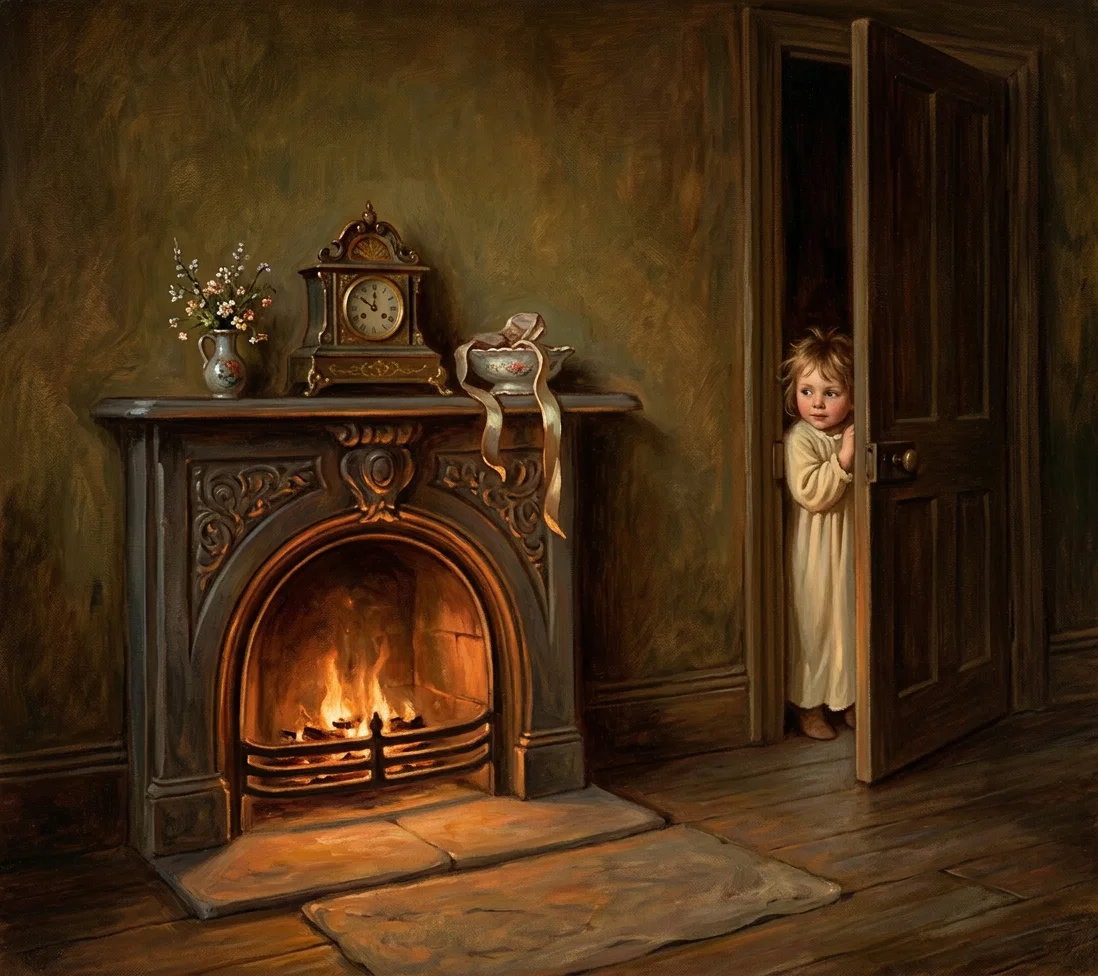
That night being Christmas eve, the little family Fred and his wife and child, gathered around the fireplace, played some simple games, and told stories, while the sad-faced brother sat back in a cozy corner, looking on gloomily, but not caring to join them. By and by the hour of retiring came, and Fred took down the old Bible to read the “chapter,”—this time the fourteenth of John. By the flickering light he read those familiar words where Jesus comforts his disciples. “Let not your heart be troubled,” and all down the page till he came to the promise of the Teacher, the Comforter, which Christ would send to teach all things, and abide forever, that men’s joy might be full.
“What!” thought Julius, listening intently, “what is that about a Teacher to teach you all things? Why, that fits the painting to a T, surely.” And all at once the parallel of the chapter and the picture burst in on his mind with irresistible force. Was it possible that his air-castles could be real! Was it possible there was a Teacher for him? Eagerly he asked Fred to read the chapter again. The brother and his wife were surprised at the interest of his tone. What could it mean?
In the fire Julius’s imagination traced over the “Training of the Prince,” glorified and real. He himself the prince—a prince of the house of David, an heir together with Christ! Across the table, with a look on his face of ineffable love, wisdom, and kingly might, sat the greatest Teacher the universe knows, the Spirit of God—the Comforter. Ah, now he saw it all! Like the kings of the earth, the King of kings has provided for the training of the princes and princesses who one day will wear the crowns. It mattered not about the small brain now, the King would make up for it. With its healing balm, the reality of Christianity swept in over his mind, filling it with peace and content.
“Fred,” he said, in a voice that was strained to keep back the joy he felt, “Fred, if you don’t mind, I think I won’t go home in the morning!”
“Why, God bless you, brother!” exclaimed Fred, “nothing can make me happier than to know that you will stay.” The others added their heartfelt thankfulness to Fred’s, and then wishing him good night, they left the boy sitting by the fire.
“I think,” said Fred, as they mounted the stairs, “I think Julius has received a gift from God to-night.”
Restored with AI
WHY UP SO EARLY, LITTLE MISCHIEF?
And Julius had. Often since then I have seen the lad go to the hardest kind of study, and work with the confident air of one who is sure of success. He worked just as if he felt the presence of the Great Teacher by his side, ready to help him do that for which his natural powers are inadequate. And he succeeds, as he only can to whom God gives success. He doesn’t claim success on his merits, either, but says plainly that God gave him a Christmas present once, and he has it yet.—