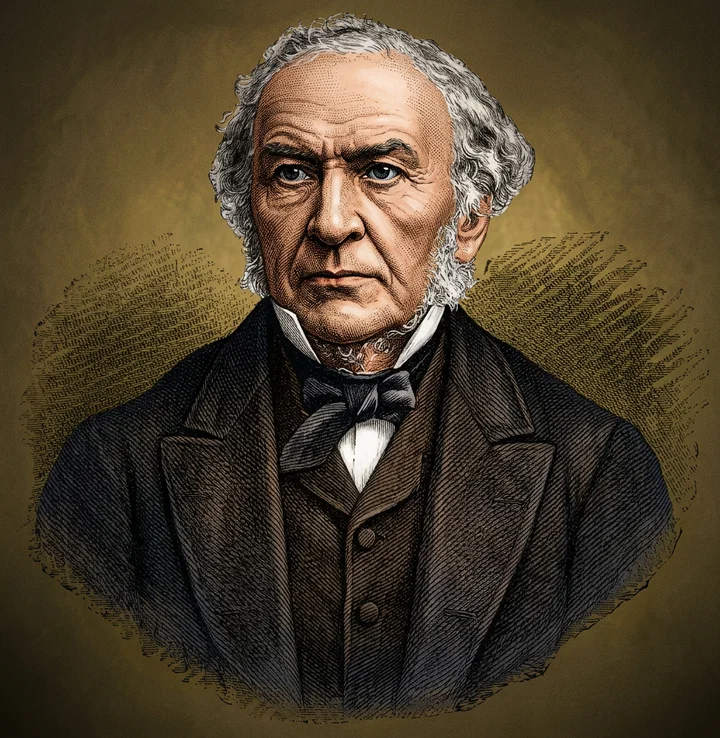
GLADSTONE AT EIGHTY.
The following description, taken from a popular youth’s paper, of one of England’s greatest statesmen, together with the accompanying engraving, will no doubt be of interest to those of the INSTRUCTOR boys who are studying the great political movements of the world, and the men who stand at the head of them:—
On the 29th of last December, Mr. Gladstone, still hale and hearty in body and mind, completed his eightieth year. As he entered the House of Commons in 1832, he was able on his eightieth birthday to look back upon fifty-seven years’ continuous service in that body.
Nor was this service, even at its outset, obscure. There was, in Mr. Gladstone’s case, no long and toiling climb up the hill of fame. He had not been in the House a year before his brilliant talents were recognized, and two years after he made his first appearance within its walls, he became a member of the Ministry.
Ever since, he has been a conspicuous figure in British politics, and during more than one half of the time he may be said to have occupied the highest position in British political life.
Of his great achievements as a statesman and as a party chief, it is needless to speak here. His titles to the gratitude and veneration of his countrymen, and to the respect of all the world, are too many and too clear to need recounting.
The thought uppermost, perhaps, in most people’s minds, when they heard of the widespread celebration of Mr. Gladstone’s eightieth birthday, was of the marvelous strength and sturdiness of his green old age. He has always been noted, indeed, for his physical robustness. Thirty years ago some one was remarking to Sidney Herbert, Mr. Gladstone’s colleague and intimate friend, what a wonderful mind Mr. Gladstone had.
“Don’t talk to me about Gladstone’s mind,” retorted Herbert. “It is nothing compared with his body.”
The secret of Mr. Gladstone’s unrivaled powers of physical as well as mental endurance may be found in an originally strong constitution, aided and fortified by health-giving habits. Like the great Napoleon, Mr. Gladstone is a good sleeper, and can apparently summon sleep to his eyes at will. No matter how long or how frequent have been his speeches, he has always been able to secure at least seven and a half hours of deep and serene slumber every night.
In his taste for recreation, Mr. Gladstone differs from most Englishmen of his social rank, who are addicted to field sports. He never has been known to follow the hounds but once. That was more than forty years ago, and on this one occasion an accident with the gun cost him the index finger of his left hand.
But other open-air pastimes have always attracted him. He is known as an expert feller of great trees, and this is a recreation in which he still, at eighty, takes a keen delight. He is also fond of taking long, fast, and vigorous walks in the open air. Some years ago, he was in the habit of saying that he could easily make forty miles a day without over-fatigue.
It is rarely the case, even now, that Mr. Gladstone is seen in a carriage or a cab. When in London, he always walks to and from the House, or from one part of the great metropolis to the other, and this even in severe and stormy weather.
Mr. Gladstone does whatever he has to do, whether it be work or play, with all his might. Addressing some school-boys once, he said, “If a boy runs, he ought to run as fast as he can; if he jumps, he ought to jump as high as he can.” This expresses the keynote of Mr. Gladstone’s own character. He always uses his varied gifts of body and mind to the uttermost strain.
At eighty he not only keeps up regularly his vigorous physical exercises, but continues to justify the remark made by a political antagonist, that “Gladstone is the most indomitable worker in England.”
To-day he conducts the leadership of a great party; makes speeches as long and as full of mental force as he did in middle age; writes an uninterrupted succession of review and magazine articles on a wide variety of topics; maintains a heavy correspondence, much of it with his own hand; keeps abreast of all the prominent questions of the day by steady reading, and sustains, almost without any falling off, social relations which have been the growth of sixty years.
Rarely is it, indeed, that the world is called upon to witness such a robust, active, young old age, and to perceive in a man of eighty the possibility of great usefulness and lofty achievements yet to come.