ROUND THE WORLD.—17

7%

S. D. A. Publishing Association · Battle Creek, Mich. · July 2, 1890

FromThe Youth’s Instructor, Vol. 38, No. 27

Read the full edition

ROUND THE WORLD.—17.

A DAY AT POINT DE GALLE, CEYLON.
“Ceylon, from whatever direction it is approached, unfolds a scene of loveliness and grandeur unsurpassed,” says Sir J. Emerson Tennant. In all ages and in all times it has been celebrated for its beauties and its productions,—its gems, ivory, pearls, and spices,—and although the poet’s raptures regarding it fade before modern commercial pursuits, still there are many most interesting features connected with Ceylon. Its length is over 271 miles, and its breadth 137, and in 1876 the population, exclusive of the military, amounted to 2,556,777.
Four-fifths of the country consists of undulating plains, the remainder, occupying the center of the island, being a mass of mountains, which rise from six thousand to eight thousand feet. Every district, from the depths of the valleys to the highest summit, is clothed with perennial foliage. The island has been gradually rising above the sea, and this is especially visible in the northern peninsula, where the whole of the land, and forty or fifty miles to the southward, is composed of corals and madrepores, which form a singular bank known as Adam’s Bridge.
Colombo is the commercial capital, though it would be difficult to say why this site was chosen for such an important town. It occupies a projecting, rocky headland, which was fortified by the Dutch. It contains within the walls of the fort some modern buildings, which are a clumsy adaptation of European architecture to tropical requirements. With the exception of the military officers, most of the European residents live in the cinnamon gardens, the most famous of which is Kadarani, or else in the cocoanut groves of the charming village of Colpetty.
The chief industries of Ceylon at the present day are tea and coffee culture. Lately cinchona, from which quinine is made, has been raised in large quantities.
In olden days the island was infested with elephants and tigers, but they have been shot off in large numbers.
Point de Galle, where we touched, is said to be by far the most venerable emporium of foreign trade now existing in the universe. It was the resort of merchant ships at the earliest dawn of commerce. It was the Kalah of the early Arabians, and centuries before, the Sabeans came hither; it was the mart of Portugal and afterward of Holland. It is also asserted by writers of note that the long-sought-for locality of Tarshish is identical with that of Point de Galle. But at present it only exists, and that by being a coaling station for merchant ships going to all parts of the world.
No sooner had the Umtata cast anchor than she was surrounded by a multitude of the native boats. These are called catamarans, and are exceedingly curious in their structure. They are made of the trunks of cocoanut trees hollowed out so that there is just enough space to put one’s legs down into them. On one side are two long poles, lashed so as just to clear the water line, and to the ends of these is made fast a heavy spar. This rests on the wave, and is always kept to windward, so as to balance the boat and keep her from drifting, just as American navigators would use a center-board. The natives will put to sea, and cross the surf in one of these, where an European boat could not live for an instant, and they are seldom wrecked.
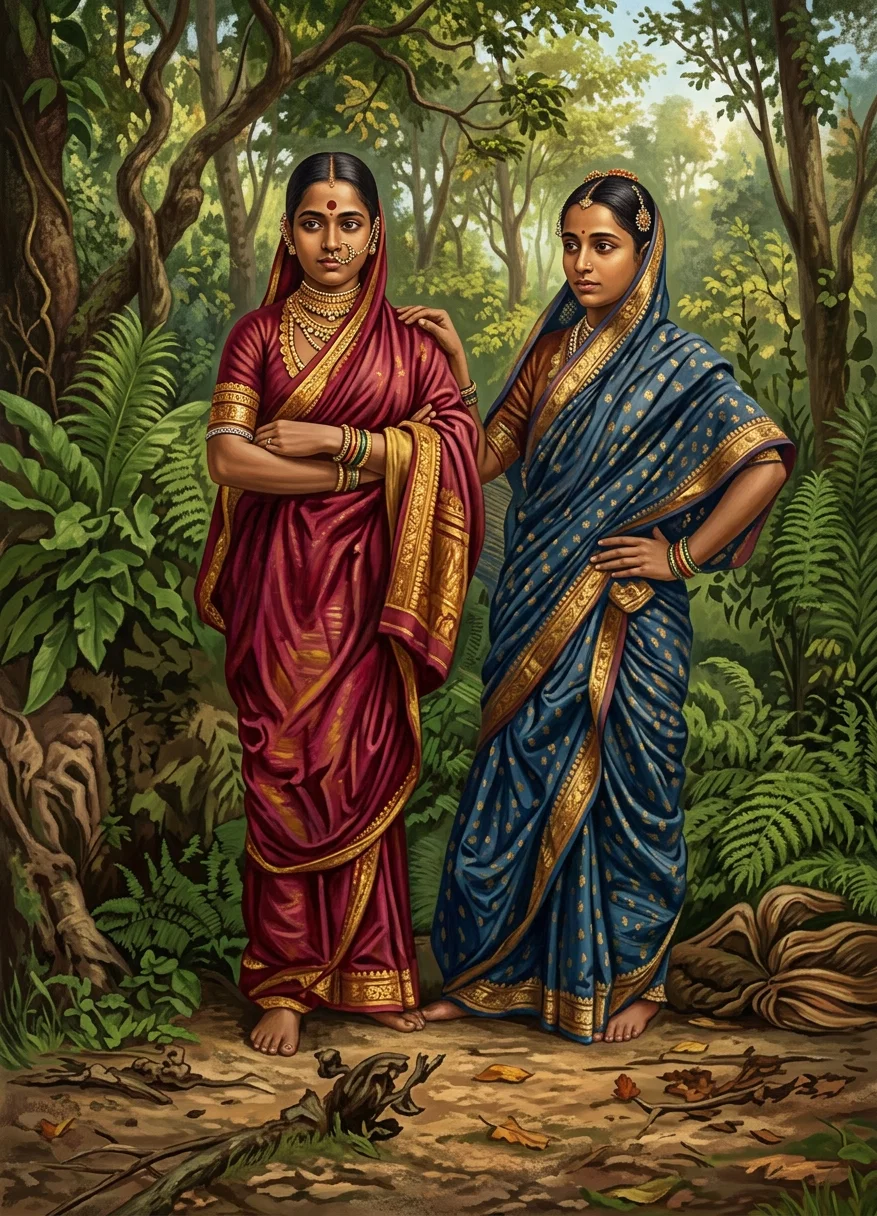
HINDOO GIRLS.Restored with AI
HINDOO GIRLS.
The natives crowded all over the decks, some of them begging, others wanting to take our clothes that needed washing, saying that they would return them all finished in three hours, and still others selling little ornaments made of tigers’ claws or tortoise shell, and desks and boxes of ebony and porcupine quills. They invariably commence by asking about three times what they expect to receive, and they cheat and lie without any compunction, if they think they can make anything by it.
The town itself is very old; there are some old forts that bear the date of 1669. They are made of stone, and are exceedingly massive, the walls being four feet thick. They are not used now, and are covered with moss and ivy; they look as if one shell would put a speedy termination to their existence. The streets are lined with beautiful Niem trees, but everything wears a deserted appearance, as if all the inhabitants had forsaken their homes. The natives all reside outside of the forts, and their houses are pictures of slovenliness and poverty. They are mostly situated in the groves of cocoanut and Jack-fruit trees, which abound all over the island.
There is also a Buddhist temple, a singular looking place. It is circular in shape, and at the entrance is a hideous figure, half man, half animal, suspended by a cord from the roof. To him all take off their hats, and pass on to the interior of the sacred pile. The different gods are arranged in a circle in the middle. Some of them look like Egyptian statues, others are representations of the Indian cobra, a large and venomous snake. Great, indeed, must be the moral darkness of a people who can see anything to be admired or imitated in such idols. All round on the outer walls are pictures of heaven and hell. Their idea of a perfect heaven, according to these portraits, seems to be a place where they can feast on all the cocoanuts they desire; while those in torment for smaller sins, such as stealing this most coveted fruit, are allowed only to walk up and down beneath the trees, the fruit being beyond their reach. Buddhists are not nearly so particular as to who enters their temples as are the Hindus; it is seldom that these will let foreigners go inside their places of worship.
There appeared to be but few horses. Most of the wagons were little two-wheeled vehicles, with a few boards nailed on the axle, and covered with an immense hood of cocoanut matting. They were drawn by two little cows, with a driver walking behind them. These animals were covered all over with designs of every description, which we supposed were charms to keep away evil, and to call the favor of the gods upon the owners.
P. T. M.