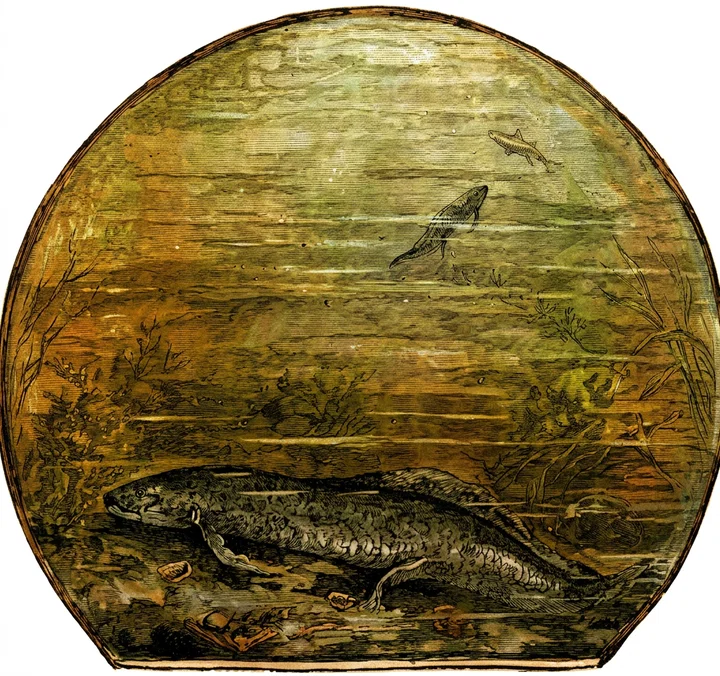
THE next time you go to Africa, my dears, you be sure to bring me back a lepidosiren, will you? I am very anxious to have one. Lep-i-do-si-ren. Can’t you say that? Well, it is rather a hard word. You may call it mud-fish instead, if you like that better, though I am not sure that it is a fish.
There is a difference of opinion on the subject of this creature. One very learned man, with green spectacles, calls it a fish; another, whose spectacles are blue, vows that it is a reptile. Now I don’t wear spectacles, so really I cannot pretend to decide the matter; but suppose you and I just please ourselves, and call it the mud-fish, whether or no.
There is some reason for that name, because at home it lives in the mud. When you are in Africa, as I was saying, and in some very hot place, you must know how to look for the mud-fish.
If it is in the rainy season, it will be easy enough to find him; for he is swimming about, like any other fish, in some pretty little river. But in the hot season it will be harder to find him. The river is dried up then; there is not a drop of water; the reeds and rushes that were once so fresh and green, are withered and dry, and even the mud of the river-bank is baked into a hard, stony flooring, which looks as though it had never known a drop of moisture.
Surely no living creature can be here, save such as can live on land. Not so fast! Take your spade, and dig up carefully some of this hard-baked earth. Dig deeper!—carefully now; spread out the earth you have dug up. Ah! what is that queer-looking lump, from which the dry earth falls away? That is what you have been looking for. That is Mr. Mud-fish’s cocoon, and Mr. Mud-fish is comfortably asleep inside it. You see he knew well enough what to do when he found the water was all drying up around him. He wriggled his way deep, deep down into the mud, his eyes being so conveniently made that the wet soil does not hurt them. When he has gone deep enough, he curls himself round, and wraps his tail around his head by way of a nightcap. Then he brings out of his body a quantity of a smooth, slimy substance, which he carries somewhere about him, and with this he plasters the inside of the mud-cell in which he is lying, making it all smooth, and binding the particles of earth together so that there is no danger of their cracking apart from the heat. Having done this thoroughly, Mr. Mud-fish goes to sleep, and he sleeps, and sleeps, and sleeps; and never wakes up until the rains have come again, and the welcome drops, sinking down through the softening mud, loosen the walls of his cell, and let him out again.
If you were to put one of these earthy cocoons into a tub of water, it would fall to pieces at once, and you would see the sleeper, with his tail wrapped round his head, just as I have told you. At first he would be very stupid and sleepy, but after a time he would wake up; and if he should live and do well, you would find him as curious a creature in his waking as in his sleeping hours.
Did you say you had an aquarium? That is very fortunate, for now you can watch all the queer ways of the mud-fish. Take a small piece of raw meat in your hand, and make a splashing in the water with your finger. He will rise slowly, snatch the meat away, and go down to the bottom to eat it. Now watch him as he eats it. He takes the very tip of it between his sharp teeth, and gives it a tremendous bite, seeming to bite with his whole head; then he sucks it in a little farther, and gives it another bite; this he does again and again, till he has bitten through the whole length of the piece. Then, if you please, he shoots it out of his mouth, catches it by the tip again, and bites it all over again, and then again. Three times he goes through this singular process, and then, with a quick jerk, he swallows the meat. He will always do this, every time you feed him, and will never swallow the food until he has chewed it all three times. It is a very good thing to chew one’s food thoroughly, but I do not recommend this way of doing it, except for a mud-fish.
Oh! oh! I forgot to tell you that you must not keep him with the other fish, but in a separate part of the aquarium, for he has very cruel and unmannerly ways. He will swim quietly up under another fish till he is quite close to him; then, with a quick dart, he will seize the poor creature, and bite a great piece right out of him, his strong, sharp teeth cutting through scales, flesh, and bones. He never takes more than one bite out of each fish, but takes his morsel down to chew, and leaves the poor victim bleeding and dying in misery. That is why I have called him a “bad neighbor,” and it is a good name, for him; for, say what you will, a good neighbor does not bite.—Our Little Ones.