NOTES ON OLD CALCUTTA.
THERE is no city in all the Orient more famous in the annals of history, or better known to East Indian commerce, than the modern Calcutta, so named after Kali, the Hindu goddess.
It is situated about one hundred miles from the head of the Bay of Bengal, on the banks of the Hooghly River, a branch of the sacred Ganges, and is equally reverenced by the followers of Brahma. It is the capital of the empire of India, and is the residence of the viceroy, or, as an Asiatic would express it, the “Burra Sahib,” meaning the “great man.”
The rulers of Calcutta have been many, but the city finally fell into the hands of the English in 1860, and the memorable spot where Job Charnock first hoisted the royal standard of Great Britain can still be seen on Clive Street.
Calcutta lies in the tropics. From the middle of November till early February, the weather, though very warm, is pleasant, but with the exception of these months, it is almost unbearable. From February to June the heat is intense; then the rainy season commences, lasting till the return of cold weather. During this period the water descends in sheets rather than in torrents, causing streams to flow, but paralyzing everything else.
To estimate the population is a difficult matter. Of English-speaking people* there are between 14,000 and 15,000, but the number of natives is almost infinitesimal. There are probably about a million of them.
To the west of Dalhousie Square, the finest in the city, and just north of the magnificent post-office building lately erected, is a space eighteen feet each way, covered with stone flags. It marks the spot where once stood that fearful dungeon known as “the Black Hole of Calcutta.” It was in 1750 that Siraj-ud-Dowllah, the native viceroy of Bengal, with an army of 50,000 men, took possession of old Fort William. After the surrender had been made, on the evening of June 20, the entire garrison of one hundred and forty-six men were crammed into this wretched prison. It was one of the hottest nights of the most sultry season of the year, and the unhappy prisoners soon became frantic with suffocating heat and insufferable thirst. One by one they sank into the arms of death, and when the door was opened in the morning, only twenty-three came out alive.
This well exemplifies East Indian inhumanity. As a people, they are cruel to a degree, of mercy they know nothing, and it is stated that in the Bengalee language there is not a single word having the significance of “gratitude.”
The shrine of the goddess Kali, who may be regarded as the patron saint of the city, is at Kalighat, and has probably stood there for centuries, from the time when the Ganges itself, some miles in width, laved its walls, and when human blood streamed upon its altars. Under British rule, the Hindu can no longer appease the wrath of his gods by the sacrifice of his brethren; but in one of the temple courtyards are two guillotines, where perish kid and buffalo, and with their gore the sign of the cross is made on the forehead of the one who offered them.
On certain days, thousands of natives flock to Kalighat to make their “Poojah” to the goddess; all the daily worship is performed at home, or on the river bank at bathing time. Every morning the river is crowded with natives busily engaged in laving themselves in the sacred stream, although, to judge from the color and density of the water, its cleansing properties must be very scarce.
Next in point of antiquity is the Armenian Church, bearing date of 1724. It is partly surrounded by a courtyard, which is completely floored with slabs, inscribed to the dead, whose remains lie beneath. It is curious how this people have retained their religion for so long, without being influenced by the idolaters who have been so closely connected with them.
One of the most repulsive and yet characteristic sights of the city is the Nimtolla Ghat, or burning place. The Hindus never bury their dead, but resort to cremation. There is no funeral service. The bodies are carried thither on stretchers, faggots piled under and above them, and then fired. The relatives stand round without exhibiting the slightest sign of emotion or remorse, and when the embers have died out, return to their daily avocations.
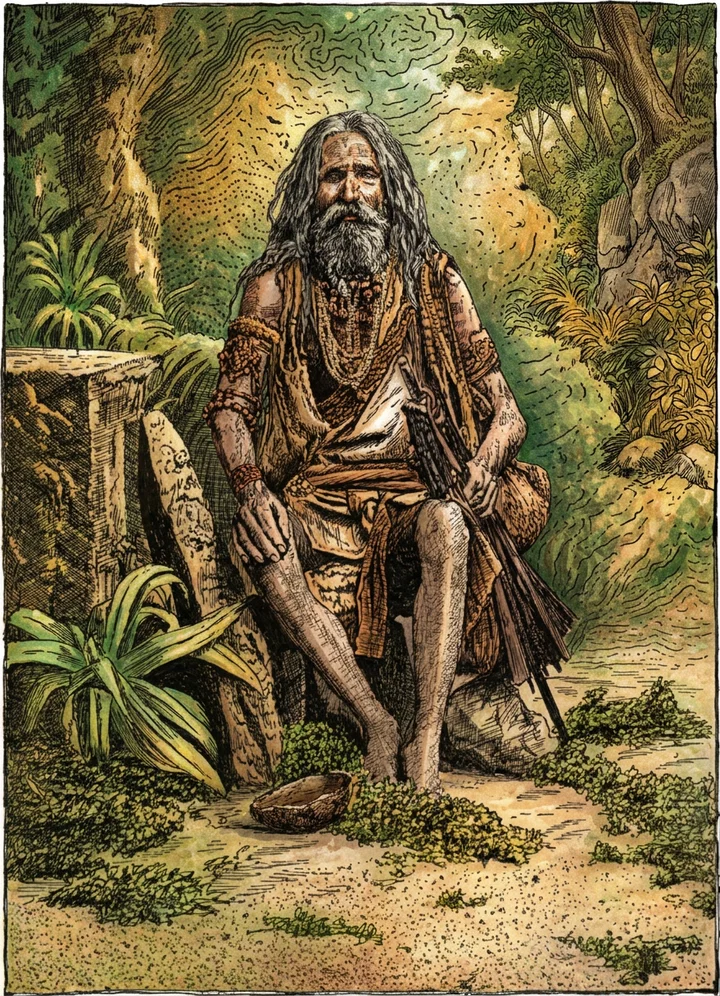
Round almost all these places linger the veritable “Fakirs,” and their constant cry for “backsheesh,” which means “a present,” greets all visitors. They are religious heathen fanatics, who spend their lives sitting on a stone in the open air, or lying on small nails, or torturing themselves in some way or other. They believe it will bring them to heaven; but if this were the only road, we should want to stay out.
F. T. M.