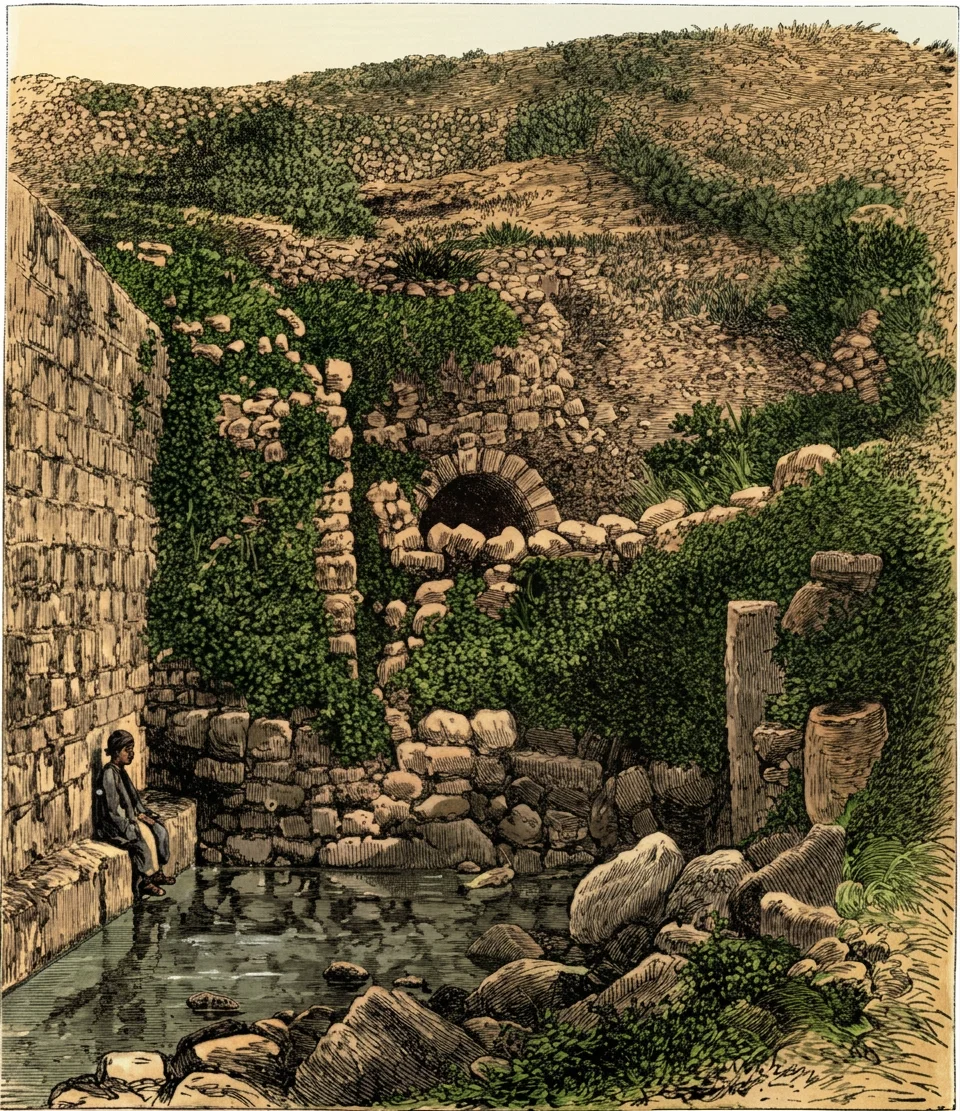
THE POOL OF SILOAM

11%

S. D. A. Publishing Association · Battle Creek, Mich. · July 9, 1890

FromThe Youth’s Instructor, Vol. 38, No. 28

Read the full edition

THE POOL OF SILOAM.

Many, many years ago a blind beggar sat by the gates of Jerusalem, asking alms. “And Jesus passed by, and he saw the man which was blind from his birth. . . . And he spat on the ground, and made clay, and he anointed the eyes of the blind man with the clay, and said unto him, Go wash in the pool of Siloam. . . . And he went his way therefore, and washed, and came seeing.”
The traveler, mindful of the miracle which Jesus performed, still visits the pool of Siloam with much interest. It lies outside of the Jerusalem walls, to the southeast, in the valley of Jehoshaphat, near its junction with the valley of Hinnom. Perhaps there comes to his mind these lines of familiar song,—
Restored with AI
“By cool Siloam's shady rills, How fair the lily grows,” and he quickens his footsteps in expectation of finding Siloam a pleasant and poetical retreat.
But as he reaches the spot, how is he disappointed! Whatever Siloam may have been when the poet penned these lines, its rills are not now shady, nor bordered with lilies. “There is nothing picturesque about it, certainly,” says one traveler, “and the crumbling walls and fallen columns in and around it give the pool an air of neglect, unusual even for this city of ruins and forsaken sites. It is a parallelogram, about fifty-three feet long and eighteen feet wide, and in its perfect condition must have been nearly twenty feet deep.” This reservoir “is never filled at present, but the water may be retained to the height of three or four feet from the bottom, where it passes off through a duct, and soon reappears in a deep ditch under the perpendicular cliff of Ophel.” The people do not hesitate to bathe in its waters, to wash their clothes in it, nor after that to drink the water from it!
Siloam receives its waters from the Fountain of the Virgin, the only true spring known at present to exist in Jerusalem. The water is conducted to the pool through a rough-hewn passage cut in the rock. The supply is small and irregular, depending in large measure upon the rainfall. “Its taste is slightly salt and decidedly unpleasant, owing chiefly to the fact that the water has filtered through the mass of rubbish and filth on which the city stands. This peculiarity of taste is intensified at Siloam, as the water passes over a slimy deposit from two to three inches deep, which covers the bottom of the passage.” The fountain received its name from the tradition that the Virgin Mary drew water from the well, in which to wash the infant Saviour’s clothes.
All around Jerusalem may be found ruins of pools, cisterns, and aqueducts, which prove that there was a time when the water-supply of the city was in an excellent condition. Although Canaan was a land flowing with milk and honey, it was nevertheless dependent in part on a carefully-regulated water-supply. Rain fell only from November to March, and hence it was necessary to provide reservoirs in order to keep a supply of water. The aqueducts and cisterns which have been found show a skill in masonry and engineering which has not been surpassed at the present day.
But there is in Jerusalem now-a-days great neglect in sanitary matters; for the waters which collect in the cisterns filter in through masses of garbage, and the pools are put to use both for bathing and drinking purposes. So that where Jerusalem was once the most healthful city in the world, while it followed out sanitary laws given by the Lord himself, it has now come to be one of the most unhealthful, through neglect of those laws. W. L. K.