CALCUTTA AND ITS INHABITANTS.
Calcutta is rather unique in some of its characteristics. It is one of the most densely populated centers of commerce in all the East, yet within twenty-five miles of its palaces, museums, and theaters are thick jungles, where tigers still abound.
There are a few fine streets built up with European stores, but when compared with the native quarters, they are very few indeed. There is no business or trade in which the Asiatic cannot underbid his Western opponent. The latter must needs keep up a large establishment, in a handsome building, which necessitates expense; he must live in a respectable house, and have many things that drain his pocket almost as fast as his customers fill it. But with the former a far different state of affairs exists. With three or four fellow-merchants, he rents, at a cost of eight cents per month, a wretched little hut made out of bamboo poles covered with cocoanut matting. Here he resides, and every day pays for his food the extravagant sum of two annas, which is equal to about four cents. His store is also of bamboo, matting, and mud, and at first sight one would hardly think it capable of containing stock to more than the amount of a few hundred dollars. But once inside, it is found to be a perfect labyrinth of shelves, pigeon-holes, and other nooks and corners, which are filled with the most costly merchandise, every space being utilized, from floor to ceiling. In the middle of the room, sitting on the floor, and almost entirely destitute of clothes, is the proprietor, having more the appearance of a beggar in South America than of any other character. And yet if the truth were only known, he has gold enough hidden away to build him a palace, and clothe him like a king, should he desire it.
The Burra Bazaar is a long, crooked, narrow street. I do not think there is a single brick building on it, but for all that it is the richest place in Calcutta, and probably in all the East. The traveler sees everything displayed for sale, from the finest Cashmeres and gems of untold value to the coarsest of hardware. A stranger is spotted at once, and he will generally find it to his advantage to offer about one fourth of the price asked him, and even then he may pay too much. One man came to the door of our carriage with a pair of very handsome peacock feather fire-screens, and in lusty tones called out,—
“Three rupees, master, three rupees.”
“Give you half a rupee,” I answered, never dreaming that he would take it.
“All right, me sell them to Sahib for that much.”
These are not only characteristics of the Hindu, but apply alike to all the Asiatics, from the Parsee fire-worshiper, Mohammedan, and Afghan, to the Celestial.
In little shanties eighteen or twenty feet square are often seen twenty or thirty shoemakers all seated on the mud floor, busily stitching and hammering away. How they can exist in such a place is a puzzle to any civilized mind. The streets are crowded all day long, and many of them are so narrow that it takes all the skill of a driver well used to the place to pass another vehicle. In this narrowness there is to them economy. They say, “English build streets big, broad, sun shines down hot in them, Englishmen have to buy umbrella to keep heat off. We build narrow street, shade all the time, no ‘solar hat’ needed.”
The Hindus love education, and are among the keenest mathematicians in the world. In all the government offices, banks, and business, they are employed as accountants and book-keepers; while as judges, lawyers, and doctors, they excel all over the country.
There is a vast difference between the Asiatics and the South Africans. They are very proud of their pedigree as a nation, and will argue with great eloquence against Christianity, which, however, by its influence has to some extent broken down their customs, although “caste” remains much the same as ever.
It is considered a disgrace if a Hindu girl is not married by the age of twelve, and some of them are brides to men of seventy at half that age. The house of a baboo, or native gentleman, is called a zenana, and the same name is also applied to his wife, who is always kept within, and screened from all human gaze, save that of her nearest relatives. She is permitted to visit other zenanas, but on such occasions she is carried through the streets in a covered palanquin.
The modes of conveyance are rather curious. Such a thing as a hack is unknown, the nearest thing to it in point of appearance being what is called a gharry. None of these have any glass in the windows, merely a Venetian blind, which is pulled up when the sun is hot. A palanquin looks like a box about six feet long, three broad, and two and a half in height. At either end is a pole sticking out, which is placed on the shoulders of the four men who usually carry them. These go along at a slow jog trot, which they will keep up for a considerable distance.
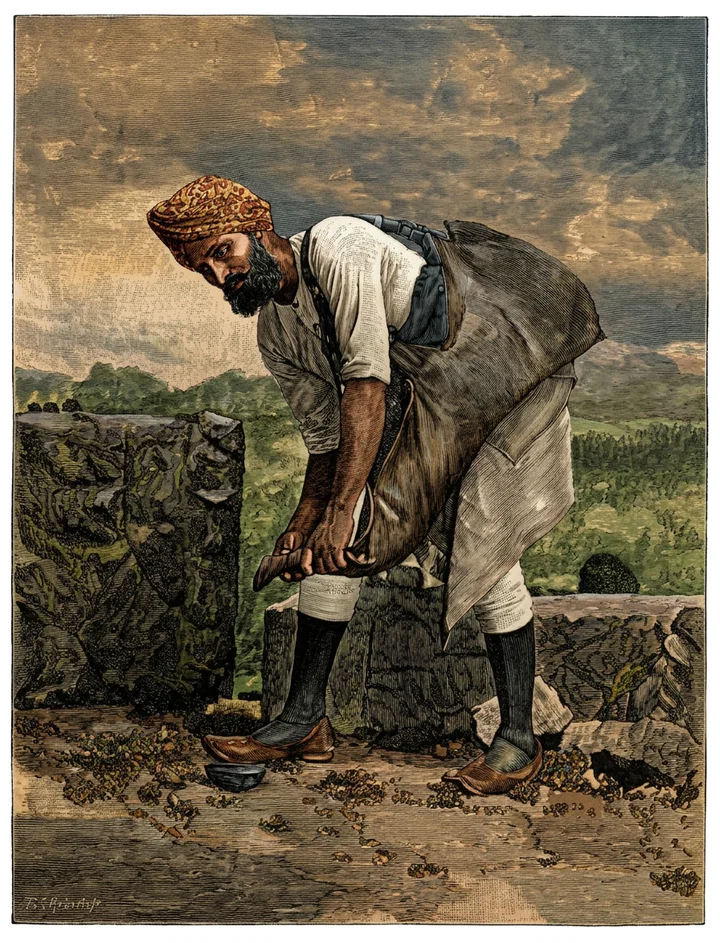
There are no street sprinklers, but in their places men fill a goat skin with water, place it on their back, having it gathered up at the neck so that they can give the water some force, and run along the road distributing it. Much labor might be saved, but this class of laborers receive so little for their day's toil that Europeans think it is the cheaper way.
P. T. M.