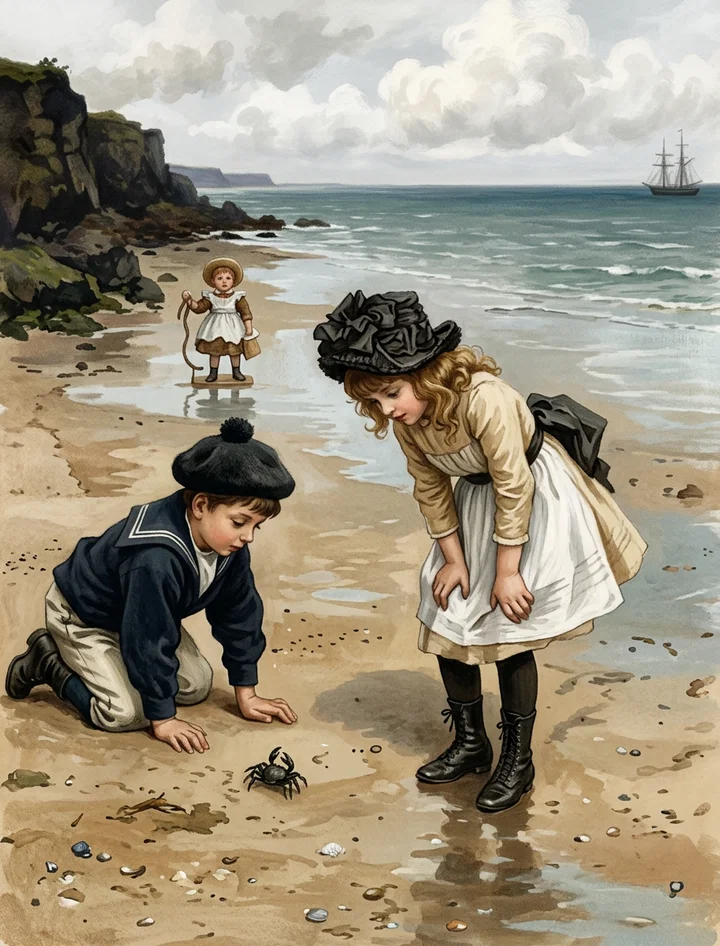
FRED and Rose visited the seashore one vacation. They had never seen so much water before. They loved to watch the waves and the clouds, and to see the ocean get angry in a storm. They also liked the sunshiny days. Then they could play in the white sand on the beach. They saw many strange things that had been washed up by the waves, and left on the sand when the tide went out.
One day they saw a queer thing crawling along. It had a hard shell and ugly claws.
“Let us call mamma,” said Rose, “and have her tell us what this is.” So they ran to find her.
Mamma came and looked at it. She said it was a crab. So the children had to be told about crabs.
“Crabs are hard-shelled creatures, as you see,” said mamma. “They are relatives to the lobster you had for dinner to-day. Their family name is Crustacea.”
Fred and Rose ran to write the name down in their Wonder Book; for they each kept a book in which they wrote out carefully all the new and wonderful things they learned about that vacation. It kept them busy on rainy days, and would be nice to read after they got home. They were anxious to have neat books to show to their papa, and so they took a great deal of pains to write well.
“Crabs do not like to live in cold water. Most of them live in warm seas,” mamma went on.
“There is one kind of crab that has no hard armor on the back part of his body. He cannot run, and he cannot swim. He is very helpless. He has to have a house to live in.
“He hunts around till he finds a shell that suits him. Perhaps there is a snail in the shell. But the crab draws it out and eats it. Then he walks into the snail’s house. His head and front legs are covered with armor, like those of other crabs. These he thrusts outside the shell. He lives in this shell until he grows so fat it pinches him; then he hunts around for a larger house.
“There are some crabs that cannot live in the water. The land crabs would die if they fell into the sea. They like to live in the shadow of a dark, damp forest.
“All crabs have little gills, by means of which they breathe. It is necessary that these gills should be kept wet.
“The land crab likes to take journeys. He cannot do it unless his gills are wet; for if they dried down, he could not breathe. Under the gills are little water-bags, which the crab fills up before he starts out, just as an engine might do.
“As he travels along, the water falls in little drops on the gills, and so he can breathe.”
“That is wonderful,” said Rose. “I will put that in my book, ’cause papa will want to know it.”
“I will tell you about one other kind of crab,” continued mamma, “and that will be as much as you can remember to write down.
“This other crab is called the cocoanut crab, because he lives on cocoanuts.
“The crab eats the nuts that fall to the ground. He hunts until he finds a nut that suits him. Then he tears away the husks with his strong pincers.
“You remember the three eyes in the end of the cocoanuts you buy at the grocery?”
“Yes,” said Fred, “that’s where you made the holes to let the milk out.”
“The cocoanut crab hammers away at these eyes until he makes an opening. Then he thrusts in his hind claws, which are smaller and weaker than his front ones, and scoops out a good dinner.”
“He builds a nest out of the fibers from the husks.”
“This crab grows so fat that he is considered a great delicacy to eat.”
“Now see who can write the best story about what I have told you, and about this crab that you have seen.” W. L. K.