“Ah me!” said the sponge. “Dear! dear! dear! well-a-day!”
“What is the matter?” asked the bath-tub. “Have you been squeezed too hard? or has the nurse rubbed soap on you again? I know soap never agrees with you.”
“I am rather exhausted by the squeezing, I confess,” replied the sponge, “but it was not for that I sighed. I am gradually getting used to these daily tortures.”
“But I was thinking about the past; about my beautiful home, from which I was so cruelly torn, and the happy, happy life I led there.”
“Tell me about it,” said the bath-tub. “You have told me before, but I always find it interesting. My home was in a tin-shop, as you are aware. The society was good, but it was a rather dull place, on the whole. You lived, you say—”
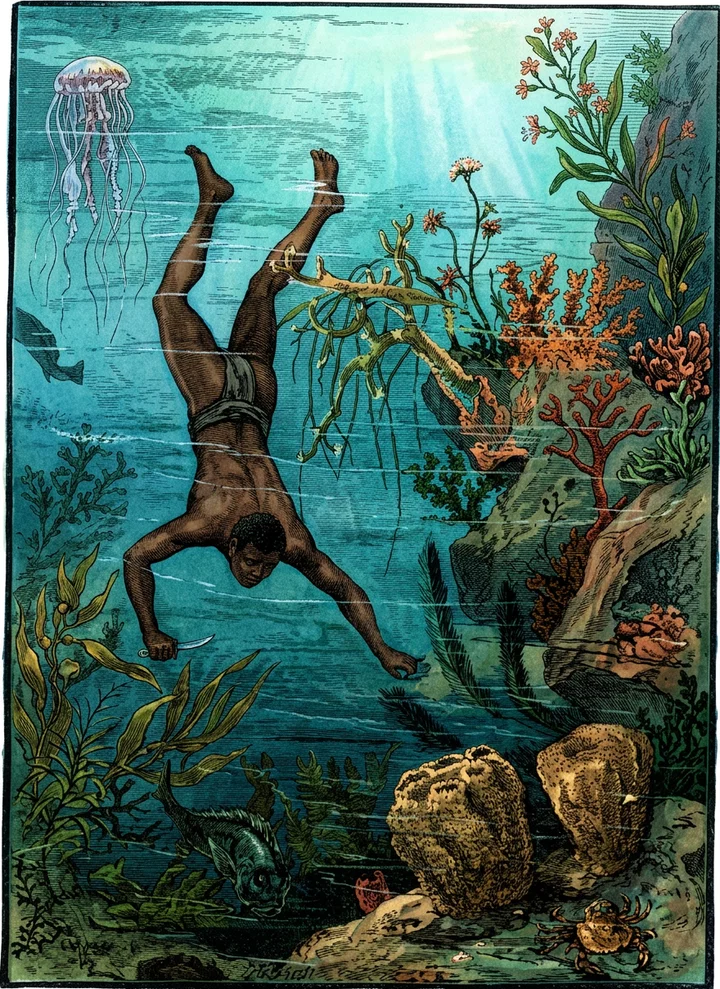
“On the coast of Syria,” said the sponge, with a sigh,—“the coast of beautiful Syria. There is a tiny bay, where the shore is bold and rocky. The rocks are bare above the water, but down below they are covered with lovely plants and fringed with gay mosses, beautiful to behold. The bottom of the sea is covered with silver sand, and over it move the crimson and gold-colored jelly-fish, the scarlet star-fish, and a thousand other brilliant creatures, making the neighborhood always attractive and delightful. On a certain ledge of rock, close by the bottom, I lived, as happy an animal as could be found in the Mediterranean Sea.”
“What do you mean?” interrupted the nail-brush, which was new and very ignorant. “You an animal? I don’t believe it. If your back were bone, and your hair pig-bristles, like mine, you might at least call yourself an animal product; but you have no back that I can see, nor hair either.”
“You are extremely rude,” said the sponge. “But you know no better, and ignorance should always be pitied rather than blamed. I was an animal, my young friend, though now, alas! I am only the skeleton of one.”
“I lived, as I said, a very happy life on my rocky ledge. I never moved from it. I had no occasion to do so, even if I had been provided with legs, as so many animals are. I never had any fancy for a roving life. To draw in the warm, delicious water through the thousand small holes and canals of my frame, and spout it out through my large holes, was my chief occupation, and one of which I was never weary. The water was full of tiny creatures of all kinds, and these formed my food, always giving me plenty to eat. In the spring I was always busy with my maternal duties. I brought out hundreds of lovely little round eggs, yellow and white, the prettiest eggs you ever saw. In a short time they put out tiny feelers, a sort of fringe of waving lashes, like those things on the nurse’s eyes; as soon as they appeared, I knew my babies were ready to come out; and, sure enough, they soon broke through their egg-covering, and, waving their lashes, swam out into the sea.”
“At first they staid near me, delighting my heart with their pretty tricks; but very soon they felt the need of homes of their own, and went off to fix themselves on rocks or coral trees, and become, in their turn, full-grown sponges like myself. I could not complain, for I had left my own mother in the same way. I never saw any of them again except one dear child who made his home on the shell of a large crab. He grew finely, and became a noble sponge; but the crab never seemed to mind him in the least, and carried him about with him wherever he went. In this way he often passed near my ledge, and as the crab was a friendly and sensible fellow, we often had a pleasant chat together.”
“One day, one dreadful, dreadful day, I was talking thus with my son and his landlord, when suddenly something huge and dark was seen above us, swimming slowly downward through the clear water. At first I paid no attention to it, supposing it to be a shark or some other large fish; but as it drew nearer, I saw that it was no fish, but a strange and horrible monster, the like of which had never been seen under the sea. It had four long arms, something like those of a cuttle-fish, only much less graceful, and divided at the end into five claws, or feelers. (I have since learned that two of those arms are called legs, and that the feelers are fingers and toes.) It had gleaming eyes, and in one hand it held something bright and shining. Ah! it makes me cold to think of it. To my horror the monster fixed his shining eyes on me, and swam directly toward my ledge. The crab scuttled off with my son on his back, and I was left alone and helpless. I saw one of the long arms extended; the five feelers clutched me in their grasp; I shrank down, and clung with all my might to the rock, but in vain. The shining thing in the monster’s other claw was slipped under me. It cut my delicate fibers; I felt them give way one by one; and at last, with one terrible cut and a violent wrench, I was torn from my peaceful home—torn from it, alas! forever. ”
“I was thrown into a bag full of other sponges, which the monster had slung about him, and then he pursued his path of destruction. I will pass briefly over the dark days that followed the drying in the sun, till all the life was dried out of me; the fearful squeezing, with thousands of other wretches like myself, into wooden cases; the voyage over seas; finally the exposure of my bleached and miserable skeleton in the window of a druggist’s shop. All these things are too painful to be dwelt upon; and, as you know, I am now resigned to my lot. I find in you a sympathizing friend. I have water given me (though of a very inferior quality) morning and night, and, were it not for the soap and the squeezing, I should make no complaint. But often, as I hang idly in my wire basket, my thoughts go back to my own dear home under the Syrian shores; and I long for a draught of the warm, delicious water, for the cool retirement of my rocky ledge, and for the sight of my dear son, riding gracefully about on the back of his crab.—Our Little Ones.