South Africa—No. 3
Program
OPENING EXERCISES:—
Song.
Scripture Reading: Gen. 12: 1-10.
LESSON STUDY: Matabele.
General Description.
Opening the First Mission.
CLOSING EXERCISES.
General Description
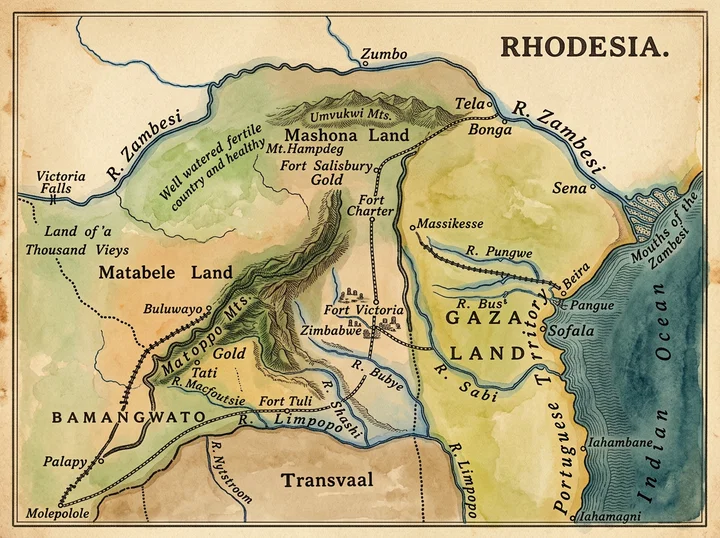
Lying between the Matoppo Mountains and the Zambesi River is Matabele land. Buluwayo, the capital city of this country, is just about half way between Victoria Falls and the Limpopo River.
The great province of Rhodesia which includes Matabeleland has been proclaimed British territory, and the development of its resources has been entrusted to the British South African Company. This country is rich in minerals, and its animal life is abundant and varied. Elephants, lions, rhinoceroses, giraffes, ostriches, hippopotami, antelopes, zebras, and gnus, abound here.
The native inhabitants belong to the Bantu family; the chief tribes are the Matabele and Mashona. The latter tribe is unwarlike, docile, and industrious. They are skilful in smelting and manufacturing; but the Matabele are a wild race, made into a nation by Moselekatsi, the great Zulu chief who fled from Tshaka into this country. They live in small villages enclosed by a strong fence, along the inside of which are packed meanlooking huts and cattle kraals.
Lobengula, the son of the Zulu chief, was for many years their ruler. He resided in Buluwayo, and he and his warriors persisted in making destructive raids in the neighboring tribes, keeping them in constant terror. The Mashona tribe was the chief sufferer at the hands of the Matabele. Finally in 1893 a well-equipped force under the command of the officers of the British South Africa Company entered Matabele territory for the purpose of stopping these raids. The Matabele were defeated, and Buluwayo was occupied by the British. Lobengula fled toward the Zambesi, and on the way died of fever.
Since Lobengula was driven away from Buluwayo, a town has been laid out by the British. Churches, hotels, and newspapers have sprung into existence. Telegraphic communication has been established, and a message can pass from Buluwayo to London in five hours. A railway connects this town with Mafeking where it joins the Cape railway system.
Opening the First Mission
More than ordinary interest centers in Matabeleland, as it was our first mission established in a really heathen country. For some time the Mission Board had desired to open up a mission center in the interior of Africa. The Cape Colony Conference contributed $2,500 toward the enterprise. On May 7, 1894, a company of five brethren met with the little company of Sabbath-keepers in Cape Town for consultation and prayer before starting on their long trip to the interior to seek for a mission site. The congregation accompanied the party to the station; and even the trainmen became interested and wished them success. Those taking this trip were A. Druillard, F. J. B. Wessels, F. Sparrow, E. J. Harvey, and L. Guoff.
At Vryburg, about seven hundred and forty miles from the starting-point, they reached the railway terminal and proceeded with wagons, mules, and oxen for the remainder of the long journey. The monotony of the trip was constantly broken by exciting chases after their straying oxen, heroic exertions in extricating their wagons from muddy pits which seemed to have no bottom, by the work of repairing or replacing axletrees broken in the strain, and by searching for water and game to augment their slender stock of provisions. Each Sabbath day was a season of rest and of spiritual refreshing. They held their little Sabbath-school at the same hour their home school was held, and the Lord came very near as they studied the precious lessons of trust from the life of Christ as given in the book of Luke. After the Sabbath-school, they held a prayer service, and the remainder of the day was spent in reading, singing, and talking of the blessings the Lord was giving them.
July 4, almost two months from the date of starting, they reached the town of Buluwayo, their objective point. To their surprise they found the stars and stripes floating to the breeze in the city; as about thirty Americans were there, determined to celebrate the day.
A letter of introduction to Dr. Jameson enabled our brethren at once to make known their desires to the authorities. When they laid their plans before him, he stated that he would aid them if they would make their mission self-supporting, and teach the natives how to work and be cleanly, to let rum alone, and to build houses and plant gardens for themselves. He offered them twelve thousand acres of land for a mission farm, in any direction where the land had not been taken.
The hearts of these faithful workers were greatly cheered by this bright prospect, and they earnestly sought the Lord for guidance in the selection of the proper location. With light hearts they gratefully accepted the guides offered them by Dr. Jameson and started on the last part of their journey. They were obliged to travel very slowly, as they were not following even the semblance of a road. At every kraal the guide would tell the natives the object of their visit. Without a single exception, the chief would urge them to locate there. After a careful search a location was decided upon thirty-five miles west of Buluwayo, near the Guye River. Eagerly they returned to Buluwayo, fearful lest some more fortunate one had secured the tract of landp. 5 they desired.
- (Concluded from page four)*
To their delight, not only was this large tract given them, but they were each offered a farm if they would settle there as self-supporting missionaries among the natives. Two of the brethren took up claims near the mission farm.
One hundred head of cattle were purchased, the mission farm was staked off, and Brother Sparrow was left in charge.
The next call was for workers from America.
(To be continued)
MRS. L. FLORA PLUMMER.