ROUND THE WORLD.—23.
By F. T. M.
ASIATICS IN INDIA.
That there are on the earth “all sorts and conditions of men” is a truth as universally agreed to by “globe trotters,”—as those on the “grand tour” are often derisively styled,—as is, by soldiers in the British and Continental armies, the Bible text that says, “Promotion cometh neither from the east, nor from the west, nor from the south.”
Sometimes it seems to us that our eyes grow weary with viewing nothing but these dark-skinned Asiatics, with their scant apparel, or long, white, flowing robes, and turbans of every shade; and although we acknowledge the truth of the adage that “the negro is as good as the white man so long as he behaves himself,” our natural inclinations lead us to wish that we were back among white folk once more. It would be a pleasure to walk down a street where you would not have to watch lest a leper jostle himself up against you, or hideously deformed negroes, with legs and arms sticking out from every part of their bodies except where they ought to be, besetting you on every side with cries of, “Salaam, Sahib! backsheesh! backsheesh!” which by interpretation means, “Hail, master! give me a present! give me a present!”
Authorities differ as to the population of India, and in reality it cannot be correctly estimated, as the natives have a special antipathy against allowing themselves to be numbered. They will hide in every conceivable place, to escape the vigilant eye of the Government official, who comes to take the census. What prompts them to do this we do not pretend to say, but we do not believe that it is because they have any religious scruples in the matter, and are afraid that judgments will be visited upon them as upon ancient Israel when King David numbered them. The standard authorities on Indian statistics give the population of British India, the twelve groups of feudatory States, the Portuguese and French settlements, and Burmah as 258,073,753, or 182 to the square mile. This is more than double the number that is accorded to the Roman Empire when in the zenith of its glory. When compared with the United States, it is a dense population, and the statement is made that on an average the British Provinces, exclusive of Assam and Burmah, have to feed two hundred and fifty-four to the square mile. Imagine, those of you who have homes on a quarter-section of land, that you had to share the living you obtain from it with sixty-two and a half people besides. It would be close circumstances at best.
Comparatively speaking, there are not many large towns in India. It is a rural country, and many millions of Indian peasants will not only live, but become positively rich where a white man would starve. Many of them have no homes at all. In the streets of Bombay are wide stone sidewalks, and after about 8 P. M., hundreds who have toiled hard all day in the heat of the sun may be seen stretched out on a sorry-looking blanket, with a few yards of cotton cloth around them, and sometimes not even that, taking their rest. Some of them could afford to take far better care of themselves if they only wished to, but they love to hoard money and spend it all again on some great occasion, such as the marriage of one of their children, an event at which a Hindoo generally spends the earnings of years of labor. Many, with only a loin-cloth for their apparel, are worth thousands of rupees, and could drive in a carriage and four if they felt so disposed.
For the sake of convenience in describing them, we will divide the people of India into four divisions:—
- The Non-Aryan, or Aboriginals.
- The Aryan or Sanskrit race, now called Brahmins or Rajputs.
- The mixed Hindoo population.
- The Mohammedans.
The Hindoos are by far the most numerous, and in proportion to the Mohammedans are about one to five.
The oldest dwellers in India consisted of many tribes, who, in the absence of a race name of their own, are called Non-Aryans, or Aboriginals. Concerning their early history no written records are left; indeed, the use of letters, or of even the simplest hieroglyphics, was unknown to them. From remains found in their tombs it has been discovered that they fought with iron weapons, and wore ornaments of gold. They are mostly very dark in color, have coarse and sometimes woolly hair, thick lips, and squat noses. They are seldom tall, never corpulent, but strong and active. They subsist by the chase and on fruits, herbs, and roots known to them, and wear little or no clothing. The hillmen of Madras are of this class, and live on jungle products, mice, or any small animals they can catch, and worship demons. Another clan, the Mundavers, have no fixed dwellings, but wander among the innermost hills with their cattle.
When fairly treated, the aboriginals are, as a rule, truthful, loyal, and kind, and under British rule they are prospering instead of decreasing.
The Aryans belong to the splendid Aryan, or Indo-Germanic stock, from which the Brahman, the Rajput, and the English alike descend. From the early camping-ground in Central Asia, some went east and others west. Some went to Italy, and reared the “City on the Seven Hills,” which grew into Imperial Rome. Other powerful bands found their way through the passes of the Himalayas, and spread themselves chiefly as Brahmans or Rajputs over India. The Brahmans were, and are, to a greater or less extent, the priests, and the Rajputs were the warriors or fighting companions of the kings.
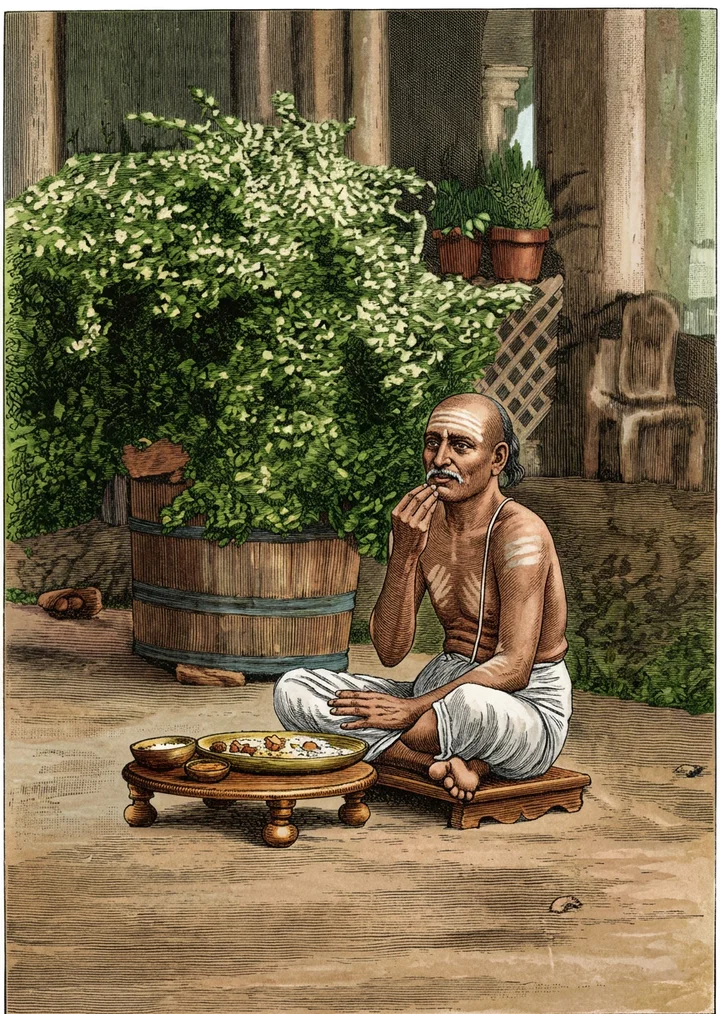
The Brahmans of the present day are the result of several thousands years of hereditary education and temperate living. They have evolved a type of manhood quite distinct from the surrounding population. They are different in appearance from the bronze-cheeked, large-limbed, leisure-loving Rajput warrior. They are tall and slim, with finely-molded lips and nose, fair complexion, high forehead, and cocoanut-shaped skull. They are an example of a ruling power which has gained its ascendency, not by bloodshed and victory in battle, but by hereditary culture and temperance. “One race has swept across India after another, dynasties have risen and fallen, religions have spread themselves over the land and disappeared; but since the dawn of history, the Brahman has calmly ruled, swaying the minds and receiving the homage of the people, and accepted by foreign nations as the highest type of Indian manhood.”
“The Brahmans had a long struggle with the warrior caste as to who should be supreme, but finally secured that position by teaching that it had been given them by God. Their legend was that at the beginning of the world the Brahman proceeded from the mouth of the Creator; the Kshatriya [Rajput warrior], from his arms; the Vaisya and Sudra [lower castes], respectively from his thighs and feet.” This legend is true so far as that the Brahmans are really the brain power of the Indian people, the Kshatriya its armed hands, the Sudras the down-trodden serfs. The Brahmans were and are the theologists, physicians, and philosophers of the Indian people. All animal food is forbidden them, and even some vegetables. In Northern and Central India they eat unleavened bread; in Bengal, the south of India, rice with ghee, or boiled butter, which is esteemed very nourishing. Formerly they abstained from the use of fermented and spirituous liquors, drinking nothing but milk and pure water.
The third class are Hindoos en masse, who fill the ordinary vocations of life. In Southern India they are small of stature, narrow-chested, and arrant cowards. They are cowards to such an extent that they will acknowledge it themselves. Were I to be asked their chief characteristic, I should say that it was habitual lying.
The last class in the fourfold division are the Mohammedans. They are believers in Mohammed, and are to a man entirely separate from the Hindoos, just as much as the Hindoos are from the Christians. Hindoos worship thousands, yea, a million gods, but the Mohammedan believes in only one true God, but ascribes no more power to the world’s Redeemer than that of an ordinary prophet. They are opposed to the Hindoo religion, and cannot eat or intermarry with those of that faith. The two races have but little sympathy with each other, as the Hindoos were the original possessors of India, and were conquered by the Mohammedans, who held sway over them for many centuries, and indeed till the English gained the ascendency over both. Mohammedans are more grave, more formal, more proud than Hindoos, conservative and reserved in the extreme, yet with a considerable amount of courtly and polite manners. F. T. M.