During the first rainy days of October, when windows however yet remained open, I could hear the low warbling of the titmice in the pines and firs of the garden. They had come there in troops ever since the last of September, and they were actively engaged in picking spindle-trees, yews, and larches. Ever alert, they flutter about from one group of trees to another, skipping on the branches, turning the leaves, climbing along the bark, suspending themselves with their back downwards, so as to be able to pick more easily the crevices in the bark, where they know that worms and insects hide their chrysalis.
All these titmice differ in color, size, and general appearance; still they offer certain general characteristics which do not allow us to have the slightest doubt about their common parentage. They all have a short, cone-shaped bill, which is slightly flattened on the sides, and covered up to the nostrils with feathers which bristle easily, and give an impertinent expression to their countenance. All titmice have very robust muscles in the neck; their skull is very thick; they also have much strength in the muscles of their feet and toes; this explains the suppleness and agility of their wonderful gymnastic feats, when they destroy caterpillars on the branches, pick hard seeds, and pierce the shell of hazelnuts. It has even been said that they take advantage of the sharpness of their bill, which can be compared to a blade of steel, in order to pierce the skulls of small birds when they find them dead or weakened by illness, so as to feast on their brains. Ordinarily, however, titmice are satisfied with more innocent food; they live chiefly on caterpillars, the eggs of butterflies, and also on hazelnuts, beech-nuts walnuts, and in general on all kinds of oil-seed.
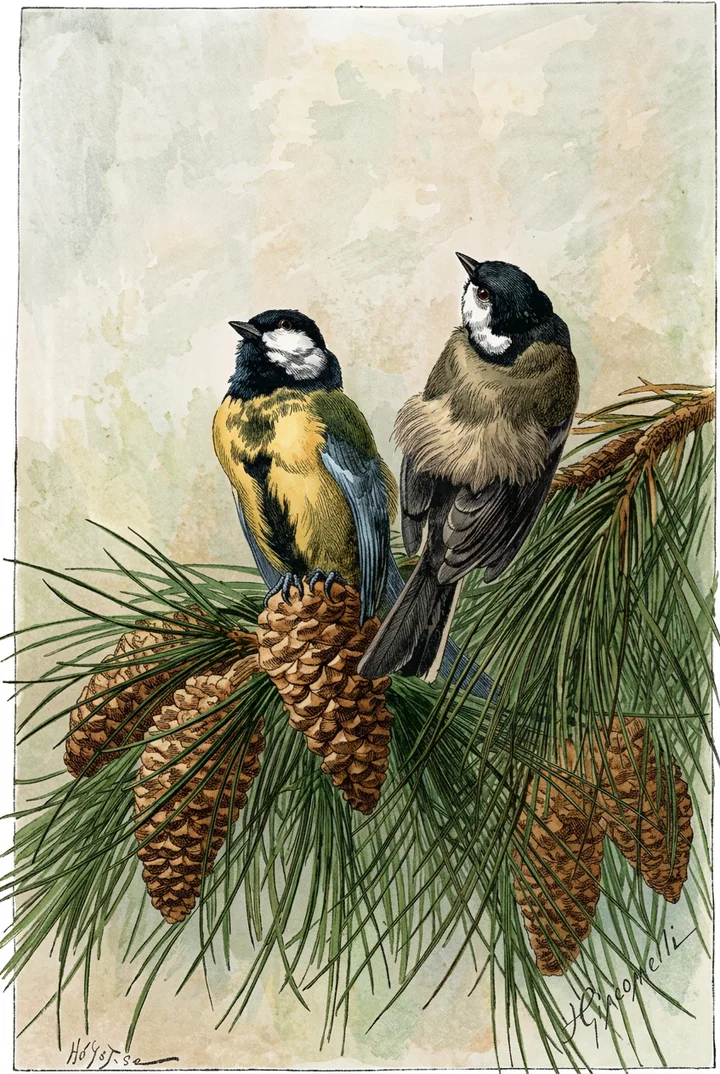
During the fine season they live in the depths of hilly woods; but as soon as the first cold sets in, and the first snow falls on the mountains, they draw nearer inhabited regions. Nearly all titmice are remarkable for their talent in nest-building, which is truly extraordinary in such small birds. They employ in the construction of their nest choice materials, such as small blades of grass, flexible roots, soft, silky moss, bits of wool, feathers, and vegetable down, and they use their bill in a most skillful manner for interweaving, rounding off, smoothing, and shaping these materials so various in texture and form.
Titmice are all very prolific. Their family instinct is also very much developed. Both males and females display untiring zeal in feeding their large family, and unequaled energy in defending it against the attacks of owls and other rapacious birds. In the main, the disposition of titmice is naturally violent, daring, and warlike.
Their fondness for live flesh has often been cast at them as a reproach,—live flesh which they tear with their nails, just like the shrike and the raven; but one is apt to forget that their small body is only a bundle of muscles and nerves, and needs very substantial food to resist the wear and tear of life. Why do we not cast the same reproach at that beautiful singer, the nightingale, which also lives on quivering flesh? Titmice are very sociable. Whether they have a taste for society, or whether the sense of their weakness makes them congregate together, is more than we can say; but sure it is that they are fond of their equals, and take their flight in larger or smaller troops. When perchance some accident has separated them, they quickly utter their call, and are promptly reunited.
While I was meditating on the faults and qualities of titmice, I happened to be an eye-witness to a sample of those beautiful relations which are established among the different members of the family. In the pines and firs, in the hawthorne and barberry bushes already stripped of their leaves, which I could see from my window, all the different species of titmice were represented, seeming to live in perfect harmony. They formed various groups, all very busy and very restless.
There was the great black-headed titmouse, easily recognized by its square build, its black hood, and black breast-plate. When the weather is unsettled, and it is going to rain, it utters a cry which is like the grinding of a file on a piece of iron. But generally it has a pleasing warble. It builds its nest in the holes of walls, in the trunks of trees, sometimes also in coal-sheds, abandoned by coal-burners.
Besides the great black-headed titmouse, the blue titmouse is very busy, the prettiest, the boldest, the bravest of the family. It is a lovely bird, with its delicate head covered by a blue hood, its bluish wings, its white cheeks, and its dark blue collar. This bird is the most terrible destroyer of caterpillars. It has been calculated that it eats daily half an ounce of the eggs of butterflies.
Then comes the ash-colored titmouse, or nun, which stores away seeds in its hole, and makes war on wasps. Then the great titmouse, which weaves its mossy nest in a marvelous manner, and suspends it on the boughs of trees, just like the gold-hammer. Lastly, the long-tailed titmouse, with its rapid, elegant flight, which can only be compared to the shooting of an arrow.
All these minute folks were hopping, skipping, and springing about, and warbling peacefully in the green boughs. Suddenly the whole troop took wing with a startled cry; at the same time the report of a gun was heard. I recognized there one of those characteristic traits of man, that mild and benevolent animal who is so very much shocked at the ferocity of titmice. Fortunately these birdlings are wise and experienced; they had foreseen the shot, and had taken wing in time.—From Song Birds and Seasons, by Andre Theuriet.