AGRA.
Prior to arriving at Agra, we had become rather disappointed in Indian architecture, which had not come up to our expectations concerning the land of the Orient. Of mosques and temples we had seen a few, but they lacked gracefulness and refined taste in construction. And we could not think that the noble sentiments contained in the hymns of the Vedas were properly crystallized in such work as stuccoed brick, covered with whitewash, and what appeared in the distance as gilded domes of perfect shape and apparently massive construction, but which on close examination proved to be mere shells of wood, considerably damaged by weather.
At Agra, however, the scene changed, and the brightest pictures ever seen in the most vivid day-dreams of an imaginative and beauty-loving mind were more than realized.
The town is situated on the Jumna River. It was built chiefly by the famous Mohammedan conqueror, Akbar, commonly called “the Great.” Formerly the city was surrounded by walls pierced by eleven gates, ruins of which are still seen. There are many lovely buildings, fabrics of the purest white marble lace-work, but space will admit of describing only the most prominent. The first is the fort,—a vast structure, irregular in shape, a mile and a half in circumference, and surrounded by a wall of red sandstone, sixty feet high, with crenelated battlements and numerous turrets. The outer ditch and rampart have disappeared; but the river moat, thirty feet wide, still exists. We entered by the Delhi gateway, an imposing structure flanked by two enormous towers, then up a stone ascent, and into a noble court-yard, 500 by 370 feet, surrounded by arcades. This was formerly the carousal or tilt yard. On one side is the judgment-seat of Akbar, a splendid hall, one hundred and eighty feet long and sixty feet broad. In an alcove in the center is a throne from which judgment, if not justice, was administered. It is a pavilion of white marble, with charming recesses, and containing three exquisitely sculptured marble chairs inlaid with mosaics. At the foot is an immense slab of marble, on which Akbar was accustomed to seat himself on public occasions.
Next we passed to the private hall of audience. It consists of an oblong room of white marble, beautifully sculptured, communicating with an open marble loggia of elegant Saracenic arches, exquisitely carved and inlaid. Adjoining this is an immense court, formerly the harem, three sides of which are occupied by the residences of the ladies.
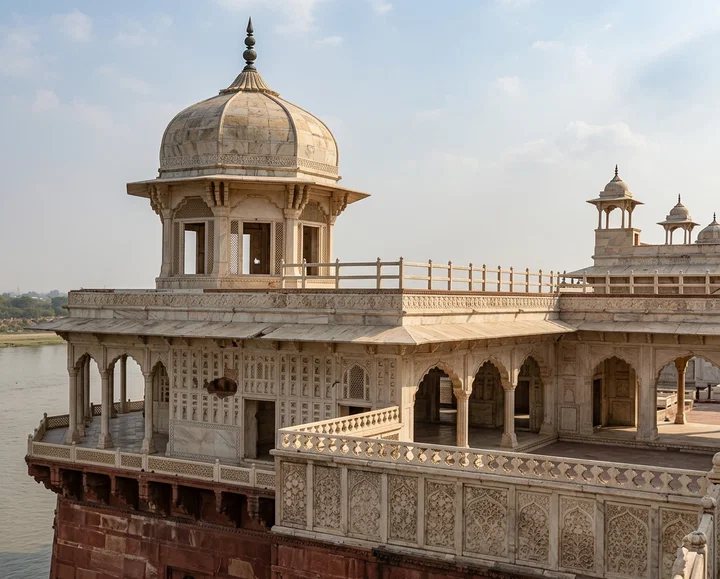
The monarch’s palace is still in a tolerable state of preservation. Cannon balls have torn huge gaps in the Sultan’s pavilion, and here and there an inlaid blossom of carnelian, with leaves of blood-stone, has been wantonly excavated from its marble bed; the fountains are dry, but this is all. The chambers, windows, and staircases are complete. One cannot stand there long, before in vision the former inhabitants of the palace of the great emperor are back again, following out such courtly games and sports as would be befitting those of royal state.
The pavilion overhanging the river, as shown in the cut, is inlaid within and without with a rich style of Florentine mosaic. There are precious caskets of marble, glittering all over with jasper, agate, carnelian, blood-stone, and other precious stones, and there are balustrades of marble, wrought in open patterns of rich design, till they appear like fabrics of finest lace. The Jumna washes the wall seventy feet below, and from the balconies attached to the zenana, or women’s apartments, there are lovely views of the palm groves and fairy-like gardens on the opposite bank.
The most curious part of the palace is the Shish Mahal, or palace of glass, which is an Oriental bath; its chambers and passages are adorned with thousands of small mirrors, disposed in the most intricate designs. The water fell over brilliant lamps in a broad sheet into a marble pool, and the fountains are so constructed as to be lighted from within. Mimic cascades tumbled from the walls over slabs of veined marble, into basins so curiously carved that the motion of the water is said to have produced the appearance of fish. This bath must have realized all the fable splendors of Arabian story. The chambers of the sultanas and the open court connecting them are filled with fountains.
Though the building is an incrustation of gold, marble, and precious stones, water was its most beautiful ornament. There are superb little fountains which once gave forth sprays of rose-water, richly perfuming those royal dwellings. On the inner side of these fairy-like precincts is the garden, where sweetest roses rival their odors with that of the jasmine vine, the upturned petals of both receiving the silver sprays from many an artificial font. There is also a court-yard paved with squares of black and white marble, so as to form a chess-board. The game played was called pachisi, and was similar to chess. Pieces of ivory were not used, but little girls ran from square to square as the moves were made. On an open terrace in front of the diwani-khas, where Akbar sat on great occasions, is a large slab of black marble, which was his throne. It is cracked from end to end, and this, the guide said, was caused by the Mahrattas when they took the city,—the Rajah seated himself on it, whereupon it instantly cracked, and blood gushed out of it in several places. There are two red stains on its surface, which is sufficient proof of the reliability of this legend to all good Mohammedans. Opposite is a throne of white marble, where it is supposed that the clown, or jester, sat to amuse the king, the master of this magnificent abode.
Among other wonders are many underground passages, where the wives of the king, it is said, played at the game of hide and seek, clothed only in the garb of Eve, dashing through the fountains of water, and making the halls resound with merriment, which caused the boatmen on the Jumna to look up to the lofty walls and wonder what it all meant. At the end of one of the passages is a deep well, where it is said that those who were unfaithful were put when sentenced to death. Two soldiers some time ago fell down this well, and were either killed by the fall or starved to death, as their bodies were not found till some days afterward. The authorities have now had the end of the passage bricked up.
In the fort is also the Pearl Mosque, which surpasses in loveliness all other buildings of its kind. We ascended a flight of steps, a huge door was flung open before us, and there rose the long-wished-for sight, in all its glory and magnificence. There is a large white marble court-yard, and at the farther end rise in stately grandeur three domes of sublime proportions, terminating in gilded spires. An inscription records the mosque to have been built by Shah Jehan in 1656. P. T. M.