ROUND THE WORLD.—27

6%

S. D. A. Publishing Association · Battle Creek, Mich. · September 17, 1890

FromThe Youth’s Instructor, Vol. 38, No. 38

Read the full edition

ROUND THE WORLD.—27.

THE INDIAN MUTINY.
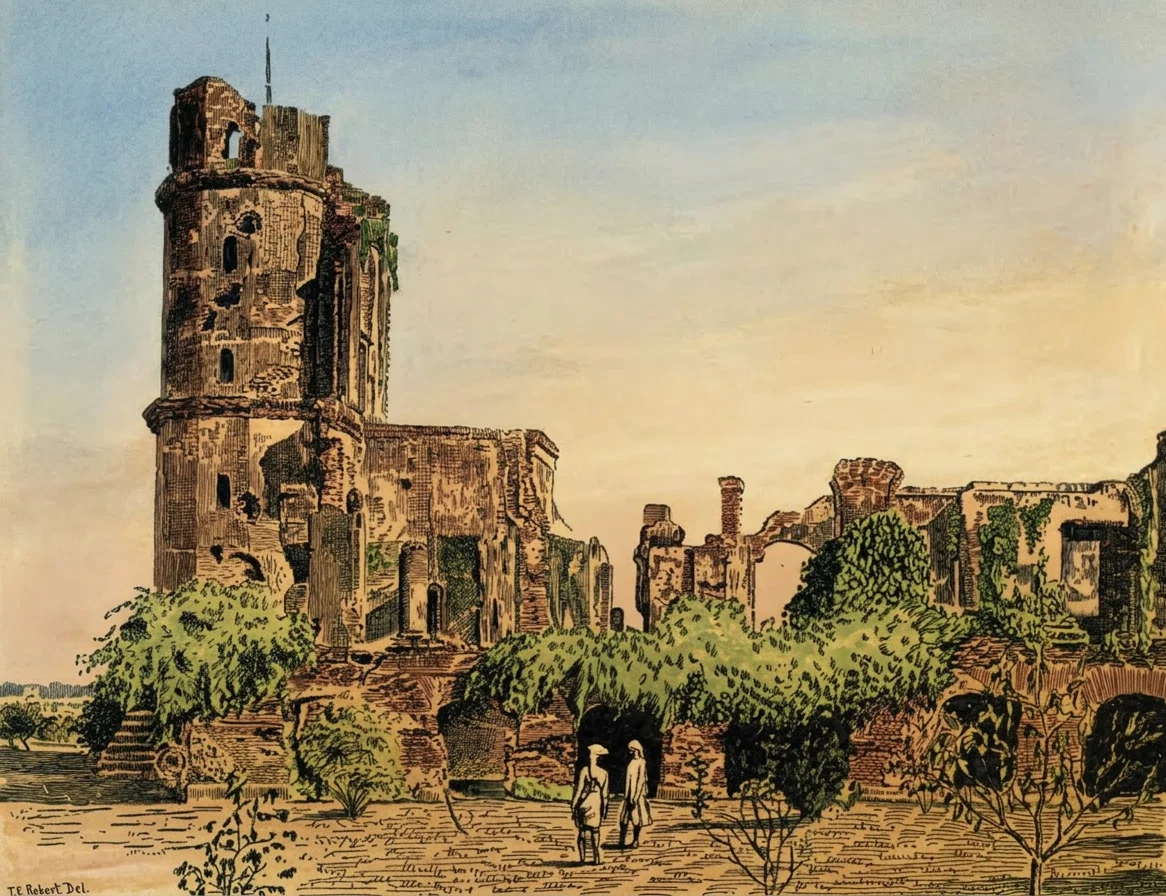
On the Oudh and Rohilcund Railway we journeyed to Lucknow, a city famed in part for the buildings erected there by the Mohammedans, but more especially as having been the scene of one of the most terrible sieges recorded in history. This took place in the year of our Lord 1857, when from the second of July to the twenty-fifth of September the Christians were besieged, and a harassing fire constantly poured upon them by the hands of the mutineered native troops.
RUINS OF THE LUCKNOW RESIDENCY.Restored with AI
RUINS OF THE LUCKNOW RESIDENCY.
In this year, 1857, arrived the Hindoo “Sumbut,”—the hundredth year after the battle of Plassy, a battle in which the British arms had gained a decided victory over the natives. Hindoo astrologers had declared that the “raj,” or reign, of the British power was to continue for one hundred years, and then be no more. It is impossible to overrate the effect of this strange prediction upon a people who are credulous and superstitious to a degree, who will not marry, make a bargain, set out upon a journey, or even have their nails pared, without a favorable conjunction of the planets.
The British had carried civilization forward to a comparatively high state of perfection, but the religion of the country had not been interfered with in any way. For a while the mutiny smoldered, but was soon kindled to a flame by the following spark:—
A rumor ran through the native army in British employ that the cartridges served out to the regiments had been greased with—the Hindoos said the fat of cows, the sacred animal, and the Mohammedans said the fat of pigs, the quadruped that they detest so much. No sooner had this source of dissatisfaction spread over the country, than the troops revolted, and open hostilities commenced.
The Lucknow Residency, and the compound, or inclosure surrounding it, and the other buildings connected with it, form a spot which nature has spared no pains to adorn, and the arm of mutiny no steps to devastate. The buildings are on slightly rising ground, now covered with beautiful trees and shrubs, with a soft, mossy carpet of grass beneath. Round the gray old walls the dark green ivy has entwined her loving tendrils, as if to soothe with loving embrace the wounds made by the rebel bullets. In many places there is hardly a square inch not dotted over with the marks of the bullets from the murderous rifles, and huge gaps still remain where cannon balls tore away the masonry, causing pain and death to those within. We walked in the dungeons where the women and children were placed for safety, and where they remained during all the siege, without a change of clothes and with scant provisions. We could but think of the early Christians in the catacombs, and we wondered how many fervent prayers had ascended to our Father’s throne during that fearful time. In one room upstairs is a huge hole torn by a relentless shell, and the place is shown where it struck the floor and exploded, killing a young girl who was in the act of crossing the room to go to her father.
Near by is the old well which supplied the garrison with water. Over it are the remains of stone arches covered with pretty creepers, and bright syringas gently and softly wave their graceful stems and comely leaves in the pacific zephyrs which are wafted across the Indian plains, as if bewailing in low and mystic music the fate of those gallant defenders whose noble hands had often drawn cooling draughts from the pure, quiet spring beneath, to quench the burning thirst of brothers wounded in the fray. So calm, so secluded is the well, that it almost seems to say to the hearts of those who gaze upon it, “My own praises I never tell; but many a thirsty soul I have refreshed, and the Master knoweth all.” The heart was filled with so many sad memories of relatives who had perished here, that we turned with sorrow from the spot to spend a quiet moment in the little church-yard, where truly the words of the poet are verified,— > “And every turf beneath his feet, > Shall be a soldier’s sepulcher.”
There is a striking contrast in the cold, dismal-looking gray slabs erected in honor of the departed heroes, and the soft, gently undulating grass and the flowers of varied hue, which, fostered by Heaven’s tender care, turn their petals to the skies, as if in the act of rendering joyful praise to their Maker. Seemingly they are oft repeating to the mourner, “God gave; he hath taken; he will restore; he doeth all things well.” Yes, faith and faithful works, crowned by a martyr’s death, will lead to that immortal garden where bloom the flowers of amaranthine shade, and where death’s sting will never again be known.
On the twenty-fifth of September, Havelock and Outram arrived with relief, but their force was itself beset by a fresh swarm of rebels, and it was not till November that Sir Colin Campbell cut his way to Lucknow, and on the sixteenth of that month finally delivered the garrison.
From Lucknow we passed to Cawnpore, where occurred one of the most cold-blooded, heartless massacres that the sunlight or stars of heaven have looked down upon. As Taylor, in his admirable history of India, expresses it: “More deliberately treacherous than the catastrophe of the ‘Black Hole,’ a hundred years before, more intensified and prolonged, the fate of those who perished there forms a tragedy so full of terrible misery, of heroic endurance, and the deepest pathos that it will ever be read with a shuddering tribute of tears, to the latest Christian generation.”
There were about a thousand whites in the town, and on the sixth of June they took refuge in a miserable and hastily-prepared entrenchment. For eighteen days they fought, under a blazing, scorching sun, until all the medicines for the sick, and well-nigh all the provisions, were exhausted. Their ammunition was also running very low. One of the best buildings was burned, and the rest were riddled with shot, many of the bravest defenders killed, and the remainder greatly debilitated. There were the little band praying for succor, which indeed came, but, alas! too late. At this critical point, Nana, the rebel leader, sent an emissary bearing the white flag of truce. His offer was to transmit the defenders in safety to the city of Allahabad, provided their goods and chattels, and whatever else of value the intrenchment contained, were surrendered to him. Had the men been alone, and not encumbered with helpless women and children, they would have preferred to cut their way through the Sepoy army; but under the existing circumstances that was impossible, and fearing no treachery, they accepted Nana’s offer.
Forever will his name be handed down to infamy. On the twenty-seventh, the survivors, now reduced in numbers to four hundred and fifty, were marched down to the boats prepared for them on the Jumna River. No sooner had they embarked than a murderous fire was opened on them from the bank. Many perished, others escaped for the time being, and were again captured. Some of them were instantly shot, but one hundred and twenty-two were reserved for awhile. Of the whole army who left the entrenchment on June twenty-seventh, only four escaped and survived. When news reached Cawnpore that General Havelock and the relieving force were coming up, Nana decided to slay the rest of his victims. Women and children were tossed in the air, and as their bodies descended, they were caught on the rebel bayonet, and dead and dying were hurled into a well near by.
When the relieving force arrived, was it marvelous that the mournful, blood-stained relics, the little shoes and scraps of clothing, and the deep well filled with fresh dead, caused every British soldier to make a vow of revenge, which to the last was sternly fulfilled? It is said that in one building, known as the “Slaughter Ghat,” the mutineers had plastered the scalps of the women and children all over the walls, and when the British entered, they stood ankle-deep in blood. Each Britisher took a scalp, and vowed that, for every hair on it, his sword should drink Sepoy blood. At first there was some resistance, but when the order, “Fix bayonets and charge!” was given, the mutineers threw down their arms, and cried for quarter. But it was too late; at the foe went the Highlanders, vengeance stamped on every brow, and like nine-pins the Sepoys went over before their terrible charge. Their rage and passion knew no bounds, and the revolting massacre was punished with a frightful retribution.
Over that well, now inclosed by a rich Gothic screen, stands an angel in marble, with folded wings and crossed hands, bearing two palms of victory, emblematic of the dead who sleep beneath, awaiting “the coming of their Lord. P. T. M.