Americans may boast of Fifth Avenue residences, or of their Government buildings at Washington; the English may plead Westminster Abbey or St. Paul’s; into the list of rival structures the Italians may bring St. Peter’s at Rome. But, alone in its glory, grandly sublime above them all, resting in a magnificence which is beyond comparison, stands the Taj Mahal. Though an orator were to elaborate upon it in eloquence rolling out like the Falls of Niagara, though a Raphael were to endeavor to reproduce it on canvas, he would utterly fail to do it justice. It is a masterpiece of architecture, equaled by no other building on earth.
It is situated at one end of a noble court-yard, the depth of which is 450 feet. The whole is surrounded by a red sandstone wall, adorned with arcades, and pierced by four gateways. The principle entrance is elaborately carved, and on it are many inscriptions from the Koran. Twenty-six marble cupolas ornament its summit. A long paved pathway leads up to the Taj, which is situated at the river end. On either side of this avenue are trees of gigantic proportions, with lovely foliage, and flowers of varied hue spring up on every side. In the center is a splendid raised marble chubutra, with a fountain, and a row of jets d’eau is carried from end to end. At one side is a fernery, containing many varieties, and on their soft green leaves the drops of water sparkle like myriads of diamonds in the sunlight.
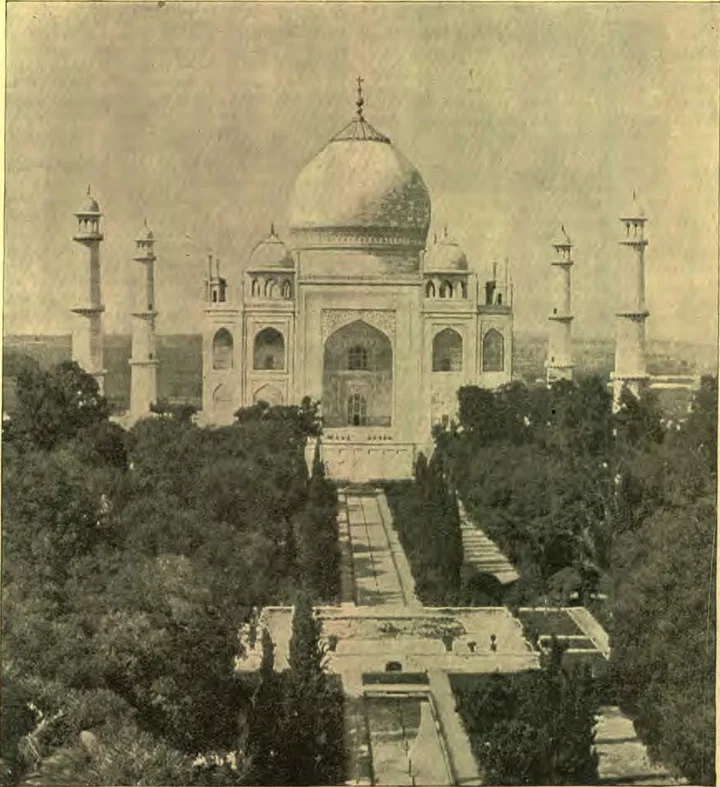
The Taj is raised on a platform of red sandstone, measuring 964 feet by 329 feet, one side of which is washed by the Jumna. Two mosques occupy the east and west sides; they are of red sandstone, inlaid with white marble, with marble domes. That to the east was built as a jawab, or answer, to the other, in order to preserve the symmetry of the group. From this platform rises a superb terrace of white marble, 313 feet square, in the center of which stands the beautiful pile itself. At each angle is a lofty minaret of exquisite proportions, built of white marble, surmounted by a light, graceful cupola, supported on eight pillars. They are about 150 feet in hight, and a beautiful view is gained from the top, which is reached by a spiral staircase.
The plan of the Taj is that of an irregular octagon, the sides facing the four cardinal points, which contain the entrances, and are about 130 feet long. The roof is about 70 feet from the terrace, and each angle is surmounted by a slender minaret. From the center springs the marble dome, 70 feet in diameter, and rising to a height of 120 feet; it is surmounted by a gilt crescent, about 260 feet from the ground level. The whole is of the finest Jeypore marble, highly polished, and retaining its pure white color, as when it was first quarried.
“On each side,” to quote from Bayard Taylor, “there is a grand entrance, formed by a single pointed arch, rising nearly to the cornice, and two smaller arches, one above the other on either side. Every part, even the basement, the dome, and the upper galleries of the minarets, is inlaid in ornamental designs in marble of different colors, principally a pale brown, and a bluish violet variety. Great as the dimensions of the Taj are, it is as elaborately finished as one of those Chinese caskets of ebony, which are now so common in Europe. It is asserted that the whole Koran is thus inserted in the Taj. The building is perfect in every part, and any dilapidations that it may have suffered are so well restored that all traces of them have disappeared. Before entering the central hall, we descend to the vault where the beautiful Mumtaz Mahal is buried. A sloping passage, whose walls and floor have been so polished by the hands and feet of thousands that you must walk carefully to avoid sliding down, conducts to a spacious vaulted chamber. There is no light but what enters at the door, and this falls directly upon the tomb of the queen in the center. Shah Jehan, whose ashes are covered by a similar cenotaph, raised somewhat above hers, sleeps by her side. Frequently the Mohammedans fill the vault with the odors of rose and jasmine and sandal wood, the precious attars of which are sprinkled on the tomb. Thesep. 158 were the true tombs, the monuments for display being placed in the grand hall above. This is a lofty rotunda, lighted both from above and below by screens of marble and jasper, and ornamented with a wainscoting of sculptured tablets representing flowers. The tombs are sarcophagi of the purest marble, exquisitely inlaid with blood-stone, agate, carnelian, lapis-lazuli, and other precious stones, and surrounded with an octagonal screen six feet high, in the open tracery of which lilies, irises, and other flowers are interwrought with the most ornamental designs. It is of marble covered with precious stones.”
The building is said to have been designed by a man who acquired his profession in Italy, and who originally came from the Indian State of Rajputana; and a legend says that after the building was finished, he was seized, and his eyes put out, to prevent his executing one of grander proportions for the Maharaja of Jeypore, king of his native home.
The dome of the Taj contains an echo more sweet, more pure, and more prolonged than that of the baptistery of Pisa, the finest in Europe. A single musical note uttered by the voice floats and soars overhead in a long and charming undulation, fading away so slowly that one seems to hear it after it is silent,—as you see, or seem to see, a lark that you have been watching, as it is swallowed up in the blue vault of heaven. The responses that would come from above in the pauses of the song must resemble the harmonies of the angels in paradise.
The best time of all to see the building is by moonlight, and there is no tongue that can tell the effect produced on the mind by the soft lunar light streaming down on this gem of architectural perfection. It then looks like a floating palace in the air, and as you approach, it seems to recede.
The Taj was built by Shah Jehan as the tomb of his favorite wife, Begum Mumtaz Mahal, hence the name,—Taj. It was commenced in 1630, and it is said to have taken seventeen years to complete it, and that its cost was $15,000,000. One writer has said that there were 20,000 workmen engaged in its erection for twenty-two years.
The black marble came from a place called Charkoh, and cost $30 a square yard; the crystal from China, at a cost of about $190 per square yard; jasper from the Punjab; carnelian from Bagdad; turquoises from the far-off plains of Thibet; lapis-lazuli from the island of Ceylon, at a cost of about $389 a square yard; coral from Arabia and the Red Sea; and amethysts from Persia. There are in the inlaying of the flowers many other stones used, which have no longer a name in our language.
It seems wonderful how such a building could have been erected by a people who possessed none of the appliances of modern science,—how the huge blocks of marble were ever raised and placed in the dome, without steam cranes or anything of the kind. But there it stands, an emblem of the skill of the forefathers of the Mohammedans of to-day, and unequaled in any other country on earth. P. T. M.