ROUND THE WORLD.—30.
By P. T. M.
DELHI.
WHEN we reached Delhi, we had journeyed 955 miles from Calcutta, and had still 880 to make before reaching Bombay.
Within a range of twenty miles south and west around Delhi are many ancient ruins, which testify to the various sites that the city has had in days of yore. This has been occasioned sometimes by Mogul invaders, who destroyed the old town with its forts and palaces, and reared up another; or sometimes by the caprice of emperors, who wished to erect more royal dwellings for themselves than those of their predecessors. Wherever the sovereign held his court, there parasites and nobles clustered around; and merchants, having no longer the protection of the king’s troops in the old town, took their wares to the vicinity of the new palace, to save themselves from exposure to hordes of bandits, who, in early days, roamed over the Indian plains, and they also wished to command the patronage of the Rajahs associated with the affairs of State.
The principal street in Delhi is the Chandi Chowk, one mile long and 122 feet broad. It is fairly clean, and adorned with a handsome row of trees on either side. The queen’s gardens are very elaborate, with many winding walks beneath the shade of varied foliage. There is a handsome clock-tower, and a museum containing many relics of antiquity. Another large street intersects the city from north to south; it commences at the famous Kashmir gate, which was stormed and taken by the British in the mutiny of 1857. After carrying the gate, the English soldiers engaged in a hand-to-hand conflict with the mutineers for six days in the streets of the city, and finally won back the town. An immense number of natives were slain, and the entire place was plundered.
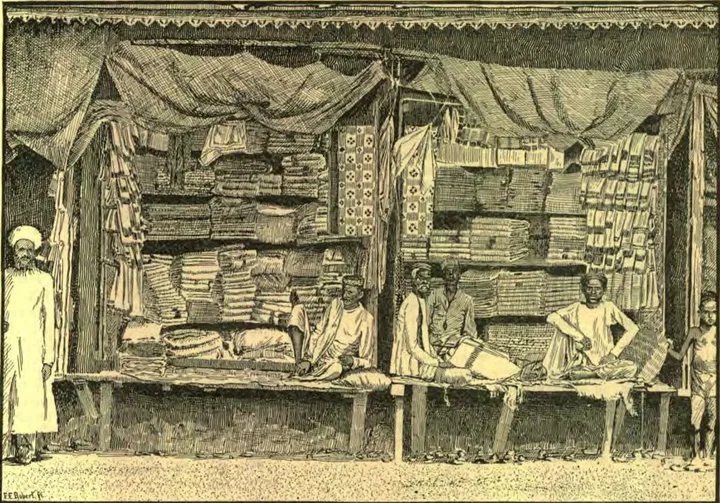
Delhi was then, and is now, noted for its wealth. The most beautiful gold embroideries, shawls of silk and cashmere, ornaments of ivory, and sweet-scented sandal-wood fill every nook and corner of the bazaars. It is a pretty sight to see the venders, in spotless white garments, seated on the floor showing their handiwork. In little stores, six and eight feet square, are crowded thousands and thousands of dollars’ worth of goods, of texture and design that would almost breed covetousness in the heart of a saint.
The citizens of Delhi pride themselves on the purity of the Hindustani they speak, and upon their politeness and affability. They will express their grief if you tell them “jow,” meaning “go,” in the rough tones in which it is customary to salute a Bengalee. They will inform you with the blandest of smiles that they are not lying, that such vices they do not cultivate; butp. 162 after taking their oath by all the Hindoo gods that they cannot sell a shawl or a sandal-wood box a rupee cheaper than they have asked, you need not be surprised if they come down seventy-five per cent; take it as a matter of course, and then bid them half that amount.
There is a fort at Delhi, much the same as the one at Agra. It, too, has a palace, which contains a hall of audience famous in the annals of Indian history. It is a square marble pavilion, resting on massive pillars and moresque arches. The marble is highly polished, but there is little decoration, a few graceful flowers in mosaics being the only ornament. One side of the hall of audience opens on a court, a second side looks on the palace gardens, a third side commands a fine view of the river Jumna, and the fourth rests on the walls of the zenana. Between each pair of the outside rows of pillars is a very beautiful balustrade of marble, chastely carved in several designs of perforated work. The roof has at each corner a marble kiosk with a gilt dome. The shape of the building is oblong, but in size it cannot nearly equal the one at Agra. The ceiling was once entirely composed of gold and silver filigree work, for which the goldsmiths of Delhi are still noted.
In the center stood the famous peacock throne, so called because its back was formed by jeweled representations of peacock’s tails. The throne was six feet long and four feet broad, composed of solid gold inlaid with precious gems. It was surmounted by a gold canopy, supported on twelve pillars of the same material. Around the canopy hung a fringe of pearls, and on each side of the throne stood two chattahs, or umbrellas, the symbol of royalty; they were made of crimson velvet, richly embroidered with gold thread and pearls, and had handles eight feet long of solid gold studded with diamonds. This unparalleled achievement of the jeweler’s art was constructed by Austin de Bordeaux, by command of the Emperor Shah Jehan, who founded the present city of Delhi. The value of the throne was estimated to be $30,000,000. The peacock throne was taken away by the Persian Nadir Shah, and the silver filigree ceiling formed part of the spoil of the Mahrattas, in 1759, by whom it was melted down.
After leaving the palace, we drove to the Jami Musjid, one of the largest and most beautiful mosques in the East. It is situated on a high, rocky eminence, and the main entrance is reached by climbing a long flight of well-worn red sandstone steps, which, under the burning rays of an Indian sun, we found no pleasant task. The court is 450 feet square, is paved with red stone, and in the center is a marble reservoir for water. The interior of the mosque proper is paved with slabs of white marble, three feet long by one and one half broad, each decorated with a black border, which gives it an extremely beautiful appearance. Near the nibla, or that part which indicates the city of Mecca, is a handsome taq, or niche, adorned with a profusion of rich frieze work, and though joined in several places, appears to have been cut out of a solid block of white marble, four feet high and six feet in length.
In the northwest angle is a little chamber partitioned off by a beautiful white marble screen, in which are deposited some spurious relics of the prophet Mahomet. An old priest opened the door, and while he was fumbling about with keys and locks innumerable to undo the heavy locks which were attached to the precious caskets, I took the liberty of resting my foot, which was very weary, on the threshold of the doorway. I shall never forget the look of horror that came over his wizened old face, and had I been alone, he might have attempted to take my life for thus profaning the holy place. I judge that such a daring piece of sacrilege had not been committed for some time. The relics consisted of some hair that was said to be from Mahomet’s beard, but which more likely was extracted from the tail of a Yak cow years after Mahomet had departed this life. Then there were the crumbled remains of his shoes, which, too, in all probability, he never wore, but were more likely purchased in the bazaar for two rupees; and part of the Koran, hand traced, said to be the work of Mahomet’s grandson, but if the truth were known, was also the handiwork of some wallah in the Delhi bazaar. But the crowning lie is told about an impression that is shown. It is a foot-mark in solid stone, and was supposed to have been made because Mahomet stood there to pray so often. He must have had powerful understandings.
P. T. M.