JEYPORE.
After a two days' rest at Delhi, we once more boarded the train, and started on our journey southward. The road is narrow gauge, and passes over some steep gradients. But as the shades of night were drawing over the landscape, we did not see much en route. The crops looked flourishing on either side of the track, and flocks of peacocks feeding quietly among them were apparently in undisputed right, their beautiful plumage glittering in the last red rays of the sun, as it disappeared behind the western horizon. The night was comparatively cool, but we were painfully aware that, as we drew farther to the southward, the heat would increase, and that sleeping would be an utter impossibility.
In the morning we arrived at Jeypore, the capital city of the native State of Rajputana. It is by far the finest town under native control in India. It is well managed, and the people are greatly advanced in civilization. Its streets are very wide, the houses lofty and well-built, and all the principal highways lighted with gas. It possesses high schools, a school of art, a college, and almost every institution found in the most advanced cities in the civilized world.
All these improvements are owing to the late Maharaja, Jey Singh, a wise, enlightened, and liberal-minded prince. The present town was founded in 1728. It is surrounded on all sides, except the south, by rugged hills, the chief summits of which are crowned with forts.
One of the most interesting sights in the city is the stables of the Maharaja. They contain, I should think, many hundreds of horses, most of them of magnificent stock. The collection has been gathered from almost every imaginable part of the surface of the globe. There are shining Arabs, with a beauty sufficient to satisfy the eye of the most critical Bedouin; little Shetland ponies, with their flowing manes and tails, and Clydesdale draught horses, that look capable of pulling almost any load. They lead an easy life, for there is little for them to do. The method in which they are tied up in their stables is a peculiar one. There are no partitions between the stalls, and to prevent them from kicking or injuring one another, a rope about a foot and a half or two feet in length is attached to each fore foot, and pegged into the ground. Then one some eighteen or twenty feet long is fastened to each hind foot, and also pegged down. From the halter another lariat is fastened to the manger, so that tranquillity is verily insured.
The public gardens are beautifully laid out; no European gardener could manifest better taste. The fernery is charming, and surpasses anything that I have ever seen before. In cages at one side of the main square are specimens of almost every kind of bird that can exist in that climate. In size and variety they range from the tiny warblers of the jungle to the silver peasant and the largest specimen of aqueous bird. A museum known as the Albert Hall stands in the center of the gardens. It is a very imposing structure, containing some well-executed frescoes of early days in India, when the gods of the Hindoos carried on wars against each other.
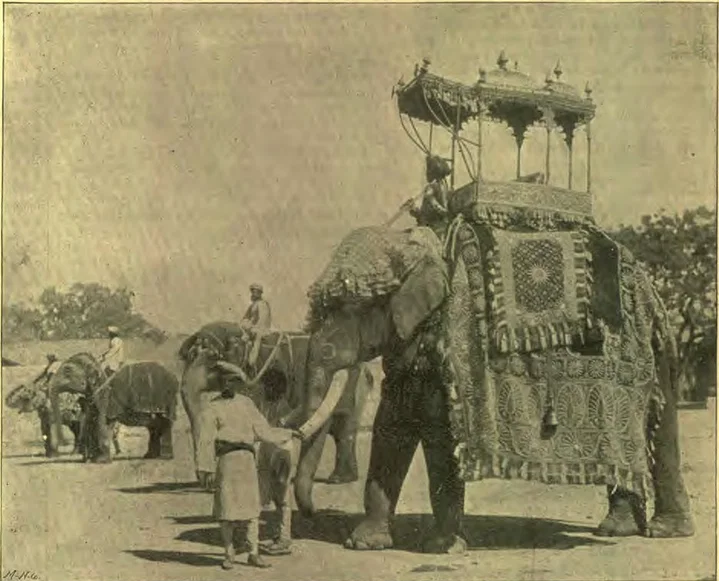
In the afternoon we drove to Amber, or Old Jeypore, four miles from the present city. Arriving at the confines of the place, we were met by an elephant sent out by the Maharaja to take us up the mountain. This is customary, and a courtesy shown to all visitors desiring to view the halls of his ancestors.
We had often heard about riding on elephants, and had seen pictures of the performance, but this was our first attempt. The driver sat behind the animal's ear, which was almost large enough to cover him, and certainly to form a good sunshade, could it only be brought into the right position. At a word from the driver and a prod from a grappling-iron by means of which he steered the beast, the giant knelt down. Then a seven-foot step-ladder was unslung from his side, and placed on end, and up we clambered. It was now Jumbo's turn to arise, which he did at considerable "passenger's risk" we thought; for the effort seemed greater than that of a ship crossing the breakers of a billowy bar. With another prod, and some inexpressible lingo from the jarvy, our steed commenced to waddle. I shall never forget the sensation; the motion is indescribable. He seemed to plow along worse than a brig in a gale of wind. We have sat astride the naked back of an Irish donkey, and poked him with a pin to call forth kicks and energy, we have ridden wild horses on the prairies at break-neck speed, we have come into the goal posts of a half-mile race poised on the dorsal vertebra of a Missouri mule, but we would infinitely prefer to brave all such dangers again rather than be doomed to another hour on the back of an elephant. It nearly made me seasick, and every little while he would sneeze, or something of the kind, wetting his deck-like back fore and aft, and completely submerging us. But to his praise be it said, he did steer well, and would tack his huge, clumsy feet round the sharpest corners among the rocks, as we ascended the mountain-side, without once grazing our toes.
The old palace is on the side of a mountain, frowning down over a dam of water which doubtless served as a moat in ancient days. It is an immense building, and the style resembles much that of other buildingsp. 166 of the same nature hitherto described. As a whole, it is not very handsomely ornamented, the decoration of but two small rooms being worthy of note. Their walls are embellished with a host of little mirrors of peculiar shape, which reproduce at least a thousand times the one gazing into them. The deserted zenana, or quarters of the queen, looks as if it wanted some one to come and live there, and the wind sweeps cruelly through the marble screens, as if telling that the days when these rooms resounded with merry laughter are over, and that the breezes have now undisputed sway. A melancholy gloom hangs over the majority of buildings of this class, and I imagine that I would often look behind me if I were passing through on a dark night.
After surveying the ruins, we once more mounted and started down grade, and the motion was, if anything, worse than when ascending. If you want any bones dislocated and set again, try a ride on an elephant; or if you wish your teeth loosened prior to visiting a dentist, take a jog on Jumbo down a canon, and it will insure “painless dentistry.” Safely landed once more at the foot of the gulch, we vowed we would never go elephant riding again.
We slept again that night on wheels, the iron horse whirling us down to India's great seaport. A reverend gentleman disturbed our peaceful slumbers during the night with a “Hurry up and get out, I want that carriage for my daughter.” But we had been elephant riding and were weary, and didn't propose to get up, dress, and shift about thirteen pieces of baggage, so we bade him depart to find a resting-place for his daughter elsewhere. Unwillingly, and with no too kind au revoirs, he did, and finally found another compartment for her, and then a roost for himself with some betel-nut chewing, poojah-performing Babus (native gentlemen), where, without doubt, he enjoyed the aroma and the local society.
Next morning we were laid over at a wayside station till the special train containing Prince Albert Victor, the future king of England, should pass. It was a pretty train, handsomely equipped, with Pullman cars and silvered railings, while from the hinder coaches appeared a perfect bevy of peons, and bearers and conductors innumerable. We queried why we were not dignified with such state, and thought we were just as ornamental and every bit as useful in this world as His Royal Highness.
We sincerely hope that the night which followed will be our last on an Indian railroad in the hot season. The heat was something fearful. H. took the upper berth, and tried to sleep, but how well he succeeded he alone can tell. A British army officer and myself disrobed, and sat in our sleeping suits gasping for air. Many of the depots we passed through were brilliantly lighted and decorated in honor of the prince, but if he was as stifled as we were, he could not have paid much attention to this burst of loyalty. It had lost all charms for us; the only thing we could summon up energy enough to do was to use our lungs lustily to the wallahs on the platforms for “pani” (water). One such experience is enough. As the morning approached, the atmosphere suddenly changed, and was quite chilly, which did not add to our physical comfort. At last the brakes grated on the rails in the Bombay depot. We hurried to the post-office to see if there was not food for folks who have undergone letter-starvation for nearly three months. Nor were we disappointed. We were glad we had a carriage, for we could not have carried it all home in our arms. P. T. M.