SOMETHING ABOUT BOMBAY.
UNTIL late years, Calcutta has been the most important city in Asiatic countries; but now Bombay has the largest trade, and the inhabitants intend to make a strong effort to have the residence of the viceroy transferred to their domain. As the nearest Indian port of any size to England, it has an unquestionable advantage; for all communication with the mother-country is by sea. But should the British engineers and capitalists carry out their scheme of bridging the English Channel, running a railroad across the continent of Europe to Gibraltar, placing the cars on pontoons, and in this manner conveying them across the straits to Northern Africa, and then on by rail again to the Suez, across it, and through Persia to Kurrachee, in India, Bombay will lose a good deal of trade.
Bombay is called by the natives, “Mumbai” (the capital of the West). It is built on an island of the same name, having only one connection with the main-land, namely, a railroad bridge. The land is mostly flat, with the exception of the rising ground called Malabar Hill, a point to the west of the island, Chinchpoogly to the east, and Parell Hill on the north.
Formerly the island of Bombay belonged to the Portuguese; but by the marriage of Charles II., of England, with the Infanta of Portugal, in June, 1661, it was ceded as her dowry to the British monarch, and an expedition under the Earl of Marlborough was sent in March, 1662, to take possession of it. This was unsuccessful, inasmuch as an excess of territory, over that named in the concession, was demanded; and while the Earl returned to England, the troops, under Sir Abraham Shipman, were encamped on the island Anjedva, the climate of which proved fatal to many soldiers and to their commanders. But Bombay was eventually taken possession of in 1664, and transferred to the East Indian Company in 1688, with all the powers of local government. The fortifications were then enlarged and strengthened, and the population soon rapidly increased, the admirable situation of the fort and harbor, the strength of the place, attracting persons of all nations, Asiatic and European.
The transactions of the period are, however, singularly deficient in incidents of history; and although the French, the Dutch, the Portuguese, and the Danes, as well as the English, held factories in India, it does not appear that local rivalry led to any bad consequences. The struggles between Sivajee and the Seedee of Jinjewra created considerable uneasiness in Bombay in 1674. The harbor was the scene of several engagements by sea, and the neighborhood of Salsette by land. In this contest the English interfered on one occasion only, when the Maharatta fleet was dislodged from their position near the island of Kenny, at the entrance of Bombay harbor; in other respects a perfect neutrality was observed. It would seem that almost all the towns and cities of note in India have at one time or another been the scene of strife and bloodshed. But now all is peace and harmony, and the natives seem happy and contented under British rule. How long this state of affairs will last, none can tell. Russia longs to pounce upon this bright gem of Victoria’s crown, and the British are prepared to fight for it to the last. Statesmen say that the storm-clouds of war are brewing, and that it will not be long until they burst again.
What shall I say of the city? Countries and cities grow monotonous to travelers after the excitement and novelty of a nomadic life have worn off. Places lose their interest. Countries appear to be but an illy distributed mass of mountains and plains, forests and deserts, and cities but immense groups of buildings blackened by smoke from tall chimneys of factories, or suburbs containing the usual villa surrounded by a flower garden.
Were it not for the sea-breeze, summer at Bombay would be almost unbearable. May is the hottest time of year, and we were there in an exceptionally hot April. It is absolutely dangerous to walk out during the day, and even should one change his clothes every half hour, he could wring water out of them at the end of that time.
The cathedral, the town hall, the new secretariat, and the post-office are magnificent structures, and the residents are justly proud of them. Once a week the mail steamer, bearing letters from England and America arrives. This is always an event of interest, as home ties are dear to those far from their native land. I watched the huge red vans, drawn by splendid draught horses, bringing the mail-bags from the bunder (landing-place) to the office. It seemed as if it would take days to sort it; but in two hours the clerks were busy serving it out.
One important feature at the time of our visit was the fair and illuminations in honor of Prince Albert Victor, the grandson of the present Empress. On the military parade ground was a miniature city of brown canvas tents and pavilions trimmed with valances of scarlet. An open fence of white St. George’s and Oriental crosses about ten feet high encircled the ground, in the center of which a tower was constructed on the same principle as those used in the United States for wind-wheels. From the top of this, a panoramic view of the cotton city could be obtained. Some of the stalls were very prettily arranged as cafes, where ice-cream, lemonade, and other unhygienic delicacies were served out to the heated visitors. Cross-legged on the raised dias of their stalls sat the Babu merchants, ever ready to bargain and sell for one-fourth their original price. Frequently, when one asks the cost of an article, they will say, “Sahib, one price or two?” If you say “two,” they start an extraordinary figure, and you may have the privilege of discounting them as much as you can. If you answer “one,” it is supposed that they will come down but very little, though as a rule they will decrease it just as much as when the other method is adopted. These venders look very picturesque in their flowing white Oriental dresses, with gold-braided caps and colored sashes. The Oriental loves display.
Almost all the curiosities of the East were exhibited, from the tortoise-shell jewelry of Ceylon to the embroideries of Delhi and the shawls of Cashmere. A “maze” was a great feature of attraction; into it there was but one entrance, and out of it but one, while inside were scores of paths fenced off from each other, and intricately arranged with turns and windings innumerable. One wrong turn to right or left, too early or too late, and the traveler finds himself debarred from further progress, with no redress but to start afresh and strive to thread the magic paths aright. Some got through in a few minutes, while others worked for hours before they unraveled the secret windings of the labyrinths. Into the “Hall of Mystery” we did not venture, and therefore cannot say what it contained.
In one street hung out the sign, “Edison’s Phonograph,” and it only proved true the ancient adage, that in order to know the wonders there are in your native land, you must go to distant shores. We have been in New York, the birthplace of this wonderful instrument, which is to supersede the poor traveling correspondent of the press; but we had never heard its history from its own lips till in Bombay. It reproduced a cornet solo which had been rendered in London some months before, and then delivered a little speech on a political crisis in India. The former was distinctly audible over a large room, but the latter only through the acoustic tubes.
But the best time to visit the fair was at night. The stalls were open till two and three o’clock in the morning, and up to midnight the concourse of peoplep. 171 was great. Immediately after sunset the lights are set burning; all the crosses forming the fence, the gateways with their Gothic arches, the tower, and the stalls were emblazoned with myriads of lamps. These were little square glass boxes of various colors, red, blue, green, and yellow, about four and one half by three inches in size, and filled with cocoanut oil, with a wick in the center. They glittered and sparkled everywhere, and the ever-moving, singing throng of white-robed Hindoos lent enchantment to the scene, making it almost like a fairyland dream.
There was only one feature in connection with this “Tamasha” (which means, anything out of the common), that reminded us of any past period of our lives, and that was the odor of the cocoanut oil from the lamps. It indeed called up remembrances of a sanitarium we were once acquainted with, where the above-named ingredient was an important item in the treatment of the sick.
One evening not only the fair-ground, but the whole city, was illuminated in honor of the prince. All public buildings, monuments, and stores were ablaze with lights of many colors. They were hung around the lintels of the doors, and from the casements of the windows on the architraves, and from parapet and buttress. Everywhere they glistened, those near the ground casting a soft light across streets and squares, while those on the cornices and heights of the towers had, as they flickered in the wind, more the appearance of twinkling stars. In the harbor I suppose there were as many as a thousand ships, and from the masts and rigging of nearly all of them gleamed these fairy scintillations, the light streaming over the water, and producing a resplendent effect. We thought of the honors that men bestow on their fellow-beings, and remembered what a cold reception was accorded to the world’s Redeemer when he came to earth to die for humanity. But so it has been ever, and will ever be, until He shall come whose right it is to reign, and shall claim his own. And then celestial rays, far brighter than anything ever conceived in the mind of man, will flood the heavens and bathe the earth in glory.
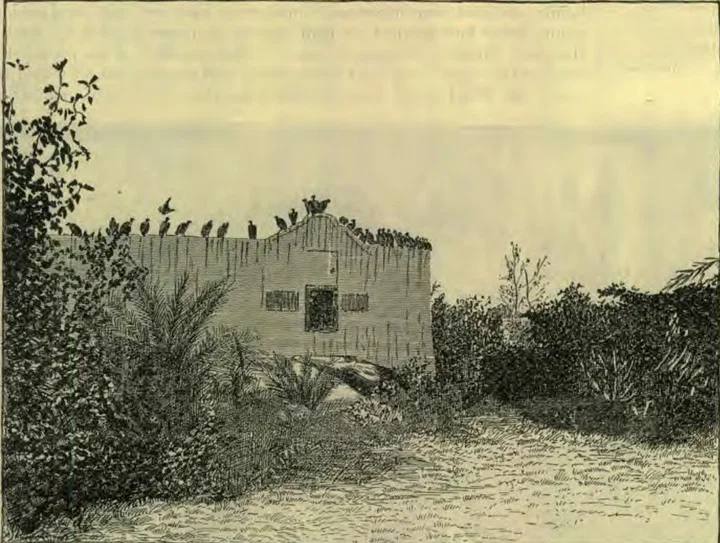
The accompanying cut should by right appear with the next article. It represents one of the famous “Towers of Silence,” the curious burying-place of a curious people. In our next we will give their story, with characteristics of the heroes and heroines.
P. T. M.