I have been telling you something of the history and religion of Japan; I will now endeavor to give you a glimpse of the people in their homes. Their houses are quite unlike ours, but are well suited to the needs of the inmates.
The ordinary Japanese house is a light frame-work structure. There are no stationary walls all around, such as we have; but the outside is protected by sliding doors, called “amado,” which are all slid into a box in the daytime. If the weather is warm, the house remains open to outside air all day long; but in winter semitransparent paper screens, called “shoji,” replace the sliding wooden doors. Rooms are separated from each other by paper slides called “fusuma,” which run in grooves at the top and bottom. By taking out these screens, several rooms can be thrown into one. The best apartments in a Japanese house are usually at the back, so that the occupants may look out upon the flower garden, which is also in the rear.
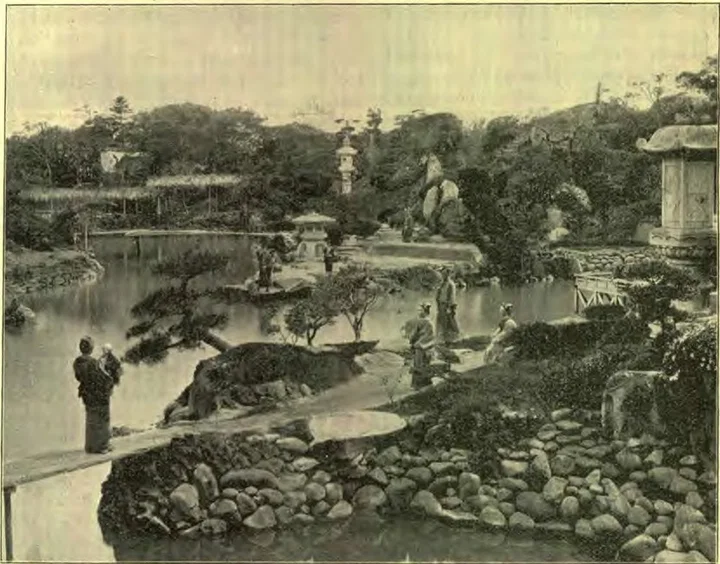
But really the Japanese can scarcely be said to have flower gardens,—at least not such as we see in this country. A flower garden conveys to our minds the idea of a little parterre, laid out in stiff, rectangular beds, in which bloom various kinds of annuals in summer, but which are bare in winter, except for the shrubbery. Now a Japanese garden is a little park in miniature. If there are flowers, they are removed as soon as their season of bloom is over, and others put in their places, as long as the warm weather continues. There are trees, rocks, hillocks, lakelets, and tiny streams spanned by bridges. You can easily imagine, when looking out upon one of these gardens, that you are gazing upon the picture of a beautiful landscape. The Japanese are great lovers of nature, and endeavor to reproduce some of her beauties in the tiny little spaces of ground allotted them at their back doors. Only the wealthy people can afford to have such large, beautiful landscape gardens as the one represented in the picture.
The floors of a Japanese house are covered by thick straw mats, upon which the people sit in the daytime and sleep at night. They have no such furniture as tables, chairs, bedsteads, etc., in their houses. Thick quilts are laid upon the floor at night for beds, and in the daytime they are folded up and put away. The Japanese eat from little trays, one of which is placed before each member of the family. These trays contain several tiny bowls filled with rice, fish, etc.
There are no grates or fireplaces in Japanese rooms, but, instead, the “hibachi.” The hibachi is a large bronze or metal bowl, or an ordinary wooden box lined with tin. It is filled to about three inches of the brim with ashes, upon which glow a few live charcoals. A tripod upon which sings a tiny kettle of water, is thrust down over the coals. Around the hibachi the family sit or squat upon their feet, which keeps their lower extremities warm, while they toast their fingers over the coals. They constantly smoke from tiny pipes. When thirsty, they pour some of the hot water upon the tea leaves kept in readiness in the little pot which is always at hand, and drink the rather bitter beverage. If a friend or acquaintance comes in, it is considered quite rude not to offer him a cup of tea and a slice of cake, or other refreshments.
The population of Japan is very much crowded. The country is not quite as large as California, and only an eighth of that can be cultivated, on account of the mountains and hills. There are forty-one million people. This allows less than a third of an acre of arable land for each person.
The young folks in Japan who get married are usually too poor to set up housekeeping for themselves, and even if they were financially able, they would probably remain with the husband's parents, because that is the custom of the country. There is generally a large family in each household—father, mother, grandfather, grandmother, and the sons and their wives and children, besides others. In America young men toil to amass wealth for old age; not so in Japan. At about fifty years of age the father gives up his business and property, if he has any, to his sons, who are expected to support the old people as long as they live. The children usually regard the care as a sacred trust, treating their parents with the utmost respect and consideration. They never seem to weary of ministering to the wants of the old, and when times are hard and food is scarce, as is often the case in Japan, they cheerfully deny themselves and their children to keep their parents in comfort. Here is a lesson to young America. With all our boasted superiority and civilization, we can certainly learn something from them in regard to gratitude to our parents and respect to the aged.
Japanese children are early instructed in rules of politeness. They are taught to be kind and considerate to all. “The grandfather and grandmother must come first of all in everything; no one at meals must be helped before them in any case; father and mother come next, and after them the children, according to their ages. A younger sister must always wait for the elder, and pay her due respect, even in the matter of walking into the room before her.” We might well emulate the politeness of the Japanese in some respects. Their soft, gentle manners are often in striking contrast with the rude, rough conduct of American boys and girls.p. 354
While we can find much to admire in the Japanese social system, we can also find many things to condemn, especially their worship of idols. Now, dear children, will you not pray that the true God, who is so loving and kind, will send teachers to them, to show them how vain and foolish it is to be bowing down to stocks and stones, which can neither see nor hear, and to teach them about their kind heavenly Father, who is constantly bestowing rich blessings upon them, though they know him not? MRS. J. A. BRUNSON.