Eyes, ears, mouths, and feet we have met with, but no heads, nor has any creature we have yet examined been able to live out of its watery home. But now a new prospect opens before us. In the study of this division of the mollusca, we shall begin to enter upon earth-life and air-breathing creatures. Not suddenly, however; for all new powers are of slow growth, and we find the largest number of this group still clinging to their old ocean home, and only here and there terrestrial forms mingling with the throng. So we will notice first some of our common water snails, which are found either on the coast or clinging to the stones in some of our brooks and rivers.
Watch a periwinkle some day in his home among the rocks, and see him gently lift his shell, open his horny door, and put out his head. He has two delicate tentacles to feel with, and just behind these, on very short stalks, are set two tiny but keen eyes, the nerves of which join the great nervous mass now for the first time chiefly centered in a head.
The under part of the periwinkle’s body is a flat, crumpled disk, or “foot,” as it is sometimes called, composed of thick muscles; and this, when lengthened out first on one side and then on the other, draws the animal gently along, just as we put first one and then the other foot forward in walking. At the slightest alarm the creature disappears as if by magic into his shell, drawing his horny door close behind him, for the powerful muscles of his mantle enable him to lengthen or shorten his body at will.
If the periwinkle is undisturbed, he pushes out his snout, moving very slowly along, scraping for his food fine shavings off from the sea-weeds as he goes, leaving little dents on the plants behind. This he does by means of a curious instrument. If you could look into his mouth, which opens on the under side of his head, you would find it paved with sharp teeth, just as if a number of minute nails had been driven into it points upward, and it is with these that the periwinkle rasps the weeds, as he rubs his jaw along them.
But this rough file wears away rapidly with constant use, and to meet this difficulty the periwinkle has a complete provision hidden within. The rasp within his mouth is only the ends of six hundred rows of teeth, three in a row, growing on a long, gristly strap, like pins stuck in a pincushion; and this strap, often two and a half inches long, is rolled up in a coil, and stored away in a fold of the neck. As the teeth wear away, the strap comes gradually forward with a new supply of teeth. This strap is generally called the “tongue;” but “rasp” is a more appropriate name.
Now, as our periwinkle walks and feeds, he must also breathe; and wonderful as it may seem to us, no creature below the back-boned animals ever breathes through its mouth. So we must look elsewhere for the entrance to the lungs of the periwinkle. We found that the sponges, jelly-fish, and actinozoans breathe through the skin, the star-fish through the perforated plate in his back, and the oyster by means of the gills which fringe his body. The periwinkle also breathes by means of gills, and we find them safely lodged in a fold of his neck, just within the broad part of his shell. When he draws his body in and closes his door, he shuts up a little pouch of water, to supply his gills with oxygen until his enemy is gone. This also enables him to live for some time when taken from the water.
The periwinkle is a vegetarian, but we have some flesh-eaters in this division. The whelks and cowries are types of these carnivorous creatures. They have to work much harder than the grazing limpet. As the hungry whelk feeds mostly on shell-fish, he has to bore a hole through a solid shell before he can take his meal; and for this he is provided with a boring instrument such as an engineer might envy. His snout, which can be stretched out like the trunk of an elephant, contains a toothed rasp like that of the periwinkle, but much more formidable; and this rasp is moved by powerful muscles, so as to act like a fine saw, and drills a neat round hole in even the hardest shell, through which the whelk can suck out the soft body it contains. It is curious that he does not always know when he will find food within; for he sometimes drills a hole not only in an empty shell, but sometimes even in a shell-like stone.
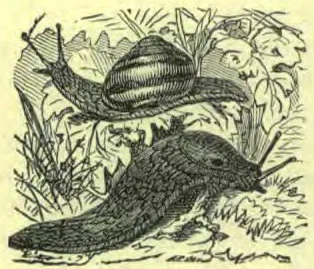
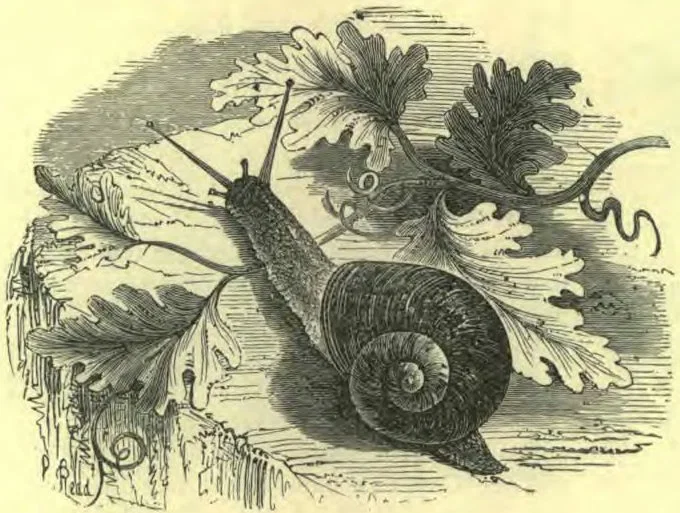
But we must pass on, and notice the air-breathers. We have not much difficulty in recognizing the land snail as being very like the periwinkle, only breathing air instead of water. The way this is done is very simple. If you will watch a snail when his head is out of his shell, you will see a little hole on the right side of the body near the edge of the shell. This opens and closes steadily, and through this hole the air passes in and out of a closed chamber, made by a fold of the mantle. The walls of this chamber are lined with a network of blood-vessels, through which the blood flows, taking oxygen this time from air instead of water.
By this simple arrangement the snail is no longer confined to the sea and rivers, but is able to live in the fields, the woods, and the gardens, feeding on the delicate, juicy plants and leaves, thus getting a share of the rich vegetation of the land. But the land snails have many dangers. They cannot breathe dry air; their bodies must be kept moist, especially the slugs, which have, comparatively, no shell. For this reason, and because birds and hedgehogs feed freely upon them, they are nocturnal in their habits, being found only in their hiding-places during the day.
The snail has sharp eyes set in the end of his tentacles, or “horns.” If you look close, you will see the eyes distinctly. Now in order to be able to retire safely into his shell, he must draw in these eyes and horns. If you watch a snail drawing in his horns, you will see that the eyes disappear down the tube, just as the tip of a glove-finger does when you draw it down from inside the glove. The horns are, in fact, hollow tubes, and a special muscle pulls them in from top downward.
The slugs have no shells except a small cap under the skin just behind the neck, which covers the lungs. The passage way to the lungs can be seen opening and closing on the right side of the body. The absence of a large shell enables the slug to go where a common snail cannot go. All snails develop from eggs. They also have heart and digestive organs.
We have only examined a few of the most common mollusks, but must leave the large sea-mollusks to the realms of natural history.