CALCUTTA

9%

S. D. A. Publishing Association · Battle Creek, Mich. · Dec 12, 1895

FromThe Youth’s Instructor, Vol. 43, No. 50.

Read the full edition

CALCUTTA

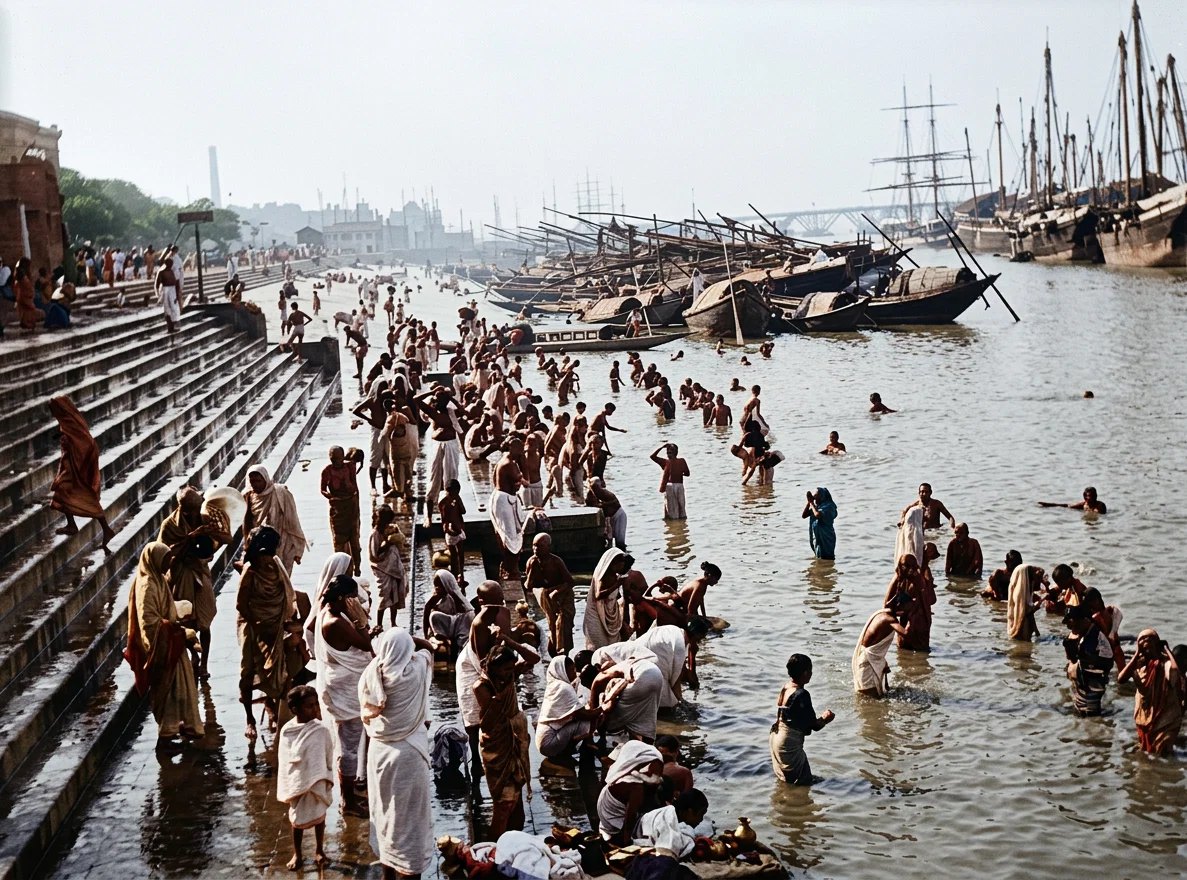
BATHING ON THE BANKS OF THE HUGLI.Restored with AI
BATHING ON THE BANKS OF THE HUGLI.
CALCUTTA, the capital of India, is situated on the east bank of the Hugli, about one hundred and twenty miles from the sea. It is supposed that it derived its name from Kali ghat, a temple of Kali, the chief goddess of India. This temple was built about three centuries ago, and is situated in the southern part of the city. The goddess is represented as having a black skin, and a hideous and terrible countenance dripping with blood, encircled with snakes, and hung round with a necklace of skulls. She is dancing upon the body of her husband, and in all respects resembles a fury more than a goddess.
The population of Calcutta is about one million, among whom are Chinese, Japanese, Persians, Cingalese, Burmese, Jews, and, in fact, representatives of every Eastern nation, as well as a larger number of Europeans than is found in any other city of India.
In the center of the city is a large open space of several hundred acres, covered with beautiful shade trees and green grass, and intersected by numerous well-kept roads, forming a very pleasant resort for walks and drives. Here one can always get fresh air, and of course it adds much to the healthfulness of the city.
In the European quarter the houses are built close together, yet they often have large trees growing in the enclosures, or compounds, as they are called. This is an agreeable rest to the eyes, under the glare of an Indian sun. The presence of trees and the absence of chimneys on the houses make the scene quite different from a city view at home. Another feature will at once strike the European eye, and that is the flat roofs, which form a very pleasant resort in the morning and evening. On account of the hot climate of India, all the houses have a great many windows and doors, and these are generally kept wide open, except during the day in the hot season and during the night in the cold season.
The native quarters, however, are very different; and with the exception of the houses of some of the wealthier classes, are miserable in the extreme, in many instances consisting of but one small room for a family of six or eight. This fact has given rise to the reproach that Calcutta, while a city of palaces in front, is one of pigsties in the rear.
Such dwellings are bearable in the cold season, when most of the time is spent out-of-doors; but during the rains, no words can describe their wretchedness. Then the cooking cannot be done out-of-doors, and as most of the houses have no chimneys, the smoke is allowed to escape as best it can, giving the passer-by who is unacquainted with the facts the impression that the houses are all on fire.
The streets of the native quarter are lined with shops about eight by ten feet in size, entirely open in front; so by walking along the street the passer-by can know just what each shopkeeper has. Passing along a street, one will see men sitting cross-legged on the ground in their shops, sewing upon the most elaborate garments, for all the dressmakers are men; in the next shop, perhaps, two women may be grinding at the mill, just as is described in the Bible; then just beyond these may be the shops of the gold-beaters, the engravers, the blacksmiths, the grocers, the sweetmeat venders, the tailors, and the like. The barber has a traveling outfit, and will accommodate his customers wherever he chances to meet them on the street. In the road is seen the ancient two-wheeled bullock cart drawn by the patient oxen with their huge wooden yoke. Taking the scene all together, it looks very primitive.
It is a very common sight in Calcutta to see the natives bathing in the water of the river to wash away their sins. They are not taught that it is a great sin to lie, steal, or cheat; but they would regard it as a sin to omit any of the usual acts of worship, or even to be touched by a Christian after they had bathed in the sacred water. It is the work of the missionary to tell of the Fountain which has been opened for sin and uncleanness, and that not by works of righteousness which we have done shall we be saved, but according to His mercy by the washing of regeneration and the renewing of the Holy Ghost.
GEORGIA A. BURRUS.