TILLIE TUTTLE was spending a few weeks with grandma on a pleasant New England farm. Tillie’s father had been born and brought up on that farm, and you can imagine how pleasant it was for Tillie to hear grandma tell the things papa used to do when he was little. Tillie thought she must go with Jane each day to feed the calves and the geese and the chickens, because that was what papa did once, you see. Of course the calves and geese and chickens were not the same ones he fed, but they grazed in the same meadow, or swam in the same pond, or laid eggs in the same dusty old barn.
Oh, it was such fun for Tillie!—quite a change from city life; but between you and me, she didn’t help much. Yet grandma never told her so. She would change Tillie’s apron when she came in with it dripping with milk from the calf-pail, or with its hem all wadded up into little bunches where the calves had sucked it; and she would wash the tiny hands all covered with wet corn-meal, listening all the while to Tillie’s chatter about how she had “helped just like papa,” with a twinkle in her eye, and a queer smile at the dirty clothes and hands. There were large washings stretched upon the line at the old Tuttle farm those days.
Then when it rained, what fun it was to go with grandma to the attic, and see the trundle-bed papa used to sleep in, and some very funny clothes he wore when he was a very little boy! Grandma had a little black box full of letters he wrote to her when he was in college, and Tillie loved to read them, spelling the words aloud for grandma to pronounce. Once she said, when she had finished a particularly jolly letter: “Papa and I have always felt real ’quainted, ’cause he’s known me all my life, you know; but I ’spose when I go back home, we’ll be ’intermer’ than ever, ’cause now I feel as if I’d known him all his life, too.”
Yes, Tillie’s visit was a delightful one; and if it had not been for one naughty thing that she did when grandma left her alone one day, there would have been nothing to mar her memory of that summer’s stay on the old farm.
Back of the farm-house, quite a bit, was the orchard. Some of the trees there were very old,—older than grandma herself,—so old that they had begun to die. Then grandma had a new orchard planted, that they might always have plenty of fruit. The new fruit-trees were of the best kind, and bore very large fruit. Some of them bore that summer for the first time, and grandma was anxious to test the quality of the fruit on each tree. Only one or two pears, or peaches, or apples hung on some of the smaller trees, so that grandma charged all the family not to touch them, but to let them hang till they were ripe, and then she would give them all a taste.
On the lowest limb of one particular pear-tree hung a very fine, large pear, the only one on the whole tree. Grandma set great store by that pear, and so did Tillie. Almost every day grandma went out to see how fast it grew; but Tillie went four or five times a day. I do not know what attracted Tillie so, unless it was that she knew she must not touch it. Anyway, she spent hours under that tree, just wishing that pear was hers. She could have had all the pears she wanted in the old orchard,—pears that in the city she would have thought the very nicest. “But this is so much nicer,” she would say to herself, “that I can’t like the others when I think of it. Why, it is almost as big as my head! I do wish it would hurry up, and get ripe.”
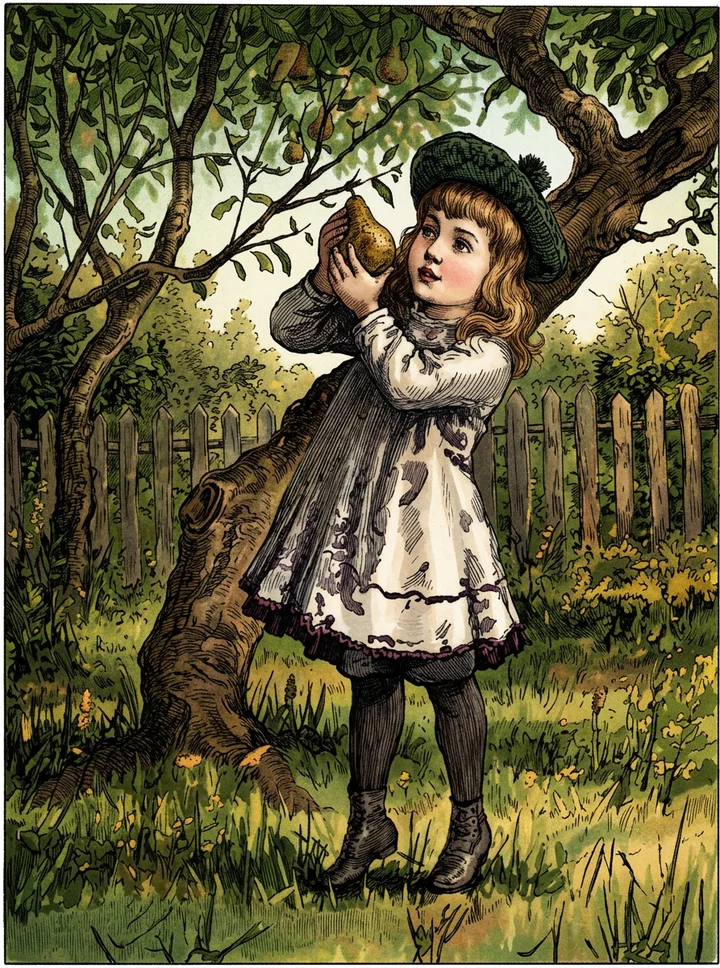
Grandma said one day, “This pear will be ripe to-morrow; then we will have a feast.” That afternoon she went to town, and Tillie went out in the orchard. How tempting that pear did look! Its great golden-brown side, with just a tint of red burnt in by the sun, looked as if it said, “Oh, I am so good, little girl!” Tillie thought she could resist it no longer. By standing on her “tippy-toes,” she could just reach the beauty, and almost before she knew it, she had bitten a piece out of it as it still dangled on the limb.
But the moment she tasted it, somehow it lost its expected flavor, and she spit it from her mouth, and crouched down on the grass, crying as if her heart would break. By and by she heard the wheels of grandma’s carriage as it came up the lane. Dashing the tears from her eyes, she made a brave resolve. Slowly she went to the house, where she found grandma busy getting supper. Tillie followed her back and forth, back and forth, from pantry to table, trying to get courage to speak, for grandma was so very busy that she didn’t notice her. Finally a little sob caught grandma’s ear. “Why, Tillie, child! what is the matter?”
“O grandma, I want to go home!”
“You blessed child! are you homesick? Come, get in grandma’s lap.”
“I’m not homesick, grandma,” moaned Tillie, as she crept into those loving arms, “but I ought to go home.”
“Ought to go home?” repeated grandma. “Why, we can’t spare you yet. Who will feed the calves and the geese and the chickens? You’re not tired of helping so quick, are you? Besides, we were going to pick the big pear to-morrow. I’ll tell you what, Tillie! We will pick it this very night, and have it for supper. So don’t cry any more.”
But at that Tillie’s tears only fell faster, and grandma couldn’t imagine what the trouble could be, till she managed to make out, between tears and sobs, that Tillie had “bit an awful large hole right in the big pear, and there it was yet hanging on the tree.”
Then grandma kissed Tillie, and told her that of course she had done very wrong, but that it was so much more honest to tell grandma about it than to wait until it was found out, or to tell a naughty story about it, that she didn’t think she would cry any more. They would go down and pick the pear, and as likely as not there would be enough for supper, after all.
And, sure enough! the piece Tillie had bitten out was only as big as her four front teeth; and as they were very, very small teeth, there was a great plenty for supper. Tillie said she had no idea that pear could taste so good, ’cause it didn’t taste as it did the first time, a bit, and that she never would do such a naughty thing again. And she never did.
MRS. S. ISADORE MINER.