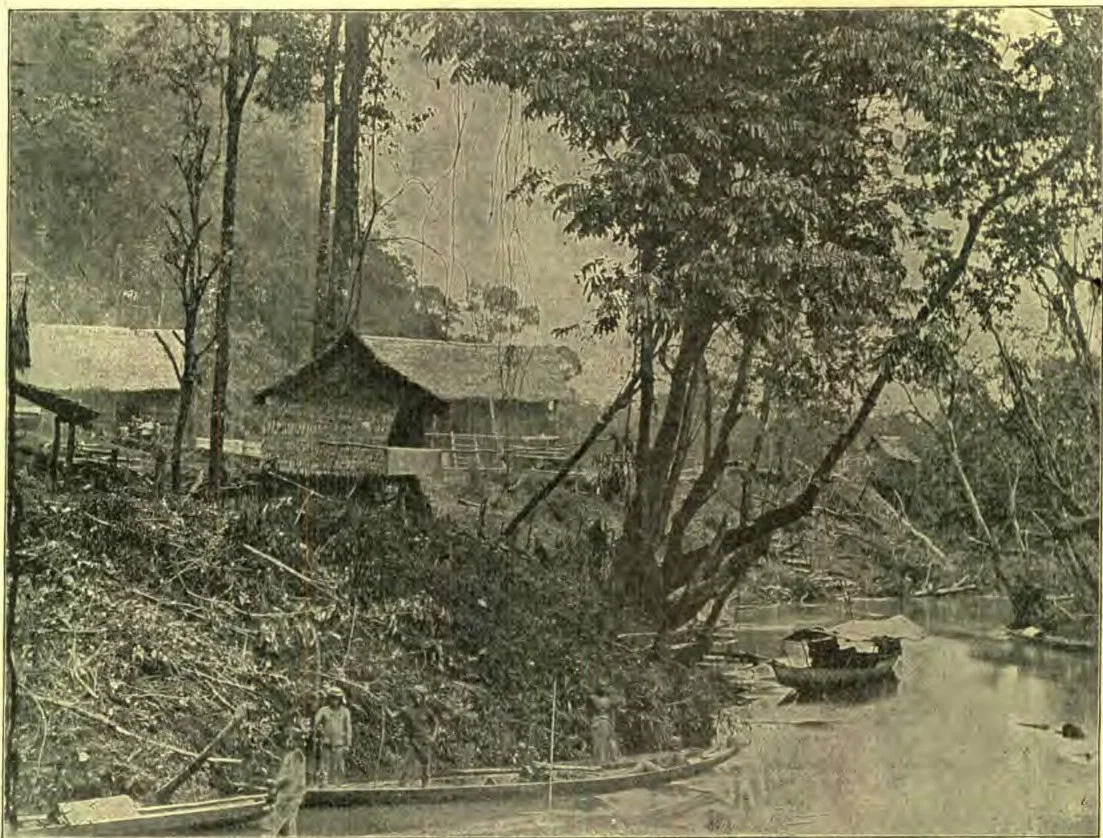
A Malay Village

11%

Review and Herald Publishing Company · Battle Creek, Mich. · Jul 6, 1899

FromThe Youth’s Instructor, Vol. 47, No. 27.

Read the full edition

A Malay Village.

In the Malay Archipelago there are several branches of the race inhabiting different sections, possessing local characteristics and distinct languages, but all belonging to the great family of Malay peoples. In the picture of a Malay village, in No. 8, Feb. 23, we have the typical Malay house.
MALAY “KAMPONG,” OR VILLAGE, IN THE JUNGLE.
This village is inhabited by Bugis (Boo'-gees), natives of Celebes. If you will turn to your geographies, and look at the map of the East Indies, you will see that Celebes lies to the east of the great island-continent of Borneo, and extends on each side of the equator. It is situated in the middle of the tropics, and its shores are bathed by the tepid waters of a shallow sea. It is rough and mountainous, and is inhabited by a warlike and daring race, who are renowned for their skill as seamen. This applies only to the navigation of the boats which they themselves construct; but with these they face heavy seas and strong winds, and weather gales that would easily swamp boats of equal size in Western waters. The Bugis are great traders, and ply between Celebes and the large European trading-ports of this region for purposes of traffic. They have also penetrated all regions of the archipelago. Some of their boats are constructed something after the fashion of a brigantine. The seafaring qualities of these are by no means insignificant, and they are capable of a high rate of speed. Other boats are designed for less extensive voyages, and still other smaller ones are used only for local navigation. Passenger-boats are supplied with awnings made of sword-grass, supported by slender poles. The speed with which these boats travel is indeed marvelous. They sit lightly upon the water, and are so constructed that a minimum amount of energy is expended in their propulsion.
The Malays are not only great sailors, but also great swimmers. Their fondness for the water accounts for their building their habitations so near it, as in this case. Malay children learn to swim at an early age, and any but a Malay mother would never permit her little ones out of her sight in such habitations as these; for they would be morally certain to be drowned in less than twenty-four hours. But with the Malays there is no occasion for anxiety; for when a child is old enough to walk, it very soon thereafter is old enough to swim. A disobedient boy, fleeing from paternal wrath, would not hesitate to plunge into the sea to escape a “tanning;” and Malay mothers have been known to kick their children into the water for no other purpose than to teach them good manners.
You will be interested to know something about the construction of these houses. The roofs are invariably made of palm-leaf thatch, while the walls are usually constructed of thin boards. In remote parts of the archipelago the natives use the same material for the sides that they use for the roof; or if their circumstances will permit, they make a wall of split bamboo, woven into a sort of basket-work, which is both strong and attractive in appearance. To American children the interior of these dwellings would appear very bare and ill-furnished; but the Malay boy, never having known anything different, is just as happy and contented as any of my readers, in their more pretentious homes. When he sleeps, his bed is the floor, with only a grass mat under him and the thinnest of blankets over him, and his pillow is made of cotton, tightly packed into a cover; or else, as is often the case with the poorer classes, it is made of slits of bamboo stretched across two boards, held apart by a round stick in the middle. When he rises in the morning, and is called to breakfast, he sits cross-legged on the floor, and eats his rice from a banana leaf with his fingers. Knives and forks and spoons—in fact, dishes of any character—are rarely used, except to hold the food, or for drinking purposes. The furniture of one of these houses could be made into a bundle and carried on a man's back. It is common for some of these Malay tribes, particularly in Borneo, to move the entire village, houses and all, to a more favorable location, where the soil is fertile, and game more abundant.
Perhaps you have read that the Malay native sits in his doorway, and fishes by throwing his line first into the water and then into the kitchen, with a member of the finny tribe attached; but this is largely fiction. The fellows who inhabit this village would fast long and well if they depended for their daily food upon the fish they might catch in the waters that surround their huts. They rise long before dawn, and in one of their smaller boats make their way six or eight miles out into the deep waters of the straits, where some of the finest fish that swim are daily caught for the market.
R. W. MUNSON.
(Conclusion in next number.)