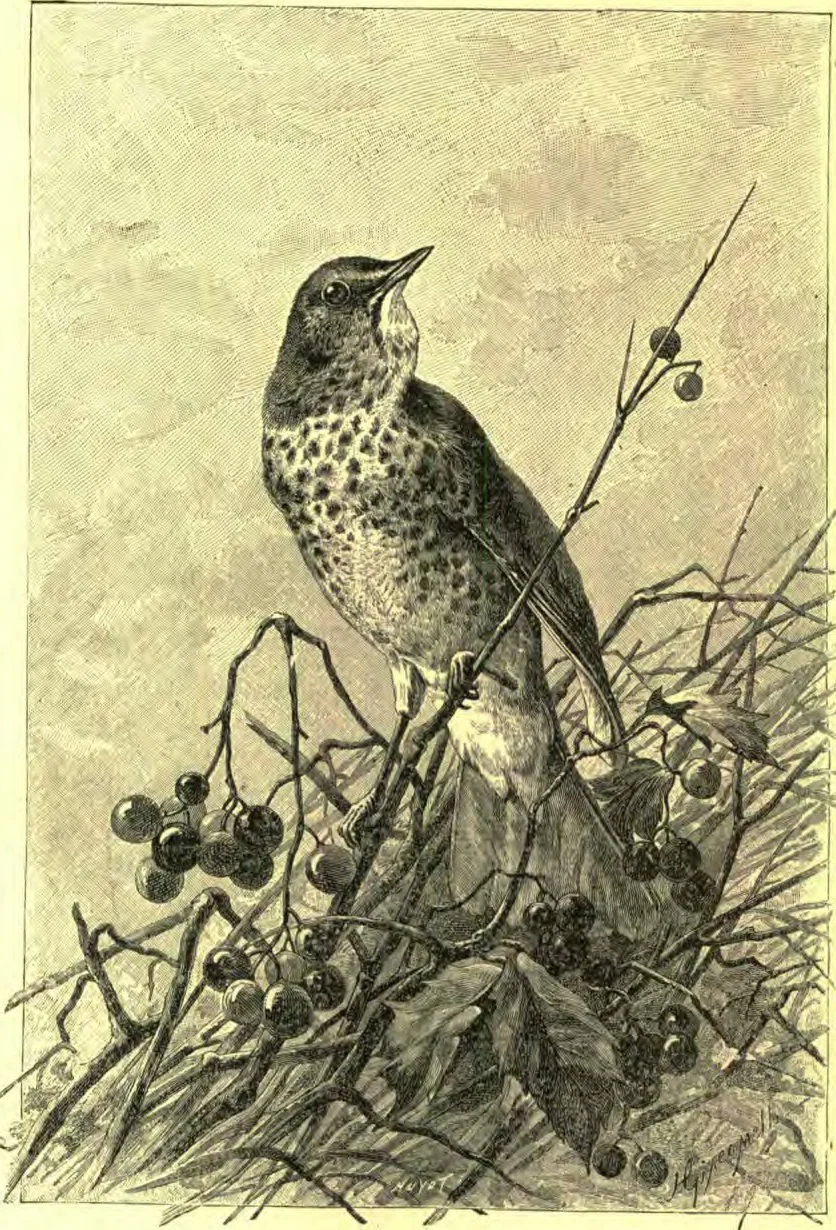
EARLY one morning in the middle of June I was an unwelcome but interested witness at the début of a family of young wood-thrushes. The nest was situated on the horizontal fork of an oak limb branching from the trunk some twenty feet from the ground, the fork being fully ten feet distant from the center of the tree. The nest was large, and well-shaded with oak leaves, only two points commanding a clear view of it. Two large heads and two pairs of yellow-rimmed eyes peered over its edge when first noticed. The male bird soon came and fed the owners of the eyes. He was followed shortly by the female, who, seeing me, thought it prudent to remain, and first perched on the edge of the nest, then covered her large babies completely with her body. Against this latter precaution they obviously rebelled, and presently two red-brown heads struggled up into a squeezed position between the rim of the nest and the creamy, spotted breast. She was clearly thwarting rising ambition; for soon she was obliged to rise to her feet and stand over the turbulent oppressed, while the nursery rearranged itself more comfortably, when she settled down to stay.
THE THRUSH.
The male next came and fed the youngsters; and as he touched the outer threshold, like an arrow from a bow the female was off and away. She doubtless thought he would care for, and keep intact, the contents of the home; but having ministered to its wants, he seemingly had business down-town, and soon disappeared. Instantaneously, on his departure, the eldest member of the brood arose, shook himself, and unhesitatingly plunged a short, wavering distance into the future, fluttering a few feet from the nest, where he stood motionless on a small limb, breathing hard, and staring about with wondering eyes.
The exit of No. 1 was plainly a relief to No. 2, who rose higher in the family circle; puffed out his feathers freely; stretched, with the stiff, weary expression of having spent several nights in a sleeping-car berth; and prodded his bill diligently into his feathered flesh, making a careful toilet, with the exception of his ruddy head. This he did not touch, and it continued to bear its feathers fiercely erect, in ludicrous contrast to the meek expression of his unaccustomed young eyes. It seemed as if this young thrushling could not get enough of stretching, and his evident comfort aroused heartfelt sympathy for what must have been his previous cramped condition. Now, in turn, a third head came to view beside his, and the nest, to all appearance, was as full as before.
Mother thrush was now returning, and I was curious to see how she would accept the changed state of affairs in the nursery. As she neared the oak, No. 1 fluttered a short distance farther away from the nest, and I lost sight of him; for, amazing to relate, No. 2’s young idea was ripe for flight; and, swifter than thought, he was away, straight, unswervingly, through the upper foliage full thirty yards before he settled slowly to the ground!
Instead of awaiting the scene of maternal consternation that surely ensued, I made the mistake of following the astonishing first flight of No. 2, and returning from a fruitless search, found that the mother had firmly and uncompromisingly set herself down upon the nest and the remaining two urchins, having made up her mind that they were not to be permitted the chance of following the mad example of their brothers. Interested to see what her success would be, and whether they were to be starved into submission, I went again, about five o’clock in the afternoon, only to find, in accordance with my expectations, an empty nest, an outgrown cradle. The point of rebellion had come to the whole brood, and they were scattered abroad in the forest, whose enchantments had long wooed their peeping eyes.
Small blame to the parent bird, however, considering the matter from a practical point of view, if she worked hard to keep her babies in the nest. With the empty mouths gathered within the shelter of the oak, her task was simplified; but with them dispersed throughout the wood, she has not only to hunt the dainties which tempt thrush appetites, but also to hunt the open mouths awaiting nourishment, and the latter are not at all sure to be found twice on the same twig when untried wings tempt flight. Whether it is particularly so with young thrushes, I do not know; but with most bird-babies it is long after they first try their wings before they feel it incumbent on themselves to provide their own food.—Selected.