THE FAROE ISLANDS

7%

S. D. A. Publishing Association · Battle Creek, Mich. · Feb 21, 1895

FromThe Youth’s Instructor, Vol. 43, No. 8.

Read the full edition

THE FAROE ISLANDS.

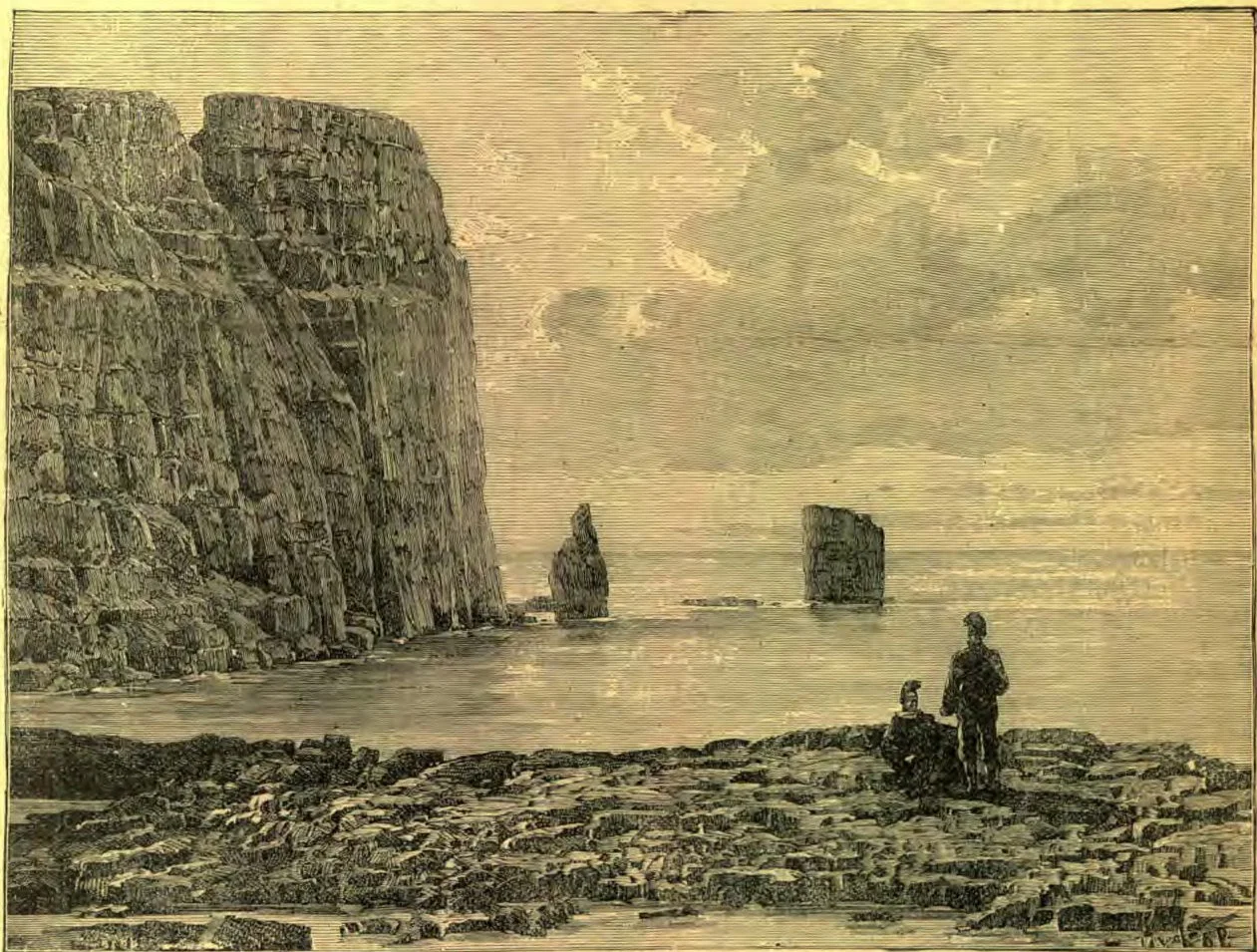
ROCKS OF TROLD-NYPEN.
In the Atlantic Ocean, about two hundred and seventy miles southeast of Iceland and one hundred and ninety miles northwest of Shetland, lies this group of some twenty-two rocky islands, about seventeen of which are inhabited, having in the aggregate a surface of five hundred and fourteen square miles, and, according to the census of 1890, twelve thousand nine hundred and fifty-four inhabitants, who are called Faroese. The uncommonly steep mountains of these islands range all the way from one thousand to two thousand eight hundred feet in height, Slatteretind on Osteröe being the culminating point. The largest isle of the group is Strömöe (six and one-half square miles, with nearly three thousand inhabitants), on which stands the Skalingefield, two thousand two hundred and sixty-seven feet high. Thornshavn is its leading city, and Westmanshavn, a good port for vessels. The islands of Österöe, Syderöe, Vaagöe, Sandöe, and Bordöe deserve special mention. The climate is moderate at all times of the year, taking into consideration that the group lies between sixty-one and sixty-two degrees north latitude; but the breezes from the sea are very damp. The winter is mild; snow remains seldom longer than eight days. The mean temperature for the summer months is about fifty degrees Fahrenheit. Storms are frequent. The soil is rocky, but in spots where a thicker layer of arable ground prevails, is very fertile. Storms hinder altogether the growth of trees, but there is no lack of coal, peat, and some driftwood. Cattle are of small stature, but the horses are exceedingly strong. Thousands of sea-fowl inhabit the cliffs, especially the so-called Vogelberg (Bird Mountain).
The language of the natives is a dialect of the old Norwegian tongue, but at court, in church and school, and in general print, the Danish is used. The chief pursuits are cattle-raising, fishing, and fowling, and the gathering of featherdown (eiderdown, from the feathers of the eiderduck). Their favorite amusement is chess-playing, and in every house one can find a chess-board. Since the laws of 1854 these islands have had their own Lagthing, or law-making body, consisting of eighteen chosen persons, at the head of whom are the Amtman (commandant or governor) and the Probst (rector of the church). In secular matters their last appeal is made to the mayor of Copenhagen, and in church affairs to the bishop of Zealand. Their only city and market is Thornshavn on Strömöe, with little over one thousand inhabitants, possessing a good port with a strand battery; also a school with two teachers, for a more liberal education.
These islands were peopled by the Norwegians in the ninth century, and in 1380 they came into possession of the Danish crown. So much as to their history. Now, what does nature offer here?
“To find a smiling aspect at the Faröe Islands,” said M. Ch. Edmond, a great traveler, “it would be necessary to be tossed ashore there by a tempest! But he who can, under such adverse circumstances, find attractions here, will agree with us when we say, They are there all the year around in all kinds of weather, and surely so, if one comes there from Iceland, for instance, that Ultima Thule of the northern world, leaving it clad in a mantle of snow and ice, whilst the little isles of Faröe seem to be entirely rid of their white sepulchral sheet, and once more attired in their spring vestments. Tourists who have hitherto written about these islands have with very few exceptions given them a character altogether more sad and gloomy than the reality warrants. Often, too, those who have painted such desolate pictures have tarried only a few days in the country, and not seldom at a time when heavy fogs extended over the coasts, intensified by the howling storm, or when the flourishing mountain-slopes were covered by white clouds.” M. H. Labonne, who visited Faröe in the month of June, records the temperature as very agreeable, being forty-five degrees Fahrenheit in the morning, and fifty-nine degrees Fahrenheit at noon; the rain lasted but a little while, and he found constantly that what he had read about the islands did not agree with the reality. He writes:
“Cultivated lands and pasture grass in broad bands of living green contrasted beautifully with the black basalt rocks that formed their borders.
“This lovely temperature is due to the slight elevation of the valleys and to the Gulf Stream, that bathes these islands, and envelops them with its hot vapors. Thus the climate here is the most even of any in Europe, the difference between winter and summer being only fifty-two degrees Fahrenheit. As little as in Iceland does one find trees in the open fields, the hurricanes uprooting them; but in well-protected gardens I have seen beautiful shrubbery with very dense foliage. As to Iceland, it is said, on the contrary, that there are no more than two or three trees on the whole island.
“In certain localities the hills are covered with a species of earth of remarkable fertility. Rye and barley, in years when they ripen, yield more than thirty-fold returns. Turnips and potatoes also do well. The Land of Ice, on the contrary, possesses no grain culture.”
It is said that in the ninth century Flocke, a Norwegian pirate, upon the discovery of these islands found large herds of sheep living in a wild state upon them, whence the name “Faröe,” from Faar (sheep), and öer (islands). Another interesting fact to notice, and that seems to-day well established, is that Christopher Columbus landed here in 1467, and that from this point he made Iceland, where the inhabitants told him of the existence of Vineland, meaning America.
M. Fred. Lacroix has seen a note written in the identical handwriting of the illustrious navigator, stating that after he sailed in the Mediterranean he cruised in the waters of the north. Christopher Columbus adds that he “came to Faeroer, whose inhabitants at the time sustained commercial relations with Iceland, about 1467.” Up to the fifteenth century the Scandinavian peoples were in communication with their American settlements at Greenland and Vineland.
Alexander von Humboldt asserts as an equally certain fact, that it was at Reykjavik where the celebrated Genoesan gleaned from the Icelandic legends that information which put it into his head to search a new commercial water-route to the East Indies. The Faröe group and Iceland, are, therefore, to follow the views of these and other reliable travelers, as it were the hinges upon which turned the gate that opened America to Europe.
From a geographical standpoint, at least, these islands represent certainly one of the parts or links of that consecutive chain which, with the Orkneys, Shetland, and Iceland, join the northern extremity of Scotland to the coasts of Greenland; the archipelago of Faröe which contains as stated before some twenty-two islands, large and small, rising in the midst of this large channel, and occupying at its full length one degree of latitude.
Traveling from place to place, one finds the landscape changing at every turn. Sometimes the steep banks will assume a gentle slope, and we discover, ensconced at the foot of the rocks, charming cabins, emerging here and there from their pretty green inclosures, which are almost always sown to barley, the only staple cereal raised on the island. Farther on, on the contrary, is a grand mass of block and bare rock, hollowed out by dashing cascades, and pierced by deep caverns, shooting upward from a single spur, as it were, above the waves to an altitude of nearly one thousand feet. The pen is unable to describe the effect produced by the spectacle equally grand and extraordinary, of these abrupt, rocky upshoots, which stand forth perpendicularly upon the bosom of the sea; we can therefore do no better than to refer the interested reader direct to the cut taken from a photograph, of Trold-Nypen (meaning “sorcerers’ turnips”).
From a religious point of view, we cannot but believe that in the providence of God some precious souls from these far-away islands will hear and receive the truth into honest hearts, and bring forth its fruits unto life eternal through Christ Jesus, our Lord; for “the isles shall wait for his law” (Isa. 42: 4), and surely these are some of them, and, as we believe, among the more promising. A. K.