WHEN we consider English history, and the fact that civil and ecclesiastical affairs of that nation have for ages been closely identified, and also the close relation that the people of Australia sustain to English history, it is not at all strange that there should be in the colonies a strong tendency toward a union of church and state. It would follow, as a matter of course, that there would be a demand for the introduction of religious matters into the Department of Public Instruction. It is true that the prevailing sentiment is in favor of the separation of religious considerations from public affairs; still, the effect of tradition lingers in the blood of many of the people of the land.
But it is vain to look for Christian education in secular institutions. There is a distinction to be observed between the terms “religious” and “Christian;” for while Christianity is always religious, religion is not always Christian. Christian instruction can emanate only from Christian sources. And it is necessary for those who have definite ideas as to what constitutes Christian education, and wish their children to enjoy the advantages of such education, to provide a school in which these religious ideas are the essential element.
Seventh-day Adventists are coming to recognize this fact, and this has led them to undertake the establishment of a denominational school in Australasia; and great efforts are being made by its promoters to have it in all respects just what such a school should be.
Having spent a few days at this school, I will, at the courteous invitation of the Editor, put some of the facts and my impressions on paper.
The initiative step toward this school was the temporary establishment, in 1892, of the Australian Bible School in Melbourne. As facts are the object of our account, we shall omit names quite largely, except where it seems necessary to mention them. But this should not be regarded as showing a lack of appreciation of the personal efforts of those who have labored unselfishly in the work.
It was felt that the city was not the place for the establishment of such a school. The counsel of Mrs. E. G. White, who during this time has been a resident of Australia, led to a diligent search for a suitable location, where lessons from nature could be drawn without stint or limit; where opportunities could be found for practical instruction in useful industries, both agricultural and mechanical; and where there would be a minimum of those influences that distract the minds of students from their work, and thus undermine the work of the teacher.
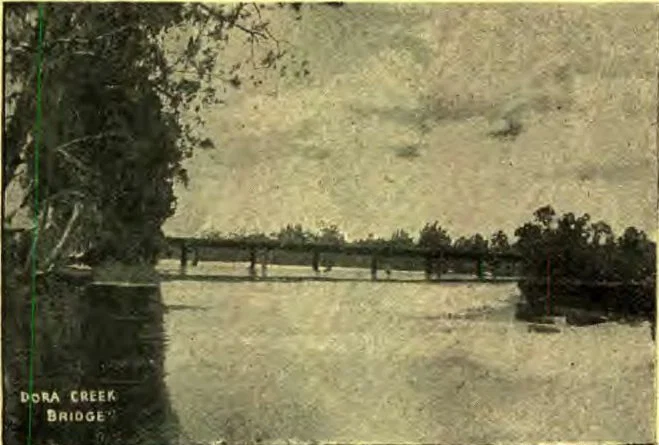
About seventy-five miles north of the beautiful city of Sydney, and twenty-five miles south of the coal-mining city of Newcastle, the railway line crosses an arm of the sea. This is called Dora Creek. It is not much of a creek, in the usual sense of the term, having but a small flow of fresh water during the greater part of the year. But practically it is a deep and beautiful waterway, capable of bearing small vessels, and is always placid and available for use. About three miles up this stream, or arm of the sea, toward the west, was found a large tract of land for sale. It consisted of over fifteen hundred acres in a wild state, covered with a dense growth of timber, and having a soil of varying quality. There was a portion of swamp; there were knolls, and dry ridges, and low valleys; and there was clayey soil and sandy soil, as well as rich mold.
After much deliberation, into which misgivings mingled with confidence, and doubts contested the ground with faith, this tract was purchased at a low price, and the work began in 1894. The school was opened in a vacant public house near the estate; and from this little fortress the students and workers sallied forth on the adjacent forest, armed with axes, grubbing-hoes, and saws. Their capital was faith in God, from whom they drew their strength and courage.p. 534
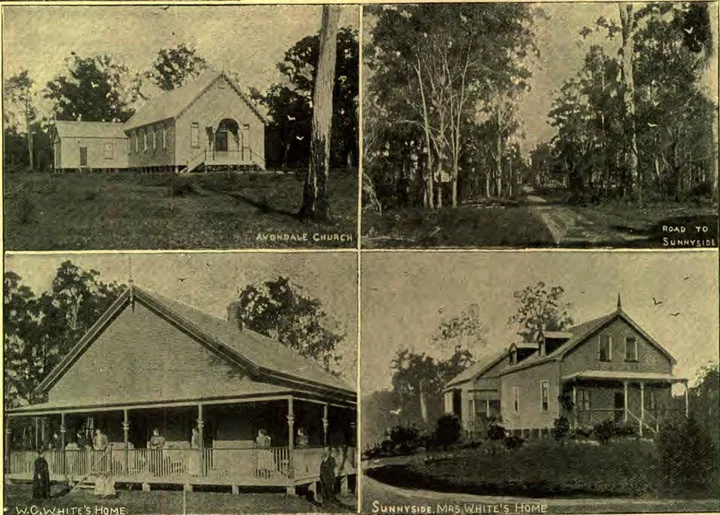
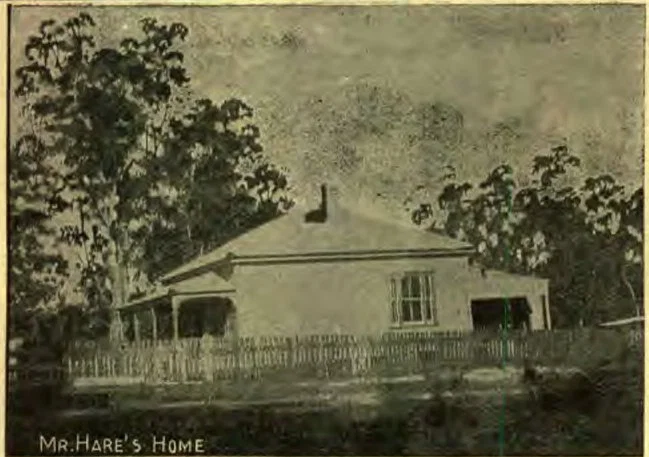
Mr. Metcalf Hare was the first to settle on the estate, and the first house was a cotton tent. This was in April, 1895. Three months later, Mrs. White opened a clearing half a mile north of the school site, and began the building of a dwelling. She immediately had an orchard planted, and advised those in charge of the school work to follow her example. While the matter of purchasing the estate was in doubt, an angel appeared to her in a dream, and confirmed the proposition to purchase, assuring her of the fruitfulness of the soil. It was her faith in this testimony, and her intense desire to see it verified, that prompted her vigorous work.
During that year one thousand of the best fruit-trees were set out; and in less than three years a good supply of peaches, plums, lemons, oranges, and nectarines was obtained, all the fruit being of the best quality. Vegetables and grains also do well. Thus in five successive seasons has the faithfulness of the heavenly witness been demonstrated, to the silencing of every voice of misgiving and distrust, even though supported by the wisdom of the world.
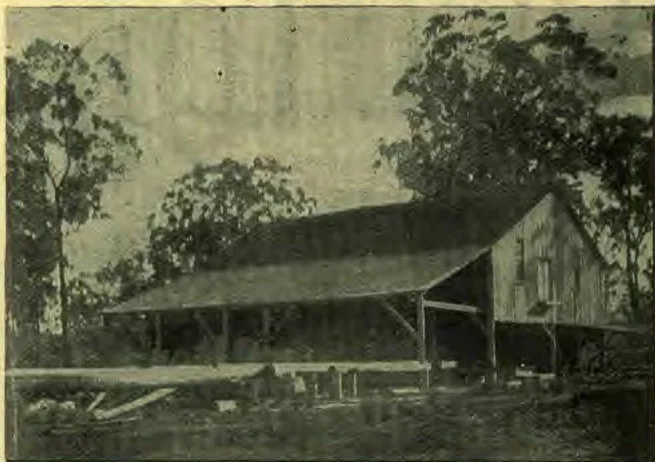
One of the first enterprises was the erection of a sawmill, in which the timber could be converted into building-material. The mill first cut its own cover, and then provided the lumber used in the construction of other buildings.
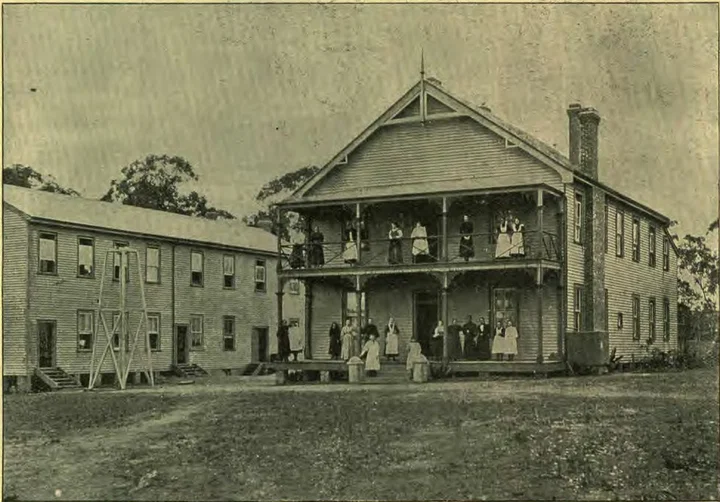
On Oct. 5, 1896, the first brick in the foundation of the first school building was laid by Mrs. E. G. White. This was the Ladies’ Hall, which is sixty-five by thirty-six feet, two stories high, and affords accommodation for thirty students. At the same time a dining-hall was erected, which is eighty by twenty-six feet, two stories high, and has a basement forty by twenty-six feet.
These two buildings were ready for use at the beginning of the first term, April 28, 1897, on which day the buildings were dedicated to their sacred mission.
During the vacation of ’97 and ’98 another building, the Boys’ Hall, was erected. This is considerably larger than either of the others. It is, like them, plastered and ceiled inside, and will accommodate fifty-six students. A bakery and laundry have also been built, and a cistern, which in all ordinary weather provides an ample supply of the best water.
The school now has seven horses, eleven cows, and six young cattle. The cows provide ample milk and cream for the school.
One year ago twelve swarms of bees were secured, and during the year they have made over six thousand pounds of strained honey, and have increased to about thirty-five swarms.
A good number of fowls provide eggs for the school. This is their only use, as the school family is strictly vegetarian, both in principle and in practise.
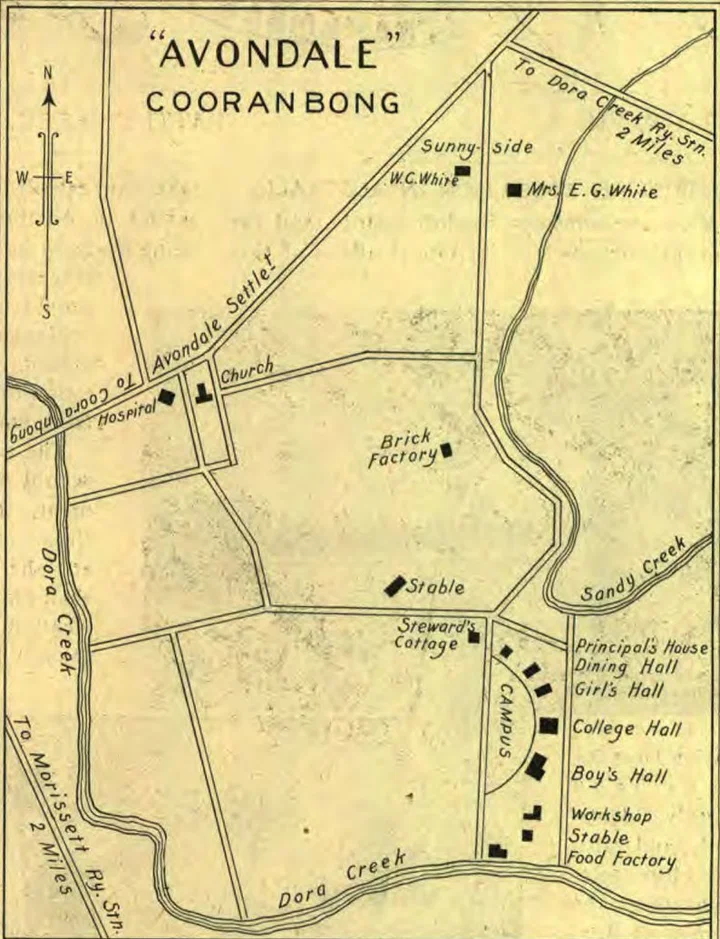
The school buildings are erected in a large crescent, in front of which is a broad campus. A short distance beyond the campus is the fertile swamp land, with a range of hills for a background. When facing the swamp, Sandy Creek is between one and two hundred yards distant squarely to the right. The road to Mrs. White’s home leads in that direction, close to the creek. In front, but a little to the right, is the home of Mr. M. Hare, and the road leading to the church is in the same direction. To the left is the mill and the Avondale boat-landing on Dora Creek, and to the rear of the buildings is the orchard. Mrs. White’s home and the church are both situated on Maitland Road, about three fourths of a mile distant. One thousand acres of the school land are beyond this road, and open for sale and settlement; and a number of our brethren have already established homes on the estate: but the greater part of the land on the school site “is, by the appointment of God, dedicated to the school farm.” G. C. TENNEY.