NATURE is God’s great library. In no other way can we study nature so well as by trying to reproduce her. To be able to picture nature correctly, we must first see her correctly, and then we must have a practical knowledge of perspective.
The text-book on perspective is usually a complex thing, though it is an admirable help to the student after he has gained, by practical work, a knowledge of its terms.
By drawing objects in perspective, we mean putting them on a flat plane. For example, this page is a flat plane; a wall or pane of glass is a flat plane. If we were to go to a third-story window, and with brush and ink outline upon the pane a few of the objects we see through it, we should be drawing them upon a vertical plane.
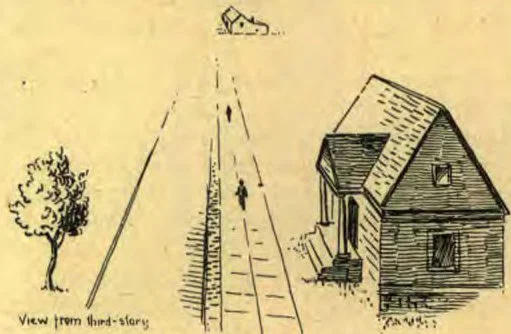
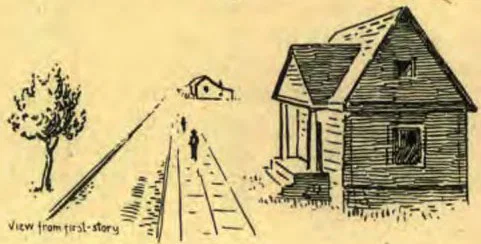
We should notice that a person half a mile away would seem to be floating in the air above the head of one nearer by. A barn in the distance would appear as small as one of our neighbor’s windows, and would appear to be floating over his roof. If you looked out of a first-story window, the distant man would appear smaller than the one near you, but would not seem to float over the latter. The distant barn would also be smaller than the neighbor’s house, though instead of being above the house, perhaps it would be on the same level. In either case your drawing, on a vertical plane, the distant objects that you saw through the window, would illustrate the meaning of the word “perspective,” which means “to see through;” per, “through;” and specio, “look,” or “see.”
Do not think that one should be able to draw before studying perspective; for the rules of perspective enter into everything one draws. With some thought and practise, a child can understand simple perspective well enough to draw correctly what he sees before him. This point we will endeavor to reach together.
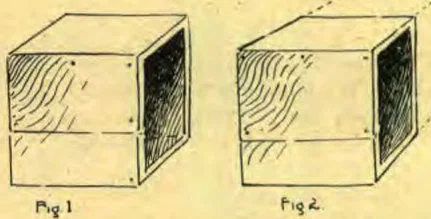
The chief thing to remember is that we must draw the object as we see it, rather than attempt to reproduce what we know it to be. Often one sees persons draw a cube or box with all sides parallel, as illustrated in Fig. 1. They know the sides of the box are all parallel, and they draw it as they know it to be, instead of as they see it.
If they observed closely, they would see that all the receding lines, if extended, would meet at one point, as in Fig. 2. This would be impossible to draw if all the receding lines were made parallel, as in Fig. 1. For example, we know that the steel rails of a track, as they go away from us, are parallel; that they are no closer to each other two miles away than they are right here at our feet. But if, when we draw them, we draw them parallel, we shall be drawing them as we know them to be; and our picture will not look in the least as those rails do when we stand and look down the track.
As they recede from us, the sides of the track appear to be nearer together until they seem to meet in the distance. PEDRO LEMOS.