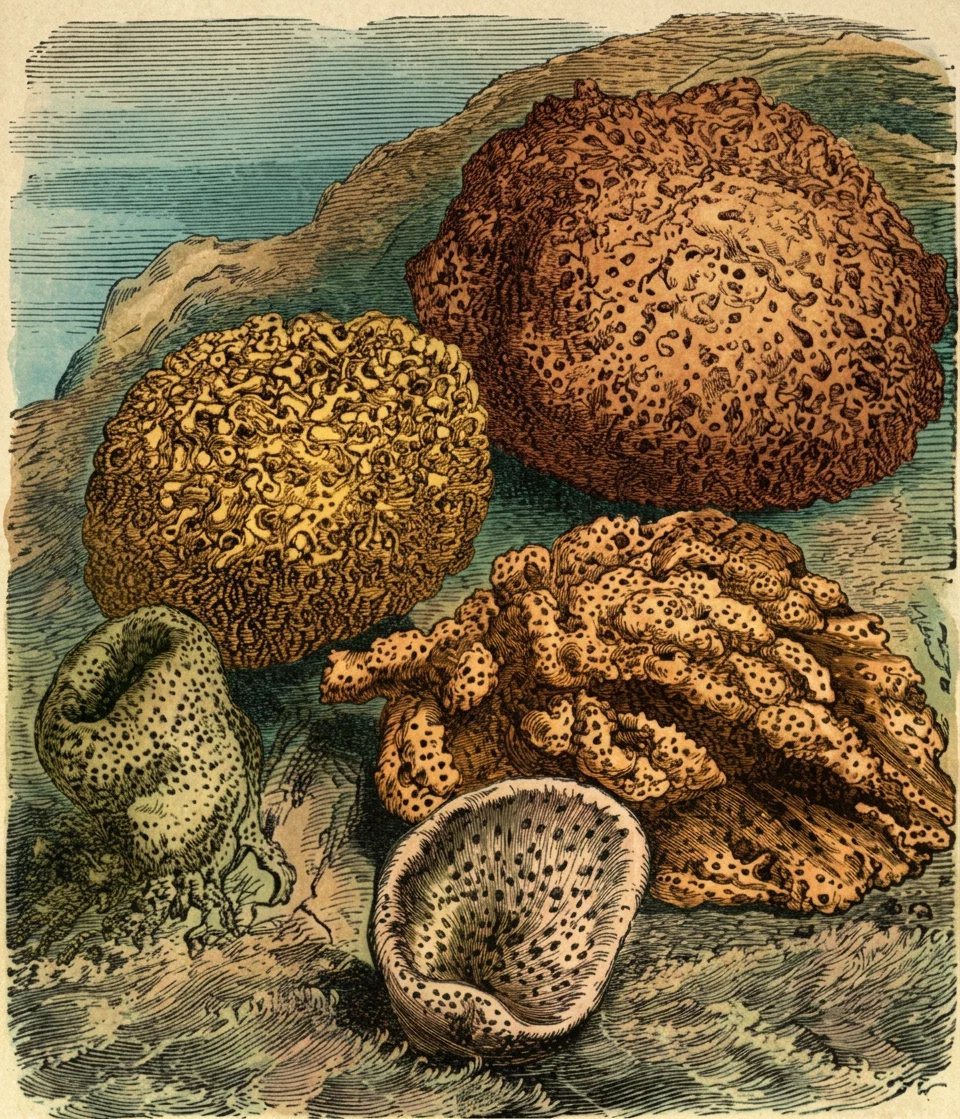
THERE are certainly very few persons who do not handle a sponge every day; yet probably not one in a hundred of these people has ever really looked at the sponge he is using, or considered what a curious and beautiful thing it is; and fewer still have ever traced its growth and birth, or read its history.
Sponges are all aquatic, and are found in the waters of every part of the globe, and in suitable locations may be exceedingly abundant. At the bottom of the warm seas, on the Mediterranean coast or in the Gulf of Mexico, they grow in great profusion, sometimes standing boldly on the top of a slab of rock, sometimes hiding in submarine caverns, or often hanging under ledges. Some are round like cups, some branched like trees, some thin and spread out like a fan; while there is scarcely a color from a brilliant orange to a dingy brown, which is not seen among them.
Restored with AI
SPONGES.
But we cannot all visit these vast sponge beds and see them growing, as they are from fifty to one hundred and fifty feet below the clear blue water, and can be seen only by the diver; yet there are at least two things in the ordinary bath sponge which ought at once to attract attention,—the large and the small holes in it, and the delicate silk fibers so skilfully woven together.
How has this web been woven so delicately? What architect has laid the fibers so skilfully, and formed such an intricate structure?—The architect is one of life's faithful workmen.
The sponge was formerly thought to be a plant; but the investigations of naturalists for the past fifteen or twenty years have shown it to be an animal of by no means the lowest type. We found in our study of the amoeba and Protozoa that they consisted of one cell only, and reproduced their kind by self-division; but the sponge animal, like our own bodies, is composed of a great number of cells united so as to form one large individual. It also develops from real eggs (ova) like higher animals. These minute eggs, in many ways, are very similar to a hen's egg. Through their transparent walls may be seen something which corresponds to the yolk of an egg, with a solid spot, or nucleus, in the center.
Soon after the separation of the egg from the mother sponge, the yolk begins to divide again and again until the egg is a globe of small round cells, surrounded by the thin, transparent wall, the beginning, or really the hatching, of the young sponge. The outside cells of this little animal at once put forth, each of them, a minute whip-like lash, so as to form a finger clear around the body. Then the young sponge is ready to make its own way in the world; and bursting through the thin bag which still surrounds it, the birth is complete. Waving its lashes, this little globe-like animal swims out an independent being, into the ocean of life.
By means of these lashes it both moves and feeds, using them as oars and prehensile organs.
As it grows, a small nipple, afterward to become a hole, appears at one end, while a group of larger cells appears at the other. By means of these cells the little animal attaches itself to the spot where it is to spend the rest of its days.
And now comes the curious part of the story. As the sponge grows larger, it is clear that the cells in the middle of the body are more and more shut out from the surrounding water, out of which food must be taken; yet these cells require feeding as much as the outside ones. In order to meet this want, the sponge animal, instead of growing up a solid mass, arranges the silky fibers in such a manner as to leave a number of canals through its body. By these it is possible for the sea water to reach all parts of the sponge. But the water must be kept in constant circulation, or no fresh food could be carried in, and the whole would become stagnant and bad. The animal constantly needs fresh oxygen and material to feed upon. How is this want met?—No sooner has the young sponge settled down, than it draws in all the whip-like lashes out of one side of its body, which we should think would be useful in driving in food, and becomes a smooth mass with these canals through it.
These lashes now occupy a more important position than when on the outside, for the whole life of the sponge now depends upon them. They are arranged in rows along the canals, and waving ceaselessly to and fro, they drive the water before them in one direction, so that it is drawn in at the small holes, and driven out at the large ones. By this wonderful contrivance fresh sea water, filled with oxygen, plants, and animals, is always pouring along the small canals, furnishing nourishment to the animal, while the refuse and waste matter are carried out through the large canals. In this way sponges grow, these canals or holes acting as mouth, lungs, stomach, and excretory organs.
So long as the animal is alive, few animals attack it, and fewer can conquer or destroy it. Only the sponge-fisher disturbs its peace by ruthlessly tearing it from its rocky bed, and crushing out its life for the sake of the skeleton. Then it becomes the useful article we could hardly dispense with; yet but few know its natural beauty, or the way it feeds.