THE JAPS OF TO-DAY.
Much obscurity still hangs over the origin of the Japanese people. Various writers have attempted to identify them with the Malays, Chinese, Tartars, and even the ten lost tribes of Israel. There can be no doubt that they are an entirely and utterly distinct race from the Chinese; their initial language and traditions conclusively declare this. With the Coreans they would seem to have more affinity, but even here the resemblance is not striking. But that they are related to all these nations through being members of the great Turanian family seems undoubted.
The Japs are a race of manikins. The hight of the average man is only about four feet eleven inches, and that of the woman considerably less. The Mongolian cast of countenance is prevalent. The Japanese face is oval, the cheek-bones prominent, the eyes dark, often oblique, and always narrow. The nose is flat, and the lips usually somewhat heavy. The hair is dark and generally straight, and the complexion in most cases sallow. The eyes often look as if the owner had been born blind, and two narrow slits had been afterwards cut to admit the light, an impression caused by their narrowness and by the disappearance of the eyebrows within the folds of the eyelid. The complexion extends to almost Caucasian fairness in some of the more beautiful ladies.
To commence at the youngest—we do not say the lowest—stages of Japanese life: The children are very attractive. They have happy, sparkling eyes; are quick, intelligent, and frank, with a politeness that is unequaled by even a Frenchman.
Nothing is more apparent among these people generally, than their air of good humor. Young and old, high and low, plain and good-looking alike, win the heart with their matchless courtesy and intense kindliness.
We cannot say that these young olive branches are brought up on flowery beds of ease. It seemed to us that whether the parents were poor or rich, the youngsters were slung on the back of a father, mother, elder sister, or brother. There they sleep, and there they laugh and cry, and it would seem to the eye of the casual observer that there they spend nine tenths of their younger days.
Their hair is generally shaven off around the base of the skull, and again from a patch about the size of two silver dollars on the crown, leaving nothing but a round circlet about three inches wide. They are devoid of head-gear of any kind, even in summer, when the rays of the sun are hottest. They remain slung in position on the back of the father while he hoes in the garden, or on that of the mother while she washes her dishes.
Among young men and women one fact is apparent,—there is a universal air of good humor. The cares of the world evidently press lightly upon them. They seem less alive than Europeans to the stern realities of life. None wear that intensely distracted look so common in a Western city. They form a smiling, contented throng, from the shaven-headed old grand-dame to the crowing baby. To look at them, man, woman, boy, and girl alike, one might suppose that there was no such thing as sorrow in the world. True, the clothing of some of the poorer sort seems thin and scant, but if one does not look too closely, the brilliant sunshine glosses and idealizes all that, not to speak of the sunny temperament which from within lights up even the plainest face. We would not contend that the Japanese never look miserable, for we have seen them the picture of despair. But the fact remains that among this people there is nothing that so strikes and wins the stranger as this aspect of geniality.
The young girls as a rule are very good looking. The complexion is pink and white, the eyes dark and sparkling, with an abundance of black tresses which they take great pains in dressing. We would not know so much about this toilet arrangement were it not for the fact that the place they generally chose to carry it on is the door-step in front of the house. Women of all ages and classes use the rich oil from the seeds of the camellia or tea-shrub to make beautiful their raven black but stiff hair, which often reaches down to their heels. Their coiffures are so artistic and tasteful that no European lady need be ashamed of them. A chignon forms the main feature, and is held together by one or more long needles of tortoise-shell, or a cheaper material, as well as by wooden combs, and is further ornamented by twisting into it strips of a peculiar red or blue crape-like fabric. They are always laughing, and even at the funeral of a parent, merriment does not seem to cease.
As for the matrons, what shall I say? They have lost all their maiden freshness, and their very features look as if they had been planted on their faces by a cyclone. It is their custom to blacken their teeth and cut off their eyebrows, to make themselves if possible more hideous than before.
In olden days the men wore their hair gathered up in a queue. But now the majority have adopted the European mode. Their dress and shoes as a rule are Japanese, although they wear European hats.
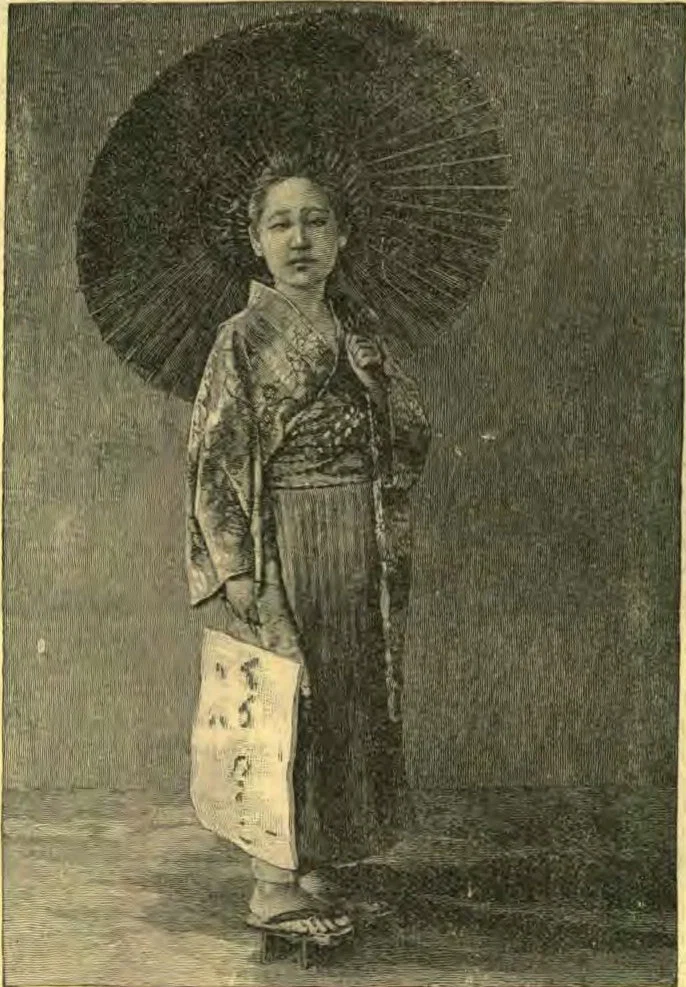
“Apparel oft proclaims the man,” wrote Shakespeare. This is a truth for the West, but we doubt whether it will hold good for all Eastern climes, where the robe of both sexes is the same. In Japan the universal garment is the kimono. It is a long dress, open in front, and fastened at the waist by a broader or narrower girdle called the obi. Her obi is the pride of a Japanese girl. Sometimes it is black, and then again of the most gaudy colors, tied behind in a huge butterfly bow, and hanging down in two long streamers. They are magnificent stiff fabrics, often a foot broad. Among the better class the kimono consists in summer of a light cotton fabric, and in winter of heavy silk stuff. The wide-flowing sleeves form under the elbows two hanging bags, which serve as pockets. In these every Jap carries among other things soft paper, which he uses as a substitute for a pocket handkerchief.
The foot covering of both sexes consists of blue or white cotton stockings called tabi. In these the big toe has a special compartment to itself, as in mittens, in order to pass between it and the other toes the strap by which the sandal is fastened on. The sandals are made of plaited rice straw. A cord is fastened in front, which comes up between the great and second toe, and then divides so that a strand goes across each side of the foot, fastening on either side, in front of the instep. In rainy weather they wear huge, clumsy wooden clogs. These have two uprights underneath, about three and a half inches high, and a quarter of an inch thick. The print left in the mud by these resembles that of a hen more than of a human being.
All this is very nice to look upon, and it is fashionable to praise Japan and admire the Japanese, but we would rather be clad as we are than robed in a thing like a pillow-slip and shod with juvenile stilts.
P. T. M.