The day was warm, but the “cave” must be built. Patiently Margaret and Arthur scanned the lawn for unoccupied chairs, the brother building and directing, while his small sister hastened to carry out his wishes, or looked on with interest as he explained that exit by the west entrance was “no fair.” Finally all the light wooden folding-chairs were used, and Arthur brought two heavy wire ones, half carrying, half dragging, them over the long reaches of grass to the shady spot chosen for the cave. Now it is complete—all but one more chair, to make a sort of outer gate to the spot! A double chair some distance away is just the thing; and his small strength failing to move it, Margaret hastens to help. “Are n’t we strong enough?” they call, gaily, to an interested watcher, as they pull the seat along.
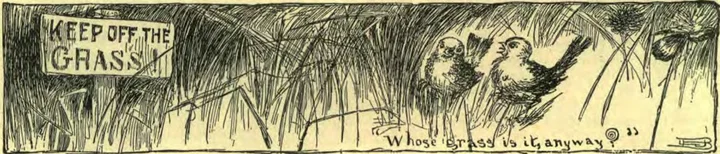
Just here an Officious Person, who had no appreciation for caves, or the patient effort put to the building of this one, passed by, and seeing the cave-chairs, hastened to help herself to one of them, though there were plenty of other seats. The north wall was thereby partly torn down; but the little laddie called out, politely, “You’re welcome to the chair,” and proceeded at once to shift the double seat to that position. “You must n’t drag the chairs around! You are spoiling the grass!” said the Officious Person (it wasn’t her grass), rising from the part of the north wall that she had just appropriated, and coming toward the children. “Here!” she added, righting the chair, and sitting down in it, “I’ll fix it so you can’t drag it along!”
Surely now the children would lose their temper! Not at all. For a moment a look of dismay passed over their eager faces; then, with unruffled sweetness, they said, “All right, we’ll take this one, then,” and replacing the chair she had first taken, went on with their play.
Dear little child-leaders! Your unconscious example brings help to a tempted soul,—one whose “rights” are being imposed on, and who feels his whole nature rise up to vindicate them. Now he asks if, after all, the way of patience and “giving up” is not also the wiser way in a world where there is so much bitterness, and decides in that moment to follow it. How much happier would we be if each one of us would give up our preferences—our “rights,” even—as graciously as did these little gentle-children!