You have all been interested in the stirring accounts you have read of life in Europe during the middle ages, when fighting was the business of life, and feudal chieftains dwelt in their strong castles, surrounded by their faithful vassals, who were always ready to sally forth to war at their lord’s commands. Now feudalism came into existence in Japan about the time that it did in Europe; but it continued to flourish there for long centuries after Europe had thrown off the yoke.
Until about the middle ages the mikado was the sole and undisputed ruler of Japan. His court was held at Kyoto, whence he issued his orders to the nation. The civil offices were controlled by the Fujiwara family, who were relatives of the mikado. The leaders of this family always took the field in person in case of an insurrection or disturbance in the empire. By and by this great family so degenerated through idleness and indulgence that they refused to share the dangers and inconveniences of war and camp life, and relegated these duties to certain other nobles, while they remained in ease at home. As luxury and sloth increased at the capital, it became exceedingly difficult to keep the empire in subjection; for the government was fast losing its power to enforce order. Many of the more intelligent farmers, on becoming soldiers, had on account of valor been sent to the court at Kyoto. Here they were not slow in learning, among other things, that nearly every one there was striving for rank and his own aggrandizement. Hence when they returned home, they put into practise the knowledge acquired at court. They schemed for power in their native districts, and if successful, which was often the case, they paid no further attention to the orders of their superiors at Kyoto, and the civil governors were afraid to enforce obedience, as these men had an armed following at their back.
Thus a class of warriors sprang up who were always ready to follow a leader and fight for pay. The country was in a continual state of strife and confusion. The government at Kyoto lost the power of enforcing authority in distant provinces, and when it became necessary to quell a rebellion, usually sent a general from either the Taira or the Minamoto family. These families had become powerful and influential, but they were deadly enemies to each other. Thus while outside power increased, the mikado’s power decreased, until he became a ruler in name only.
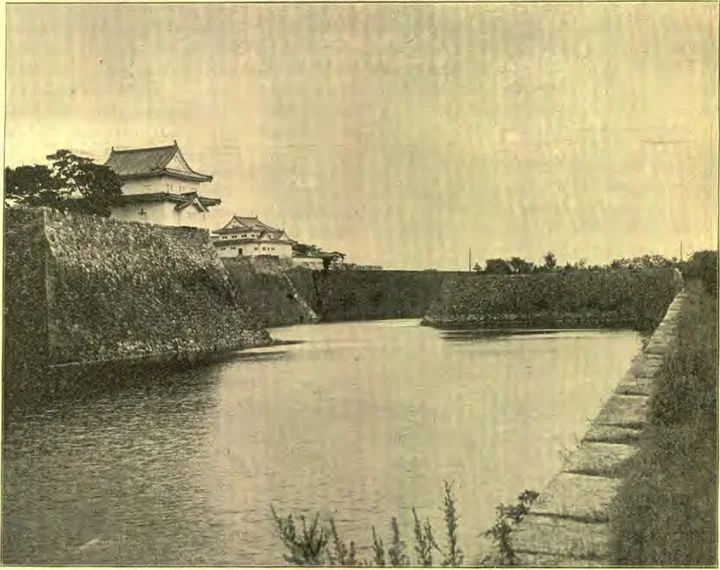
The power of the sword was lost at Kyoto about the twelfth century. Fighting and free-booting were the order of the day. The empire was split into fragments, and the man who had the bravery to seize more land than his fellows, usually found no lack of armed adherents to help him to keep it. A warrior who succeeded in gaining possession of large tracts of land, and who had many retainers, was called a daimio (literally, “great name”).
As the authority of the court declined, even the agricultural classes put themselves under the protection of some daimio, and the taxes, instead of going into the treasuries of the central government, went to enrich the local rulers and their followers.
The daimios dwelt in state in their castles, which usually stood upon elevations or commanding eminences looking down upon the rest of the town. They were well fortified for purposes of defense in case of attacks by the enemy. They were usually surrounded by moats of considerable width. Many of their castles have been destroyed, but some remain as monuments to tell of troublous feudal times.
At the end of the twelfth century, Yoritomo, a member of the Minamoto family, after a long and desperate conflict, succeeded in completely overthrowing the Taira, and getting possession of the reins of government. The mikado was the ostensible ruler only. Yoritomo, with the emperor’s consent, took the title of shogun, or general, and became the chief daimio of the empire. He was virtually the head of the realm. Under him were the lesser daimios, and their military retainers, who were called “samurai.” The merchants were supposed to have no right to oppose or remonstrate with the samurai, hence they were much oppressed.
Below the merchants were the farmers and other laboring people. A still lower class were the etas, who were skinners, tanners, and gravediggers. They were not allowed to enter a house or sit at the same table with other persons. Their condition was miserable in the extreme.
The office of shogun, with all that pertained thereto, as well as the daimiates, became hereditary. Each succeeding shogun was invested by the mikado with the title of “Sei-i-tai shogun”; literally, “Barbarian-subjugating generalissimo.” The mikado himself lived in great seclusion at Kyoto, and was completely overawed by the usurper. About the opening of the seventeenth century, Ieyasu, a shogun of great power and ambition, established a capital of his own at Yeddo, now Tokyo, and under his rule Japan became more united and prosperous than it had been for ages.
During the latter part of his reign and the reign of his descendants, there were long seasons of peace, during which the samurai and other ambitious men applied themselves to study and research. As the result of their historical investigations, they learned what had been forgotten during the lapse of ages; namely, that the mikado was really the rightful ruler of Japan, and that the shogun was a usurper. They chafed at the exactions of their masterp. 330 at Yeddo, who was after all only one of their own class, and many of them began to brood over plans for getting rid of him. Feudalism was always very obnoxious to the peasant and merchant classes, and the samurai felt sure of the support of these classes if there should be a struggle.
In the meantime, in 1858, treaties were made by the shogun, in the name of the mikado, with foreign powers, which greatly enraged the masses of the people. He was declared a usurper; and after a brief struggle and some fighting, the mikado was reinstated. Embassies were then sent abroad to study the governments in foreign lands. Competent and progressive men were put into office, and they saw that the government could never be consolidated as long as feudalism continued to exist. So in 1871 a decree went forth from the mikado ordering the daimios to relinquish their fiefs and retire to private life. With few exceptions the order was obeyed, and those who rebelled were soon subjugated.
Since then Japan has wonderfully progressed in material civilization. There are now nearly three thousand miles of railway, and more than three hundred steamships along the coast and running to China and Siberia. The postal and telegraphic systems are better than in the United States. They have telephones, electric lights, and, in fact, have adopted all the inventions of the age. Their intellectual progress has kept pace with their material progress. The school system is modeled after that in this country.
The Lord has wonderfully prepared the way for the rapid spread of the gospel in that empire. Shall we have a share in the work?
MRS. J. A. BRUNSON.