Early one morning late in December, 1887, I lay in my bunk, aboard the “Rajputana,” as she moved along the shore of the lower Malay Peninsula. I heard the ringing of the “four bells,” which ended what the sailors call the “dog-watch.” For an hour or more I had been dozing, my slumbers disturbed by the grating of the holystone and the swish of water on the deck overhead when a knock at my cabin door aroused me fully to consciousness. The steward brought me my chota-hazri (little breakfast), as it is called in Hindustani, consisting of a cup of tea, and some dry, buttered toast. The captain had notified the passengers at the supper-table that we would enter port soon after daylight; and as this is an interesting experience to most travelers, I was soon dressed in a clean white suit, and covered with a solatopi, or sun-hat, stood on the deck, inhaling the bracing air, which blew softly across the straits from the direction of Sumatra, whose shores were fifty or sixty miles below the western horizon. The slanting rays of the early sun were reflected from the pale-green waters of the straits, and gave a mellow tinge to the summits of the mountains that lay far inland, receding in the dim haze that always overhangs them. The lascars were scurrying about the deck, getting the ship in readiness for the landing at the wharf, which was more than twelve miles ahead of us, and entirely lost to view behind the little islands that flank the harbor.
There is no more charming scene or delightful experience than early morning on board an oceanp. 262 steamer as she enters a harbor in the tropics. There is a rhythm about the many confusing sounds that rise from the labors of the sailors, the hum of the deck passengers, and the clear, sharp tones of the captain as he issues his commands from the bridge. An interest and excitement attend all these preparations, which keep the saloon passengers on the qui vive; nobody can snooze with any comfort while listening to these sounds, which give warning of the arrival of the vessel in port, particularly if that port is the haven for which one has been sailing.
As I stood watching the lascars pulling ropes, furling awnings, and making their preparations for the disembarking of the passengers and the unloading of the cargo, my attention was arrested by the approach of a steam-launch alongside the ship; and soon the pilot, who was to bring us into the harbor, was aboard the ship and on the bridge. Half an hour later another launch brought the health officer alongside.
In the distance several Malay boats were scurrying across the horizon. The green, superabundant vegetation, in all its tropical luxuriance, was outlined more and more clearly upon the islands that began to shut us in. The narrow entrance to the harbor was now discernible, and frowning from the elevated crest of the bluffs on either hand could be dimly seen the muzzles of threatening cannon. Presently we found ourselves in the harbor, and approaching the wharf, which extends for more than a mile along the shore.
A dozen or more canoes, filled with well-nigh naked boys, who, in very bad English, begged the privilege of diving for coin, thronged the ship. As this was the first exhibition of the kind some of the passengers had ever seen, there were plenty of coppers forthcoming; and as the coins disappeared beneath the surface of the water, there followed them a perfect cascade of graceful, brown-skinned lads of varying ages, whose movements could be seen beneath the water as they struggled to secure the coveted treasure. Wonderful indeed was the agility which they displayed, and frequent were the exclamations of astonishment which escaped the passengers.
In another half-hour we had drawn alongside the wharf, and the shore-lines were attached.
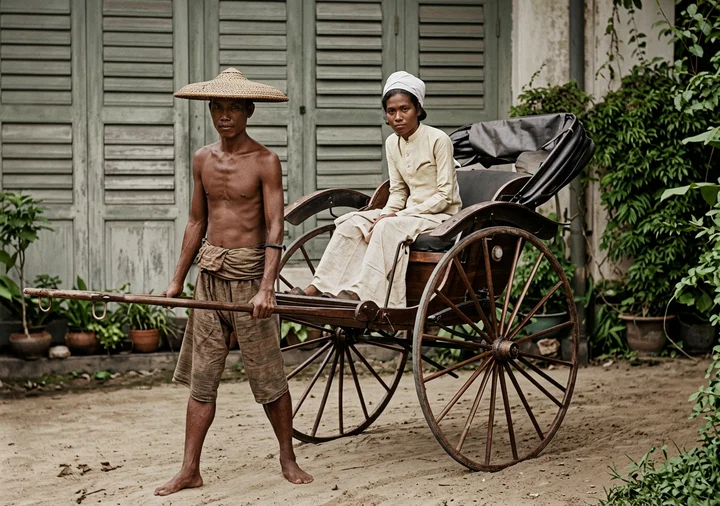
I made all possible haste to arrange for the delivery of my luggage; declining the importunate offers of the native ghari-wallas, I chose to ride in the world-famed jinrikisha. As I walked out of the steamship company’s grounds, I saw a garrulous crowd of half-naked Chinamen, upon their heads large bamboo hats, with sharp-pointed crowns, who were clamoring for my patronage. They hedged me in on every side, and outrivaled the most offensive hackman that ever worried a sightseer at Niagara. I selected the neatest and tidiest vehicle, and at the same time the most robust runner I could find.
At this point I will give a brief history and description of the jinrikisha. As the Japanese name indicates, the jinrikisha is a “man-power carriage.” It is interesting to know that an American missionary at Hong-Kong was the inventor of this now popular mode of travel. Hong-Kong is built on the side of a mountain that forms a little island, which bears that name, and lies off the entrance to the river that leads up to Canton. The streets of Hong-Kong, which run parallel with the seashore, rise in terraces, while those which retreat inland are so steep that no horse and carriage could possibly ascend them.
For these reasons, travel was at that time, and to a great extent, is still, mostly accomplished by means of the sedan-chair, for which at least two men are required. The missionary, whose purse was scant, but whose native genius for invention came to his relief, determined to cut his expenses in two, and this he did by making a very light road-cart of diminutive dimensions. The jinrikisha is now in use in all the Japanese and Chinese coast cities, down as far, indeed, as Singapore and Colombo, Ceylon; and tens of thousands of them are in constant use, to the great comfort of the traveler and the advantage of the poor coolie. Its form is graceful, having a comfortably cushioned seat, and a hood, like an ordinary buggy, constructed of bamboo frames covered with oilcloth; the seat is upholstered, and mud-guards cover the wheels. The only peculiarity which strikes the newcomer is the absence of a dashboard.
The coolie placed the shafts upon the ground, and I stepped in, and seated myself upon the forward-slanting seat. With much alacrity, the “puller” stepped within the shafts, which are united in front, and suddenly lifting them, gave me a terrible scare; for I thought I was going to get out of the back of the carriage much more quickly than I had entered the front; but a moment later I found myself resting comfortably in a seat which, for comfort and ease, resembled a cozy rocking-chair. I was surprised at the pace of the coolie, and my surprise increased to wonder as he passed carriages and other vehicles, notp. 263 slackening his pace until the four miles which lay between the wharf and the business quarter of the city had been covered. After reaching the mission house, which nestled snugly at the foot of a hill from whose summit British cannon commanded the harbor, I alighted, and consulting my watch, found that in less than half an hour we had covered the distance mentioned.
As I was about to pay him, the missionaries recognizing me, emerged from the bungalow, and cautioned me about the amount I ought to pay. I had been meditating as we sped along the smooth road, and had concluded that if I had to change places with the coolie, a dollar would be the least that I would think of accepting for such a service; but the missionary, knowing there were eight or ten thousand other coolies ready to perform a similar service for one fifth that sum, assured me that twenty cents was ample compensation. I therefore gave him that amount, though not without some self-reproach; and when the Chinaman, who was streaming with perspiration, begged for some additional coppers, I could not forbear adding another dime, which amounted, all told, to fifteen cents in American gold. Dollars and cents are the standard of currency in this colony; but it is the Simon-pure silver dollar, and is worth only fifty cents in exchange for American currency.
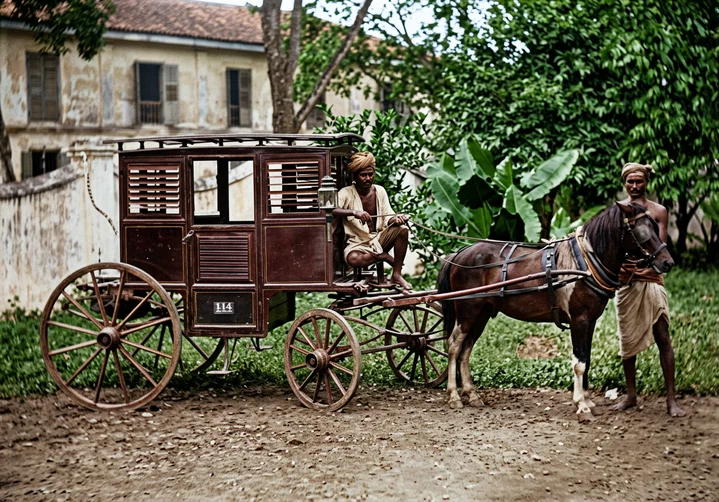
These Chinese coolies consider themselves extremely fortunate to obtain a jinrikisha; for notwithstanding the excessive competition, they are able to earn from ten to fifteen dollars a month, which is at least five times what their labor would command in China. Many of these poor fellows are the unhappy victims of the opium habit, from which source the colonial government derives an annual revenue of several million dollars. As a result, thousands of Chinese have fallen victims to the direful practice of opium-smoking. By way of illustration, I will narrate an experience that befell me several years later:—
In Singapore our house was on the crest of a hill, the road from which ran straight down one side, and at the bottom made a sudden turn to the right into one of the public streets. It had been raining, and the road was slippery; my little boy and myself were on our way to church one Sunday morning. The coolie was an opium-smoker, and allowed the jinrikisha to gain too much headway, and on reaching the bottom of the hill, found that he was unable successfully to make the turn; and as he could not stop, he was forced across the street at a sharp pace, and the shafts of his jinrikisha struck the brick wall that enclosed the grounds of the Japanese consulate. The shafts were splintered up to the body of the vehicle, and we were thrown out with considerable force, and would have received serious injury had not our progress been impeded by the body of the coolie. He, unfortunately, suffered the heaviest loss; for besides bodily injury, he had to make good the cost of the repairs on the jinrikisha.
In Japan the authorities require a rigid test of every man who applies for a license as a jinrikisha-puller. The officers require the candidate to draw a jinrikisha with a passenger around a track provided for the purpose at a rapid pace for a half-hour, at the close of which he must be in as good wind as if he had been walking. Thus it will be seen that it is no easy task to be a “human horse” in the cities of the far East. In Singapore the jinrikisha made the street-car business unprofitable, and was the cause of their abandoning the field, being unable to compete with these spry little go-carts.p. 264
When the missionaries first came to Singapore, it was considered a well-nigh disgraceful thing for a European to be seen riding in a jinrikisha, but to-day everybody uses them; and private vehicles of elegant pattern and costly finish may be seen, in the early morning or evening, proceeding to and from the European residence quarter, drawn by liveried Chinamen.
Sometimes very laughable occurrences take place in connection with the passenger traffic in which the jinrikishas are engaged. One day as I was going down-town, I noticed, at a crossing of two of the principal streets, two portly Chinamen in a jinrikisha drawn by an under-sized coolie. The coolie was either weary or was weak from the opium habit, and with difficulty maintained an equilibrium of the carriage and passengers; suddenly he lost control of it, and was lifted off his feet by the weight of the two passengers who were sinking backward. An instant later they were dumped in a heap in the middle of the road, and the coolie was thrown on top of them. For a few minutes there was a wriggling, squirming mass of legs, arms, and cues, which suggested a one-horse railroad accident. Traffic was temporarily suspended, while everybody stopped to laugh heartily, and the merriment was punctuated with exclamations that formed a part of the altercation between the passengers and the puller. They soon saw that others were laughing at them; and grinning good-naturedly, they moved on, clearing the street for the traffic that surges along it. R. W. MUNSON.