THE DAILY SERVICE OF THE TABERNACLE.
In the patriarchal age the husband and father was the priest of his own household. He erected his altar, and brought offerings for himself and his family, and prayer and praise ascended to God every morning and evening. This form of service and worship was customary with God’s true people until the erection of the tabernacle in the wilderness in the days of Moses. Then the Lord chose the tribe of Levi as his own, in place of all the firstborn of the children of Israel for the work of the sanctuary. The priesthood, however, was restricted to the family of Aaron. Aaron and his sons alone were permitted to minister before the Lord; the rest of the tribe were intrusted with the charge of the tabernacle and its furniture, and they were to attend upon the priests in their ministration, but they were not to sacrifice, to burn incense, or to see the holy things till they were covered. In Ex. 2:1–10 and 4:14 we learn that Moses and Aaron were of the house of Levi, and hence their descendants were Levites. Aaron and Moses were chosen as priests to minister in the sanctuary. Ex. 28:1.
In Exodus 28 we have a description of the garments prepared for the priests, and in the next chapter we have an account of the services connected with their consecration. These should be carefully studied.
When the tabernacle was finished and erected, it was anointed with oil preparatory to the priestly service which had been appointed. (See Ex. 30:22–33; 39:32–43; 40:1–17.) This service was carried forward from day to day by the priests throughout the year. One year was allotted to this ministration, and it always closed on the tenth day of the seventh month, with a special service. The ministration up to that time was performed in the court and in the first apartment of the sanctuary.
A lamb of a year old was burned upon the altar of burnt offering each morning and evening (Num. 28:3, 4), and on the Sabbath two lambs of the first year (verse 9), so that on the Sabbath days the burnt offerings were double what they were on other days. All the animals brought for sacrifice were carefully examined by the priests; for God had given explicit instructions that every offering should be “without blemish” (Lev. 22:18–22), that they might typify Christ, the “Lamb without blemish and without spot.” 1 Peter 1:19.
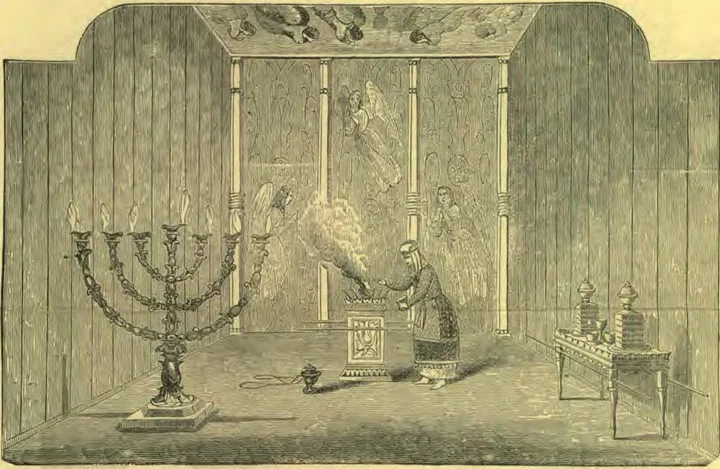
Incense was burned on the golden altar morning and evening. Ex. 30:1–8. The symbolism of this service is forcibly set forth in the following quotation:—
“The incense, ascending with the prayers of Israel, represents the merits and intercession of Christ, his perfect righteousness, which through faith is imputed to his people, and which can alone make the worship of sinful beings acceptable to God. Before the vail of the most holy place was an altar of perpetual intercession; before the holy, an altar of continual atonement. By blood and by incense God was to be approached,—symbols pointing to the great Mediator, through whom sinners may approach Jehovah, and through whom alone mercy and salvation can be granted to the repentant, believing soul.
“As the priests morning and evening entered the holy place at the time of incense, the daily sacrifice was ready to be offered upon the altar in the court without. This was a time of intense interest to the worshipers who assembled at the tabernacle. Before entering into the presence of God through the ministration of the priest, they were to engage in earnest searching of heart and confession of sin. They united in silent prayer, with their faces toward the holy place. Thus their petitions ascended with the cloud of incense, while faith laid hold upon the merits of the promised Saviour prefigured by the atoning sacrifice. The hours appointed for the morning and evening sacrifice were regarded as sacred, and they came to be observed as the set time for worship throughout the Jewish nation. And when in later times the Jews were scattered as captives in distant lands, they still at the appointed hour turned their faces toward Jerusalem, and offered up their petitions to the God of Israel. In this custom Christians have an example for morning and evening prayer. While God condemns a mere round of ceremonies, without the spirit of worship, he looks with great pleasure upon those who love him, bowing morning and evening to seek pardon for sins committed, and to present their requests for needed blessings.”
Sin offerings were made throughout the year. Instructions are given in regard to these in Leviticus 4. When the priest or the whole congregation sinned, the blood of the sin offering was sprinkled before the vail, and put upon the horns of the golden altar in the holy place. In such cases the sin offering was not to be eaten by the priests, but was to be burned with fire. Lev. 6:30. When a ruler or one of the common people sinned, none of the blood of the sin offering was brought into the sanctuary. In such cases the sin offering was eaten by the priests in the court of the tabernacle of the congregation, and this was the general law of the sin offering. Verses 25, 26. From these facts it will be seen that sin was transferred to the sanctuary by the priest not only through the blood, but through the flesh of the sin offering.
Thus day by day sin was transferred to the sanctuary, and it was defiled. Hence a special service was performed each year, on the tenth day of the seventh month, for the removal of sin. This work was called the cleansing of the sanctuary, and the day was called the great day of atonement, as set forth in Leviticus 16 and 23.— Christ our Advocate.