HER MAJESTY'S COLONIES
By G. B. Starr
(Continued.)
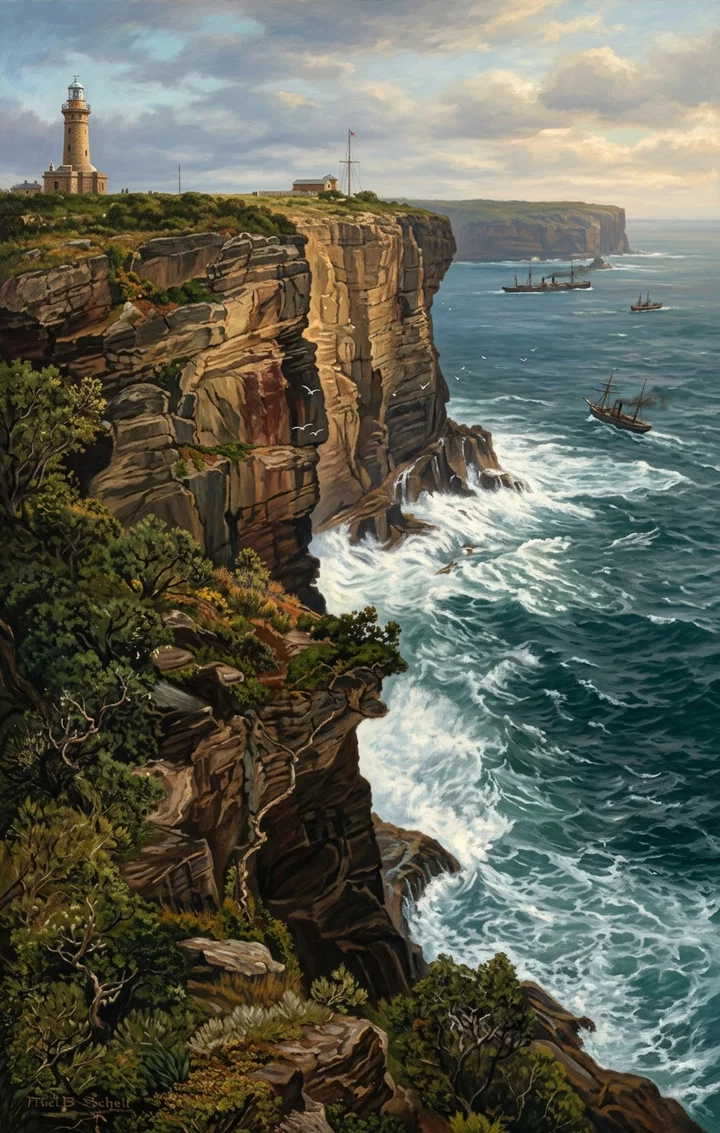
Twelve days later, after a brief stop at Auckland, New Zealand, we anchor in Sydney harbor. It is our conviction that no harbor in the world equals Sydney harbor; and we have heard of none that vies with it except that of Rio de Janeiro, though travelers who have seen both usually give preference to the former. Every bay we pass appears more beautiful than the last; palatial residences, fine cottages, and terraced gardens, with ornamental trees, ferns, and flowers, greet the eye at every turn. Ships from all nations lie at anchor in some one of the commodious inlets and bays; and we are told that all the vessels of the world could here be safely anchored from wind and storm. As mile after mile of safe harborage is passed, with miles of beautiful bays extending far inland on every side, we begin to believe that this is true.
Sydney, the capital of New South Wales, has a population of nearly four hundred thousand souls. The population of the entire colony is about twelve million persons. Being the oldest of the colonial capitals, Sydney is more nearly patterned after London than are any of the others. With a few pleasing exceptions, most of its streets are narrow and crooked. New suburbs are being laid out on a broader and better scale. The old-fashioned, noisy steam tramline, like a great train of cars, mars some of the best thoroughfares. Wherever new lines are put in, however, electric and cable trams are used, and the comparison between these and the old steam lines is the more striking. Numberless omnibuses add to the bustle and stir of the city, as they rush up and down its streets, laden, inside and out, with those who prefer this method of travel to and from business, labor, or pleasure.
The suburbs are also reached by a fine system of train service, closely resembling that of Chicago. This city having adopted the Pullman day-coach, with its revolving seat, the American traveler finds himself much more at home than in the “compartment” carriages on the through lines, or on the suburban trains of other colonies. Shut in a small compartment containing two seats, with no communication with the guard, no bell-rope, no electric button, the traveler involuntarily wonders what he should do if an accident were to happen. The first-class carriages are very comfortable, upholstered in blue, black, and brown leather, with spring back and seats. The compartments usually have lavatory and other accommodations. The second class compartments on some of the through lines are also comfortable, though furnished more plainly. Some of the second-class compartments on country lines, however, are abominable,—p. 510 “shelves in a wood-box,” one of our traveling companions called them.
But to return to Sydney: the visitor is struck by the many massive buildings that meet his eye in every part of the city,—buildings beautiful in structure and architecture, and striking in their massive solidity. “Substantial” is a mark of an Englishman's work. Everything is built to stand. Among the public buildings the post-office is prominent. The town hall, St. Andrew's Cathedral, with the new Market farther up George Street, form a group of buildings of surpassing beauty. The organ of the town hall has the reputation of being the largest, as well as one of the finest, in the world. The government supports the organist, whose productions furnish a constant source of enjoyment to the music-loving resident and visitor.
Another feature of Sydney—a beautiful feature—is its large number of well-kept, extensive gardens in all parts of the city, even in its very center. Here rich and poor alike can find a pleasant spot to spend an hour in the heat of the day; and the stranger, the homeless, a bed upon the grass for the night. The nights are so mild, the year round, that the parks are never entirely deserted.
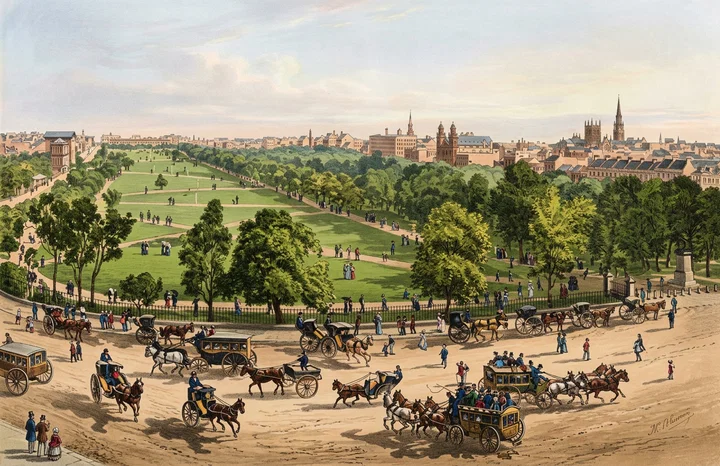
There are a large number of pleasure-resorts near the city. Bondi, Coogee, and Manly beaches are among the most popular.
Apparently the great god of the colonies is Sport. Sacrifices of time and money, of comfort and pleasure, are freely offered by the thousands who stand, hour after hour, in the heat of the day, to watch a few men playing cricket, racing horses, or trying their skill on the bicycle.
At the time of this writing, the great matched game of cricket between England and the colonies is being played; and as many as forty-five thousand persons are in attendance daily, watching with breathless attention some twelve or fifteen men at play. Gentlemen, physicians, dentists, merchants, governors, premiers, statesmen, rich and poor, leave their occupations, and travel from all parts of the colonies, at great expense, to view “Colonial,” “Intercolonial,” and “English and Colonial” test matches. It is the general verdict of the American visitor that there are altogether too many “holidays” in the colonies. Holidays, holidays, almost innumerable, interfere with one's calculations; and if not on the alert, the newcomer will come up to a holiday, or a half-holiday, with absolutely necessary purchases unmade.
The productions of New South Wales are the fruits and grains of cooler climes, with apples, apricots, peaches, pears, plums, oranges, lemons, passion-fruit, etc., but no distinctly tropical fruits. Sheep are raised in large numbers, and the shipment of their wool and frozen carcasses to other lands is a great industry. A good horse can be bought for from forty to fifty dollars, and many are sold for from ten to twelve dollars. In Queensland I have seen unbroken horses and ponies driven into the sale-yards, and sold for from $3.75 to five dollars a dozen head. G. B. STARR.