“Do WHEAT, oats, barley, and other small grains raised in this country grow in the South Sea Islands?” is a question often asked by those who are unfamiliar with the climatic conditions of those far-away lands. But though these cereals, upon which the inhabitants of cooler latitudes depend so largely for food, are not raised there, an almost endless variety of tropical fruits delights the eye and gratifies the palate the year round.
Restored with AI
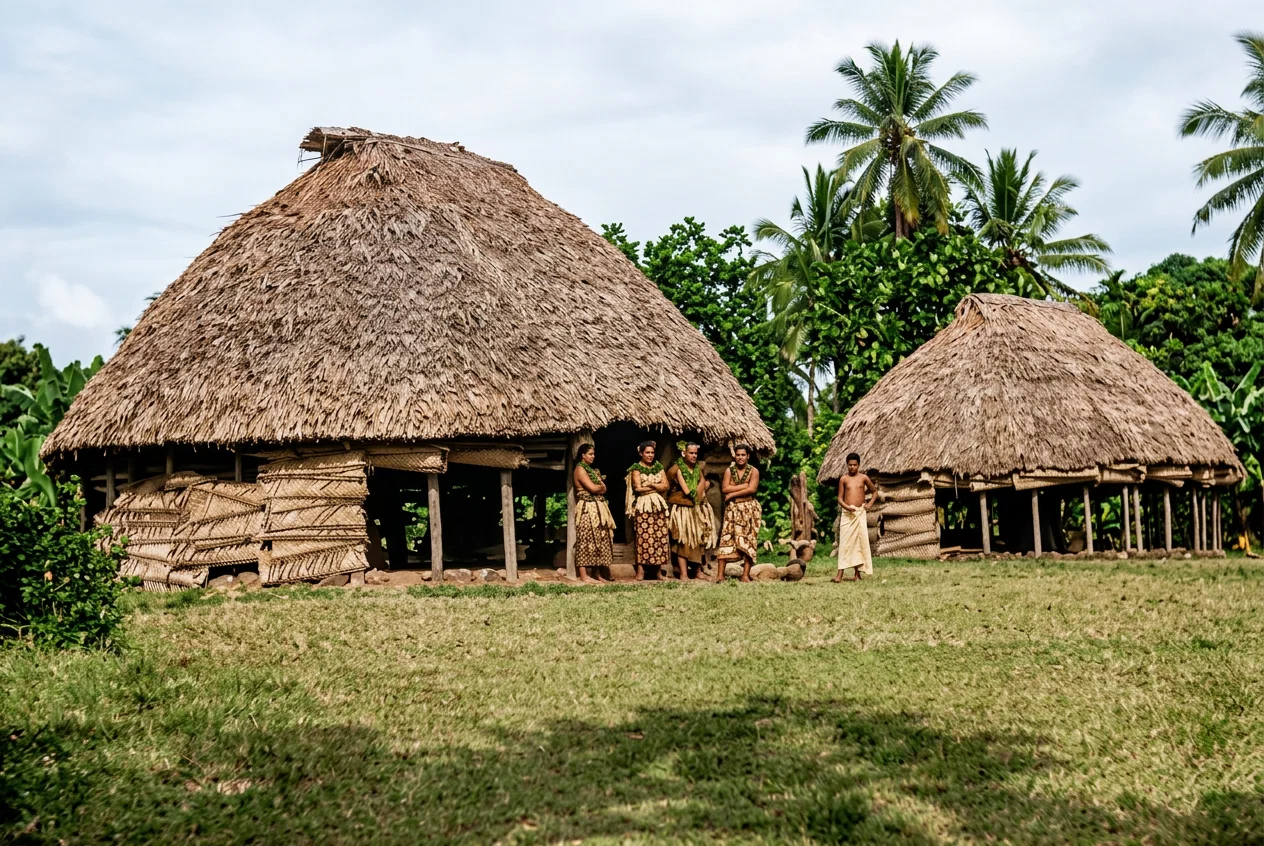
NATIVE HOUSES AT APIA, SAMOA.
Many who have never been in the tropics have an idea that the bananas that reach us here in the Central States do not taste so good as those picked from the tree after they reach maturity. This is an incorrect idea. Bananas that are allowed to ripen on the trees are tough; and for this reason the bunches are cut down as soon as they attain full growth, and while yet green. When picked, the entire tree is cut down, but the roots send out around the stump a number of shoots, each of which, when full-grown, a year later, will produce fruit. Bananas ripen all the year round; therefore there is no special season in which they are harvested.
Pineapples grow on plants close to the ground. One plant produces one apple, but that same plant will produce more fruit the next year, besides sending out shoots, each of which, when properly transplanted, will produce one apple. There are many varieties of pineapples; but the same variety tastes the same in Chicago as it does in the Society Islands.
Oranges grow spontaneously in these islands, and no one thinks of cultivating them. Whole ship-loads go to waste on the ground. Island oranges are very large and juicy, but none are so sweet as the Jaffa, which grows in Florida.
Cocoanuts are harvested by the white planters nearly every day in the year, but the islander who may possess enough ambition to harvest them at all waits until the rainy season has passed. Then he climbs the trees, and knocks down all the old nuts. These, with those that may have fallen to the ground during the year, are gathered into small heaps. They are then tied together, two and two, with a strip of the outer husk, and carried to an open spot, split open with an ax, and thrown over a pole supported by crotched sticks, where they remain at least forty-eight hours. To spread the split nuts on the ground would do just as well so far as the drying is concerned; but the owner's pigs, or those of his neighbor, might happen that way, and havoc would be the result. After the cocoanut meat is dry, it is turned out of the shell, and cut into small pieces preparatory for the market. This dried product is known as “copra.” The cocoanut also furnishes milk for the table as well as for culinary uses to nearly every one in the islands. The milk is squeezed from the grated meat after a little water has been poured over it. Young cocoanuts are full of a very sweet water.
Vanilla grows on vines, which run up the trunks of trees, the vine obtaining most of its nourishment from the tree. During the blossoming season, the flowers must be fertilized by hand, a very tedious task. As soon as the pods show the least sign of yellowness, they are picked, and dried in the sun for several weeks. The work of drying the beans requires close attention; for a few drops of rain might spoil thousands of dollars’ worth. When fully dry, the pods are tied in little round bundles weighing about half a pound each, and sold.