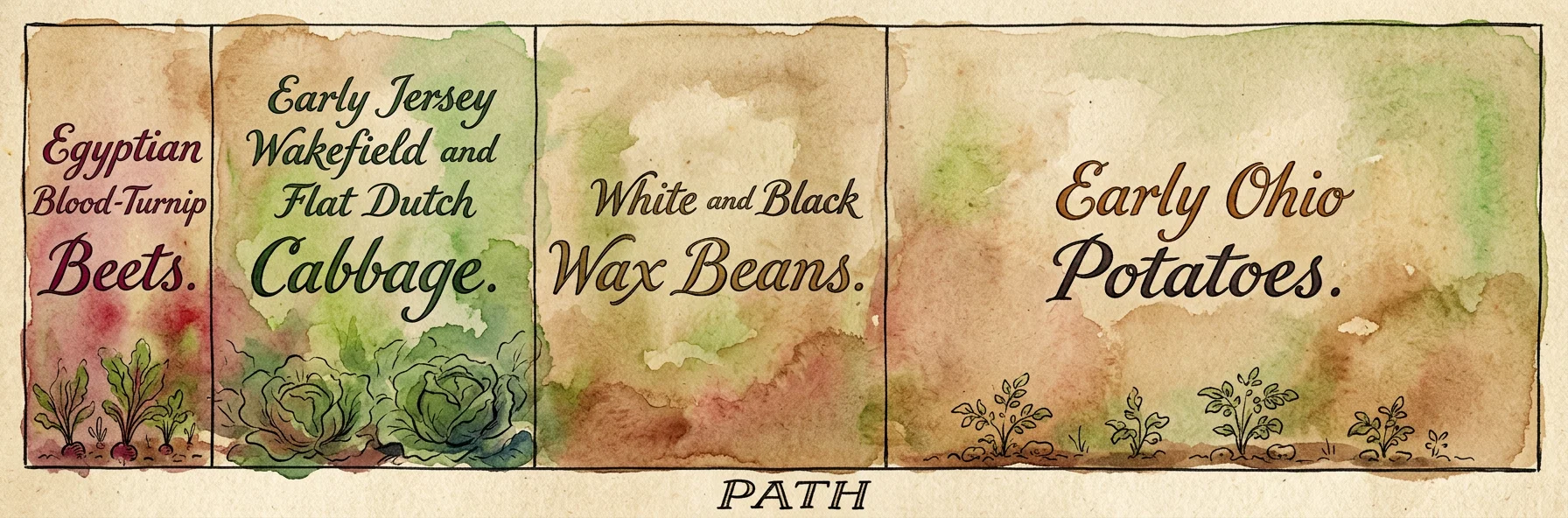
AFTER the Lord had destroyed all the trees and plants by the flood, he promised Noah that as long as the earth remained, seed-time and harvest, and cold and heat, and summer and winter, and day and night should not cease. Believing this promise, let us plant a garden for the Lord.
“But where shall we who live in large towns and cities plant a garden?” some of you ask. “If I only lived on a farm,” you say, “I would plant a large garden for the Lord, and give him all the profits.”
In every large town there are many vacant lots, some that never have any crop but weeds and grass. Go to the man who owns such a lot, and tell him you want to plant a missionary garden, and that all the profits will be used to educate the heathen. If he should refuse to let you use his lot, do not be discouraged. Remember that you are working for the Lord, and that in him your work is not in vain. Perhaps he wants you to plant some gospel seed before you plant your garden seed. Go to another with your request, remembering the promise, “In due season we shall reap, if we faint not.”
Restored with AI
PATH
Restored with AI
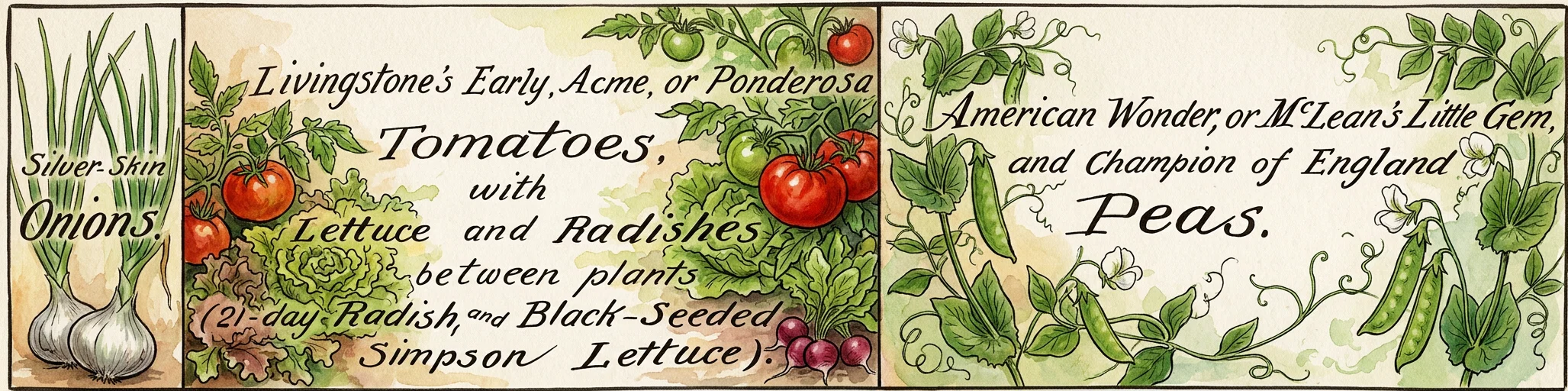
Silver-Skin Onions.
Livingstone’s Early, Acme, or Ponderosa Tomatoes, with Lettuce and Radishes between plants (21-day Radish and Black-Seeded Simpson Lettuce).
American Wonder, or McLean’s Little Gem, and Champion of England Peas.
In selecting the ground for your garden, do not choose a place where the rubbish from the city has been heaped. Be careful not to choose too large a place, or you may find that you have more land than you can properly attend to. Many men who live near large cities make a living from a single acre, or even smaller plots. They plant lettuce and radishes between the tomatoes, and not infrequently between the early cabbages, to economize space. We will apply some of their methods in our gardening.
The garden that I have planned is to be thirty by sixty feet in size. Of course those living in the country can have a larger garden than the one planned here, though one of this size is large enough for beginners.
Having selected your garden-plot, the next thing is to prepare the ground for the seed. Never try to do anything with the soil while it is wet; for it will “bake” after the sun shines on it a few days. Different soils must be treated according to their nature. One kind will need a large quantity of well-decomposed stable manure; another will not need any fertilizer. If the decomposed manure can not be obtained, new manure may be used, but it must be spread very sparingly, or it will burn the vegetation.
The next thing is to plow, or turn up, the soil. If a horse and plow can not be obtained, the next best thing is to spade the ground thoroughly. To what depth should the soil be turned up?—That will depend on the nature of the soil. Do not dig or plow deeper than the black soil. If the soil is black to the depth of twelve or fourteen inches, stir it up to that depth. After this is done, rake the soil thoroughly until all the large lumps are broken up, when it is ready for the seed. Buy a one- or two-ounce packet of twenty-one-day radishes, or some other variety that matures quickly. For lettuce buy a one-ounce packet of Black-seeded Simpson, or some other early variety. A quart of onion-sets and a quart of American Wonder peas will be sufficient for a garden of this size. If the garden is larger, buy more seed.
Lettuce and radishes should be planted first. Lettuce (Lactuca sativa) may be planted in rows about ten or twelve inches apart. Stretch a line, to keep the rows straight, and make a trench about one fourth of an inch deep. Drop the seed into the trench, six or eight to the inch. Carefully draw the soil back over the seed, and press it down firmly with the hoe.
Radishes (Raphanus sativus) should be planted in rows ten or twelve inches apart, in a trench one inch in depth. Drop the seed in the trench, four to the inch, and cover as directed above. Do not plant all the radish and lettuce seed at one time, if you wish a succession of crops.
Onions (Allium Cepa) should be planted in rows about eight inches apart. If you plant sets, put them in just deep enough to allow them to peep through; but if you plant the seed, delay planting until it is time to plant the late garden.
Peas (Pisum sativum) may be planted in succession, as well as radishes and lettuce. If the dwarf kinds, such as the American Wonder, are used, put them in rows about one foot apart. Stretch the line from north to south, if the high-growing varieties are used, so as to allow the sunlight to enter between the rows. Dig a trench by the line about four or five inches deep; drop the seed in, four to the inch; draw the soil back, and press down firmly.
Raising the beds above the level of the ground is largely a matter of taste. If the soil is well-drained, and not of a clayey nature, it is not necessary.