THE CHLOROPHYL CELL

11%

Review and Herald Publishing Company · Battle Creek, Mich. · Apr 27, 1899

FromThe Youth’s Instructor, Vol. 47, No. 17.

Read the full edition

THE CHLOROPHYL CELL.

III.

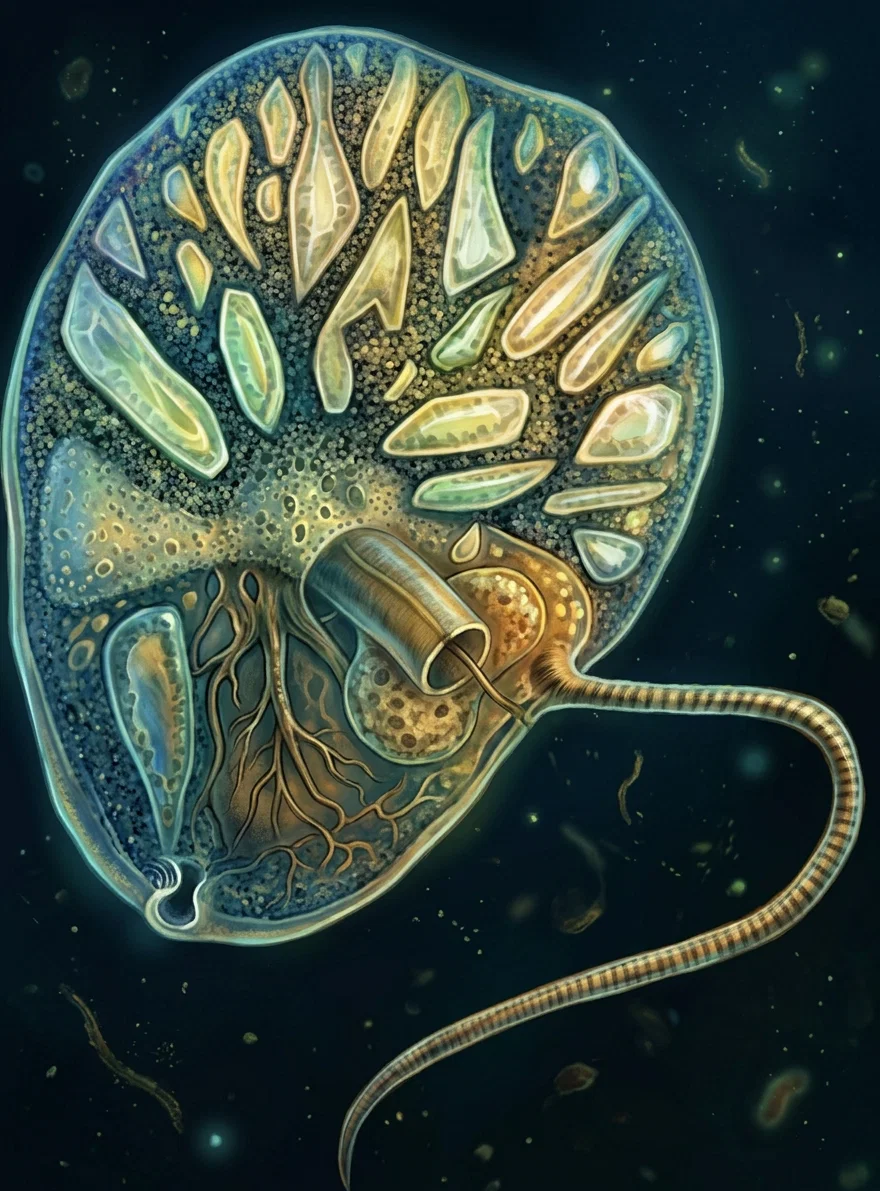
A CAREFUL examination of the teeming life of this lower depth of ocean reveals, among others, the atom of life shown in Fig. 1. It is called Protozoa (“first animal”), and is a diminutive, but very active little creature, the largest measuring, in diameter, one eighth of a line. A line is one twelfth of an inch; so it would take ninety-six of the largest of these animals, lying side by side, to measure an inch; but of the smallest it would require 1,120, lying side by side, to cover one inch of width. These tiny creatures congregate in millions, causing the water to glow with phosphorescent light wherever they appear. But we know that this is not the creature we are looking for, because this one is a wanderer, migratory, and very active, and has organs. There are still lower forms of life—but where?
FIG. I. PROTOZOA.Restored with AI
FIG. I. PROTOZOA.
Well, let us return to the land once more. There is one field we have not explored yet, and that is found both on the land and in the water,—the vegetable world. Here we may find the little creature.
“But you said the food creator was an animal!” you exclaim. No; I said it was a creature. “Well, a vegetable can not be a creature. Vegetation is not alive.” You are wrong. Vegetables are composed of creatures, and all are very much alive. If a small portion of a growing plant is placed under a powerful microscope, certain living forms are brought to light. These are called cells. Between each cell and those surrounding it, and apparently separating the cells from one another, is a substance that is different from the material composing the wall of the cell. It was formerly supposed that because of this separating substance, the cells of plants did not communicate in any way; but the walls of adjoining cells have been dissolved with acid, and it has been found that exceedingly delicate threads pass from cell to cell, forming a kind of nervous communication. Before this discovery, it was not understood how sensation was possible in plant-life, as, for instance, in the sensitive-plant.
The interior of a cell is a substance, the composition of which is still practically unknown. Scattered through the protoplasm of some of the cells are occasional diamond-shaped dark spots. These are corpuscles, and are composed of chlorophyll, the substance that makes vegetation look green.
All cells do not contain chlorophyll, but all green cells (the cells which do have it), create food for all other (white) cells to consume, or live upon; so that, as all life is composed of cells, the chlorophyll cell creates food for all other cells, and therefore for every living thing in the earth, air, and water.
W. S. CHAPMAN.