THE SUPREME TEST

8%

Review and Herald Publishing Company · Battle Creek, Mich. · Apr 27, 1899

FromThe Youth’s Instructor, Vol. 47, No. 17.

Read the full edition

THE SUPREME TEST.

When Jesus left the coasts of Galilee, on his way to Jerusalem,—the city which he was to enter in triumph, hailed as the Son of David, and to leave by the way of the cross,—great multitudes followed him.
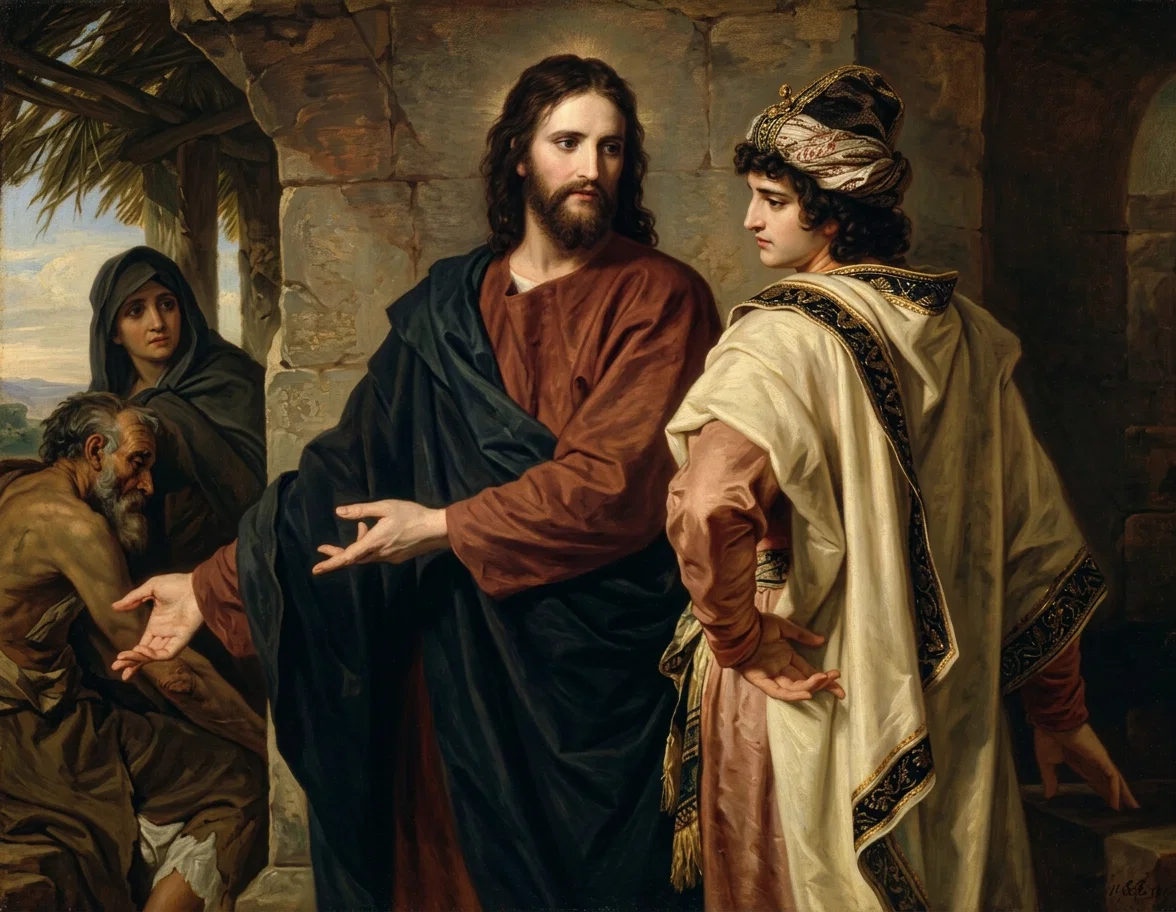
“SELL THAT THOU HAST, AND GIVE TO THE POOR.”Restored with AI
“SELL THAT THOU HAST, AND GIVE TO THE POOR.”
In the crowd that thronged his steps there were the aged, the infirm, the suffering; “and he healed them all:” there were the Pharisees, who came to catch him with questions, and to quibble over the writings of Moses; and he answered them: there were mothers, anxious that his hands should rest in blessing upon their children; and he rebuked his disciples when they would have sent these away, and took the little ones in his arms, and blessed them, saying, “Of such is the kingdom of heaven.” And when he had laid his hands on them, he departed thence. But there was one who still followed him out of the throng,—a young ruler, who had vast possessions but an unsatisfied heart. Perhaps he had debated for a while the question of following the lowly Nazarene at all, and so drawing attention to himself; for we read that he “came running,” as if not to lose any time, once his mind was made up.
Kneeling before the Saviour, he said, “Good Master, what good thing shall I do, that I may have eternal life?” What good thing shall I do! He was eager, or thought he was, to earn eternal life for himself. Many since his day have been anxious to pay their own way through to the kingdom; and too often with the same sad result that followed in this case,—when the time came to show their faith by their works, they failed to stand the test.
Jesus did not immediately reply to his question, but sought to draw from the young ruler an acknowledgment of his own divinity. “Why callest thou me good? there is none good but one, that is, God,” was to ask, in another way, “Whom say ye that I am?” Then, as he was silent, the Saviour said: “Thou knowest the commandments, Do not commit adultery, Do not kill, Do not steal, Do not bear false witness, Defraud not, Honor thy father and mother.”
The Saviour knew that the young man had been brought up from earliest childhood in the strict observance of the law. In all outward forms—prayers, fastings, washings, and all manner of observances—he failed not; yet his heart was not at peace. Filled with self-righteousness, yet troubled by his great unrest, he said, “All these things have I kept from my youth up: what lack I yet?”
“Then Jesus beholding him loved him, and said unto him, If thou wilt be perfect, go and sell that thou hast, and give to the poor, and thou shalt have treasure in heaven: and come, follow me.” Since the ruler would have something to do, the Saviour met him on that ground, and gave him a task that would test his faith. Well the Saviour knew, as he read the troubled heart before him, that where his treasure was, his heart would be,—that if he would pass this crucial test, and put his treasure in heaven, his heart would go with it.
In the invitation, “Follow me,” Jesus offered to the young prince the greatest honor ever bestowed upon men,—the honor of becoming one of his chosen disciples. It was the call given to Philip, to Matthew at the receipt of custom, to the sons of Zebedee at their work, to Peter and Andrew at their fishing. All these gladly left everything, and followed him.
How the heart of Jesus yearned over the young man! with what earnest longing he desired to see him make the right choice! but he did not put forth one atom of his mighty power to influence his decision. He was free to choose his master. He had seen the Saviour’s mighty works; he had listened to his words of wisdom and love; and in answer to his question as to what he should do, he had been told to do something that would require the exercise of great faith. Will he stand that supreme test? The struggle is short; but alas! self gains the victory. “And when he heard this, he was very sorrowful: for he was very rich.”
“He went away.” Of his own choice he left the divine Son of God, and went back to his people, his houses, his lands, choosing the god of this world for his master. Thus the gospel narrative leaves him. There is no sadder failure recorded in the Scriptures.
The choice set before this young man is set before you to-day. Whom will you serve? Great possessions are not needed to keep you from taking up Christ’s cross, bearing his burden, and wearing his yoke. A very little thing may stand in the way. Whatever it is, O, hasten to-day to lay it down at his feet, and to do his bidding!