ACCORDING to my promise in the last number of the INSTRUCTOR, I will tell you how to use the steel scraper. As I have already mentioned, it is a tool that could hardly be dispensed with in working cross-grained lumber; that is, wood in which the grain runs both ways, well represented by locking your fingers together. This tool is equally useful in dressing veneering, which is always thin. The use of the plane would chip out the veneer, thus ruining it; but with the scraper, it can be worked down smooth without injury.
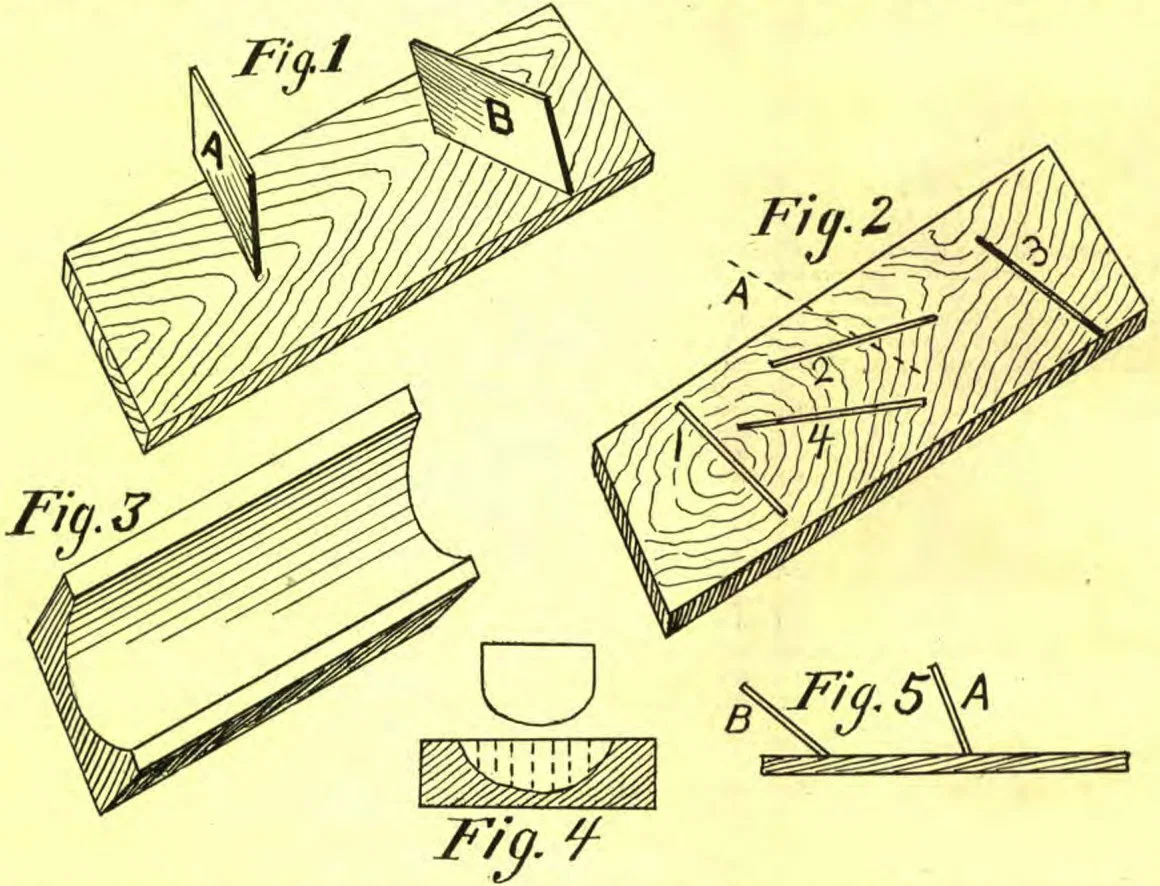
Fig. 1 shows the grain of the wood as it appears many times in boards, also scrapers a and b placed in their proper position with the grain. Notice particularly that the scrapers stand square with the grain.
Fig. 2 shows a board with two knots in it. You will see that the grain in this board does not run the same as that shown in Fig. 1, but, instead, is all chopped up, making it more difficult to work. But when such lumber is worked down true and smooth, and polished, it looks much richer than a straight-grained stick, and shows the wonderful beauty that the Creator of the lily has hidden in our forest trees.
At a, Fig. 2, you will see a dotted line. Notice that this line runs across the board with the grain of the wood; also that the streaks which look dark in the etchings are always lighter colored in a piece of timber, while the grain between, which looks light, is darker. Especially is this true of oak lumber. The dark grain is generally soft, while the light grain is hard. If you should use the scraper as indicated by the dotted line, you would work out the soft grain of the wood, and instead of making your board smooth, you would make the surface uneven, something like a washboard. In Fig. 2, at 1, 2, 3, 4, you will see the position of the scraper should be held in order to do smooth work upon a board grained like this. Constantly change the position of the scraper to keep it across the hard grains; then your work will be smooth.
Sometimes it is necessary to get out a molding of some sort, and smooth it up.
In Fig. 3 you will see a piece of lumber which has been hollowed out. If you are where you can use a buzz-saw, you can easily chip out the thin pieces by setting the saw a few times, and running it through the board (see dotted lines in Fig. 4); and with a plane, and a scraper made round on one edge, you can dress it out smooth.
In Fig. 5, at a, you will see about the position the scraper should have in order to do good work. Should you lay it over, as at b, the scraper would soon lose its edge.
If you follow the directions about sharpening and using this tool, you can use it to good advantage. “If at first you don’t succeed, try, try again.”
A few words about the use of sandpaper will fit in nicely here. Work that is to be finished in oil or varnish should never be sandpapered across the grain, but always lengthwise of it. Sometimes when wood is to be painted, especially soft wood, we work across the grain, because we can true it down more easily. For sandpapering you should have a block of soft wood about three or four inches square and one inch thick, over which to fold the paper. A block of cork, which you can get at almost any drug store, is better still. I have sometimes seen pieces three or four feet square. The druggist will cut off for you what you want. The numbers of the sandpaper I use most of are 1½, 1, ½, and 0.
Should there be any points in these articles you do not fully understand, or should you want further information concerning anything, be free to write. It will cost you only the postage. W. K. LOUGHBOROUGH.