If, standing between the rails, we look up a long, straight stretch of railroad track, we shall observe that the rails apparently come together at the place where earth and sky seem to meet. This apparent junction of earth and sky, or, at sea, of sea and sky, is called the horizon; and the horizon line is the most important line in the study of perspective, as it determines the drawing of all receding lines.
I would like to ask you who intend to take up these studies in perspective to content yourselves for the present with the most active observation, in the scenes about you, of all points to which your attention is called, before trying to draw. In this way you will thoroughly test the statements made. Statements and drawings are of little use unless we know, by personal observation, that they are true. And with such observation will come an understanding of many other facts, which can be gained in no other way.
In nature the horizon line is imaginary; it is not a real line at all, but simply a term used to define the limit upon the earth’s surface, which our eyes can see. The horizon line is always on a level with our eyes.
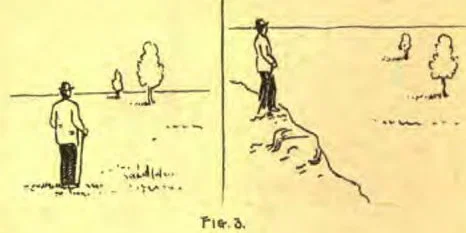
We shall observe, upon trial, that if we are low down, as in a valley, we can see less of the earth’s surface than if we stand on a level plain; and that if we are high up, we can see more: thus we learn that the horizon line is opposite the observer’s eyes, wherever he stands, and, consequently, is not the same to any two persons, unless their eyes are on exactly the same level.
One reason the horizon line appears to rise as we ascend, is that we are by that means literally taller, and can therefore see more of the earth’s surface. For example, suppose the person shown in Fig. 3 is the observer. Then the horizon line will be on a level with his eyes, and he will see the horizon line across the trees, below their branches. As he ascends a hill, the horizon line ascends with him; in other words, he sees a higher horizon line with every upward step. When he reaches the summit, the horizon line passes above the trees.
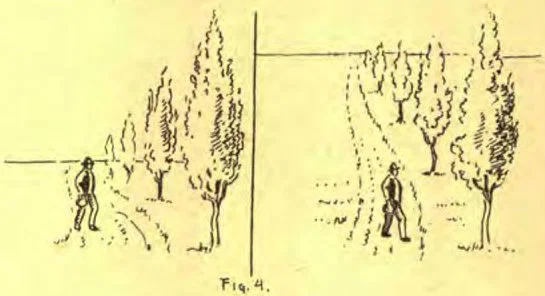
In Fig. 4 suppose you are the observer. You see a man coming along the road, and his head is about level with yours, as is shown by the horizon line. Now suppose you ascend some eminence until your eyes are near the top of the trees, you will see a new horizon line, far above the man’s head, passing near the top of the trees, and you can see much more of the earth’s surface. All this will show you plainly that the higher the eye, the higher the horizon line.
Therefore, if not so situated as to be able to see the horizon line (and we seldom can see it unless we are by the seashore, or on an open plain), we need be at no loss to know where the horizon line would be,—that is, how high or how low it would appear to us,—for at whatever height we are standing, the horizon line is always at just the height of our eyes.
PEDRO LEMOS.