Ethel Terry Reeder.
My dear Ralph: Uncle John went away last week, to be gone some time. We boys didn't like the idea of giving up our talks for so long; so he said he would write out what he had to tell us, and then we might send the letters to you. We received the first one yesterday, and I will send it on to you, with the two little pictures. Your loving cousin, Herbert.
Uncle John's Letter.
My dear boys: After arriving here, I found that the business which I came to attend to will keep me away from home much longer than I expected; but I think I shall find time for our science letters each week.
This time I will write about the use of water in running machinery. Perhaps you have never seen a water-wheel; but only a few years ago nearly all the flour and meal were ground in mills run by water-wheels. You may have heard grandpa tell how, when he was a young man, he used to ride horseback to mill, and take two bags of grain to be ground, and then carry the flour or meal home in the same way. I never think of the old water-wheels without thinking of a proverb that I learned when I was a boy: “The mill will never grind with the water that has passed.” It taught me a good lesson: see if you can find one in it.
Nowadays, a few large mills, with powerful engines, make flour and meal for all the world; and the small mill, with its clanking wheel, is seldom seen. The large mill is run by water, though, in another form.
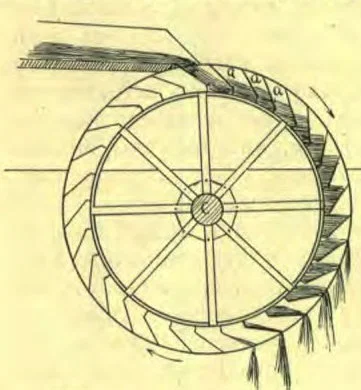
I have made two illustrations, which will help you understand how the water-wheel works. Fig. 1 is what is known as an overshot wheel. It is so arranged that the water from a running stream is caught in the little cups marked a, a. The weight and force of the water keep the wheel turning in the direction indicated by the arrows. Where there is no natural fall, the stream is dammed, and an artificial fall made. The water is carried out on the wheel by ap. 353 trough, like d. The machinery inside the mill is attached to the wheel by a strong rod, or bar, passed through c, and is thus kept in motion.
Where a fall can not be arranged, the undershot wheel (Fig. 2) can be used. This wheel is placed in a running stream in such a way that the water rushes under instead of over it, filling the little cups, or buckets, a, a, and turning the wheel in the direction of the arrows.
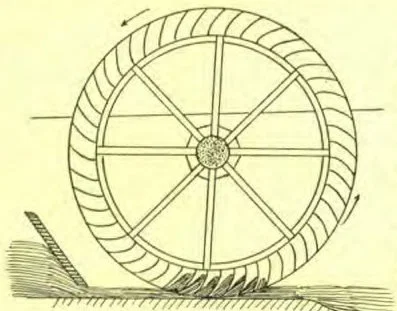
At b is an arrangement to measure and regulate the quantity of water passing under the wheel, and thus regulate the working power of the wheel. This can be done with the overshot wheel by a simple device in the trough, d.
Last summer when we went across the lake on the little steamer, you were sure you could not have taken the ride if it had not been for the water; but did you ever think, when you were riding on the train, that it was water that was pulling you along so fast? Yet it is true that our great locomotives would run little better than Bob's toy engine if it were not for water; neither would it be possible to move any of the machinery in our large mills without water; for water does much of the world's work.
You know that when water is heated, it floats away in steam, or vapor. It does this without any apparent effort when it is free to do just as nature intended; but when men want the water to work for them, they shut it up, and heat it. As it is heated, it expands; and in trying to get away, it puts forth a great deal of energy.
I hope you will sometime have an opportunity to study more about the ways in which water is made to work. Meanwhile, keep your eyes open.
Yours lovingly, Uncle John.