Illustrations by the Author.
The sunshine and soft rains of an early summer have brought clouds of foliage to wood and orchard, and there is a fulness and variety of life in the shady nooks of even a single large tree. At this season we shall find great pleasure in making friends with the birds. Some are too shy and restless to encourage acquaintance, while others freely allow a study of their ways.
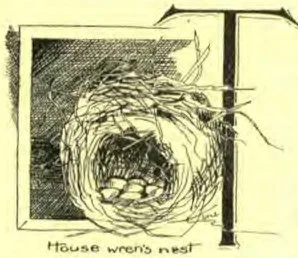
The little chirping house-wren is one of the most friendly, as well as one of the best-known of the feathered tribe. It is about five inches long, with short, rounded wings, short tail, and slender legs. Its plumage is generally dull, but its song is sweet. The accompanying picture was drawn from a nest in a secluded corner of the every-day sitting-room of a rural home. The wren and its mate are a jolly pair of home-makers, and do not appear annoyed by the motions of a spectator. There were in the nest six tiny, pale-pink eggs, speckled with autumn-leaf brown; but the number usually ranges from seven to ten.
Common in our gardens, orchards, and shrubberies, is the American goldfinch, or yellow bird; and it is pleasant indeed to lie upon the grass and watch its graceful flight, which is nothing more nor less, apparently, than a succession of joyful bounds through the air. With its beautiful color, dainty habits, and soft, pleasing song, it is a captivating little creature. It drops upon a grass stem so lightly as scarcely to bend it, while it plucks at the tiny seed. It is always happy, no matter how dismal the weather; and during a shower will sit upon a twig, its wings folded close, to shed the rain-drops, and sing its sweetest song, as if to remind us that “behind the clouds is the sun still shining.” Its nest is remarkable for its neatness, and is lined with a fine, downy material. The eggs are bluish-white, with a few spots and lines of pale purple and brown.
Humming-birds have attracted universal admiration ever since the discovery of America. Their brilliancy of plumage, endless variety of color, diminutive size, and the rapidity of their movements have caused them to be objects of special interest. They are the smallest members of the bird family, and have been poetically called the “fairies of the feathered tribe.” They have long, slender bills, which enable them to obtain honey from the flowers; but they do not, as some have supposed, feed on honey alone, but also on insects. The wings of these birds are long, and move so quickly as to be almost invisible. The humming-bird lays two tiny white eggs in a nest constructed of fibrous substances, such as lichens and cotton.
A pair of catbirds that have set up housekeeping in a crotch of the old apple-tree often make friendly calls around the doorstep. Perhaps the crumbs to be found there prove too attractive to be resisted by creatures so busy as they. The catbird belongs to the same family as the mocking-bird, which it resembles in its vocal powers; its song is most bewitching in its lack of method and arrangement. When disturbed, it utters the cry from which it takes its name, and which resembles nothing so much as the cry of a young infant. These birds are graceful and somewhat dandified in manner. Their plumage is dark-gray in color, and is very smooth. They do not attempt to conceal their nest, but often build it near our homes, and display great boldness in the defense of their young. The eggs are of an electric-blue color.
The praises of the whippoorwill, which takes its name from its clear call at twilight and during the night, have often been sung. This bird is about ten inches long. Its plumage is mottled, the head is streaked with black, and a band of white is on the throat. It feeds on beetles, moths, and other insects. Though extremely shy, the persistent bird-lover will find it out. It builds its nest near the ground. The eggs are light-blue, speckled with brown.
EVA M. CARTER