The Chinese have two of the fastest war-ships in the world’s navies,—a torpedo boat with a speed of thirty-five and one-half knots an hour, and a 4,400-ton cruiser with a record of from twenty-two to over twenty-four knots an hour, according to the draft used.
A Deep Lake.—The deepest lake in the world, as far as known, is Lake Baikal, in Siberia. While nine thousand square miles in area, or nearly as large as Lake Erie, it is from four thousand to four thousand five hundred feet deep, so that it contains nearly as much water as Lake Superior. Its surface is thirteen hundred and fifty feet above sea-level, and its bottom nearly twenty-nine hundred feet below it.
The World’s Sugar.—According to Success, the human race consumes annually between fourteen and sixteen billion pounds of sugar. In 1895 England used eighty-six pounds per capita; the United States, sixty-four pounds; Denmark and Switzerland, forty-five pounds each; France, Germany, and Holland, thirty pounds; and Greece, Italy, and Turkey, seven pounds for each individual. Every year sees an increase in the use of this article of diet. Used in moderation, sugar is valuable as a heat- and fat-producer; but its excessive use clogs the liver and causes serious digestive derangements.
Politics in School.—During the last year a novel experiment was tried by the children of a public school in Milwaukee. They were encouraged to enter upon a course of self-instruction in the principles of municipal government. The offices were all filled, and for a while all went smoothly enough. But before long the officers and citizens of this “Learning-by-Doing” town imitated too thoroughly the methods of their elders. The study of politics absorbed all the juvenile interest, bitter partisan feeling was developed, and one boy who longed for office insured his “unanimous” election by a judicious distribution of pencils, chewing gum, and candy! The parents of the children took sides, and the hard feeling that resulted was entirely out of proportion to its cause. However, it was sufficient to put a summary stop to the “experiment.” If there is no better way for children to become familiar with the usages of municipal government, than by having their consciences seared with the spirit of fraud, deceit, and bribery that too largely prevails, it would be better that they remain in ignorance of them.

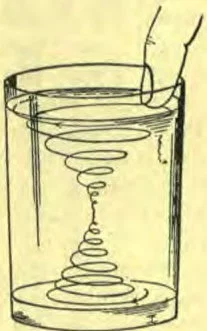
A Waterspout in a Tumbler.—The following experiment showing how a waterspout is formed at sea is thus translated in Popular Science News: “On the bottom of a tall tumbler, or, better, of a cylindrical glass jar, is spread a layer of some colored syrup, such as red currant. The glass is then carefully filled with water, so as not to disturb the layer. If a finger-tip or the bowl of a teaspoon is dipped into the water and rotated slowly for ten seconds, the syrup will be seen to swell and raise itself in the shape of a cone, whose apex is prolonged upward into a slender, flexible column, until it coalesces with the downward-pointing apex of another cone formed at the surface of the water by a rotary movement. Both cones will revolve spirally in the same direction (see figure), and will shift their positions together. If, instead of syrup, small pieces of sugar are strewn on the bottom of the glass and allowed to melt, the remaining particles will be sucked up by the mimic waterspout as far as the thinnest portion of the connecting column, and thrown forcibly outside the vortex. The lower cone will revolve a great deal faster than the upper one, and it is also much smaller. Beside this principal waterspout, others still more diminutive will be produced, whose lower cones are almost invisible, the points of the upper cones rapidly descending to meet the former at less than an inch above the bottom layer. This represents accurately what takes place when two aerial currents come together from opposite directions in the upper strata of the atmosphere, and impart a rotary motion to the latter. Smaller cones may also be set whirling on the surface below, where the air is denser, and they will move much more rapidly than the upper cones. This explains the tremendous velocity of the wind under these conditions.”