“ABOUT as much use as a last year’s bird’s nest,” is an expression we sometimes hear; but if we only knew it, last year’s birds’ nests are like old ideas,—they form substantial foundations for new ones.
The eagle, hawk, crow, and other large birds build their nests year after year in the same spot, until, large in the beginning, they sometimes attain enormous dimensions. Even the smaller species of the bird family do not reject a desirable building location, simply because it has been used before. It is an interesting sight to watch the feathered house-builders trying to pull a piece of string from an old nest, to place in a new one.
In Texas the hawk, which lives mostly in the western counties of the State, builds its nest in the mesquit tree, ten or twelve feet from the ground. The nest is composed of sticks about one foot long, and the size of one’s little finger. The inside of this rough home is lined with grass, horsehair, feathers, and other soft materials.
The crow builds her nest in the top of a lofty tree. It is much like the hawk’s nest in appearance, but is not so flat, nor so large in circumference. The mocking-bird also builds its nest of almost the same materials, only on a much smaller scale, except that it uses a few sprigs of “Indian tobacco,” a plant which bears no resemblance to the tobacco-plant of commerce, either in taste or smell. Texas birds seem to have a decided liking for it.
Sparrows’ nests are somewhat similar to those of the mocking-bird, with this difference: instead of being composed of sticks or twigs, they are made of broom-weed and the lightest material obtainable. They are lined with the Indian tobacco, moss, cotton, horsehair, feathers, etc.
The scissortail builds its nest of soft grass, Indian tobacco, cotton, etc., high up in the steady forks of trees, usually the mesquit. The nest of what is known as the wheat-bird resembles that of the scissortail, except that it is built low, in a small bush, and generally near a pond or sluggish stream. On one occasion, greatly to her grief, the approach of the writer so disturbed a family of these birds that they all left the nest, and hopped into the water.
A nest that is much admired, not only for its beauty and utility, but also for its comfort, is that of the oriole. This nest is made, in the South, of fine, soft, yellow grass, and lined with cotton and the soft down from the breast of the mother-bird. It is swung to the ends of several slender twigs, which interlap, or come close together, and have a tuft of green leaves. In this wind-swung home are cradled some of the sweetest and brightest of nature’s songsters.
The little dove, though innocent and harmless, is not a very good house-maker; for she simply finds a place where two or three limbs join, and there lays some dried peppergrass stalks together until she has a flat nest. This does not always keep her eggs nor her young safe; for many times, after a wind-storm, one may find on the ground either a capsized nest and tell-tale shells or her two birdlings, cold and stiff. The dove often makes her nest on the ground, as do many other birds.
The field-lark makes a beautiful nest under a weed or tuft of grass; but instead of being open at the top, it has a roof, and opens at the side. The quail builds a nest very much like that of the field-lark, though larger, and of a different variety of grass.
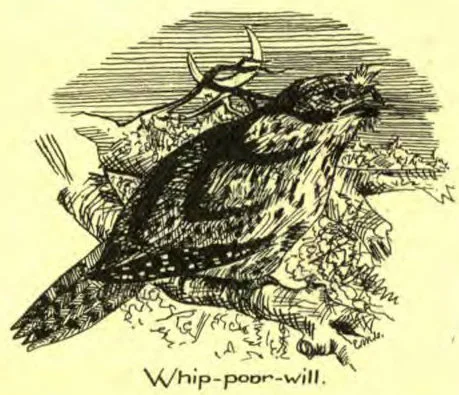
The curlew and the whippoorwill simply collect a few little pieces of grass roots for the home of their young.
A peculiar and interesting nest is the edible bird’s-nest of the swift, which inhabits the Malay Archipelago, Java, and the Philippine Islands. This nest is composed of a glutinous substance, and is regarded by the Chinese as a great delicacy. The bird first swallows a peculiar sort of seaweed, which is mixed with the mucus secreted by its salivary glands, and then disgorged, and made into the nest, which is clear and wax-like. This is the stage at which the nests are most prized.
MRS. A. G. BODWELL.