On the fourth of January I took the train at Ahmedabad for this celebrated mountain, about four hundred and twenty-five miles north of Bombay. The first part of the journey was through a deserted-looking country with a scanty vegetation,—the home of the camel. Through this section large numbers of camels were roaming about, very much the same as the cattle do on the plains of America. In India they are used as burden-bearers; and long trains of them may be seen every day on their way to or from a city. Each one has a hook in its nose, and is tied by a cord about ten feet long to the tail of the one in front of it. The leader is either ridden or led by an Indian. The crane also finds a very good home in this section. Large numbers of these were seen soaring high in the air, while others were feeding upon the scanty vegetation. As we neared the end of the journey, which was over a winding pass and through a mountain jungle, we passed a number of beautiful wild deer and some elephants with a little baby elephant.
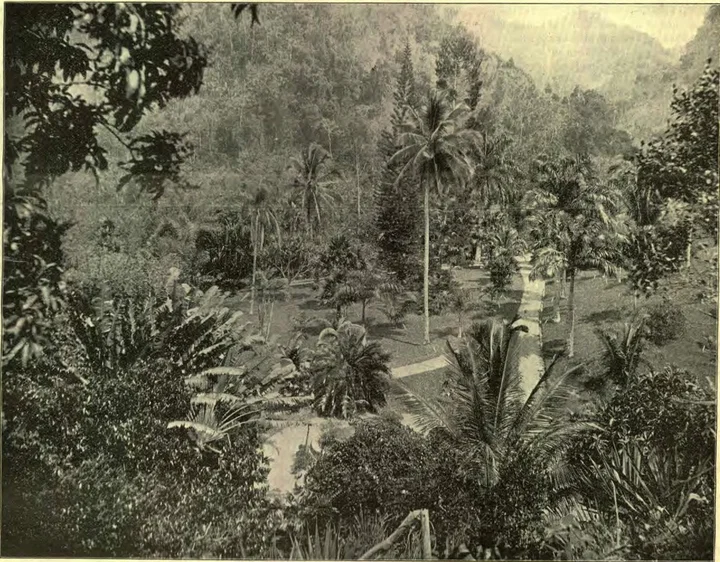
Aboo Station, sixteen miles from Mount Aboo, is situated in a valley. The surrounding mountains, covered with dense forests and jungles, are very picturesque and beautiful. The highest one, “Saint’s Pinnacle,” is five thousand six hundred and fifty-three feet high.
Near the station are two immense rocks called the “Nun” and the “Toad,” from their curious resemblance in outline to a veiled woman and to an immense toad. Near by is a beautiful little lake.
Mount Aboo is much visited by tourists from all parts of the world. In company with several tourists from Madras, I made the ascent. We went on little Indian ponies, by a good road. It is a very celebrated place of pilgrimage, especially for the Jains. About half way up the mountain is a group of four temples arranged in the form of a cross. Two of these are classed with the most beautiful temples in the world. Colonel Todd, in speaking of one of them, said: “Beyond controversy this is the most superb of all the temples in India, and there is not an edifice besides the Taj-Mahal that can approach it.”p. 154
According to tradition, the founder, Bunul Sah, a Jain merchant, purchased the site from the ruler of Sirohi by covering as much ground as was necessary for the temple with silver coin, and paying it as the price. The temple was fourteen years in building, and is said to have cost eighteen million pounds. It is a three-storied temple with porticoes on each of its four sides, supported by marble columns. There are sixteen on each quarter between the lines of entrance.
This temple, with its four approaches, ample domes, and shady colonnades, built of pure white marble, and carved with all the delicacy and richness of ornament that India at the time of its erection (A. D. 1031) could devise, is dedicated to Rishabhanath, the first of the twenty-four deified men whom the Jains worship. Inside the shrine, which is the only inclosed part of the temple, is a quadruple image of this deity, facing the cardinal points.
At different periods of the year thousands of pilgrims assemble at this place to worship this senseless image, many coming from far-distant places. Some who are more foolish than the rest crawl or roll the whole or a part of the distance, while others measure it with their bodies by a repeated falling and rising movement. I have seen them traveling in these ways in some of the cities during the Monsoon season, when the filth and mire of the streets was something terrible. Much of the worship connected with this temple is disgusting, and the worst evils result. O, how bitter are the results of sin, and how blighting are the effects of idol-worship upon its devotees!
A very extensive view is obtained from the top of Mount Aboo. It enjoys a healthful, invigorating climate during the hot season. For a number of years there has been a sanitarium here for European soldiers.
WILLIAM LENKER.