If among the many forms of life we wished to choose the most graceful and brilliant creatures, whose histories are more like fairy stories than sober reality, we could scarcely do better than to select those which we are now going to study under the name of the “lasso-throwers.” Strange as the name may seem, I hope to show that it is not too fanciful to be accurate.
Every one knows that the long cord called the “lasso,” used by the Western cow-boy and the South American hunter, is the peculiar weapon which they use to capture animals. From the earliest childhood the young Gaucho learns to play with the lasso, and almost before he can walk amuses himself by skilfully throwing the lasso-loop around the necks of young birds and other small animals round about his father’s hut, and drawing them to his feet. When he is large enough to ride, we see him galloping over the plain, swinging the cord round his head, and letting it fly at the wild horses and wild cattle; and when he becomes a man, often he captures a jaguar or a puma.
Now among animals, as we have already seen, any weapon which they are to use must be such as grows upon their own body, and we should little suspect that an animal could be provided with a lasso ready grown within its flesh; yet this is true. In the type of life standing in rank just above the sponge, we find a weapon of this kind as simple and as deadly as the lasso of the South American hunter, and far more wonderful in its action.
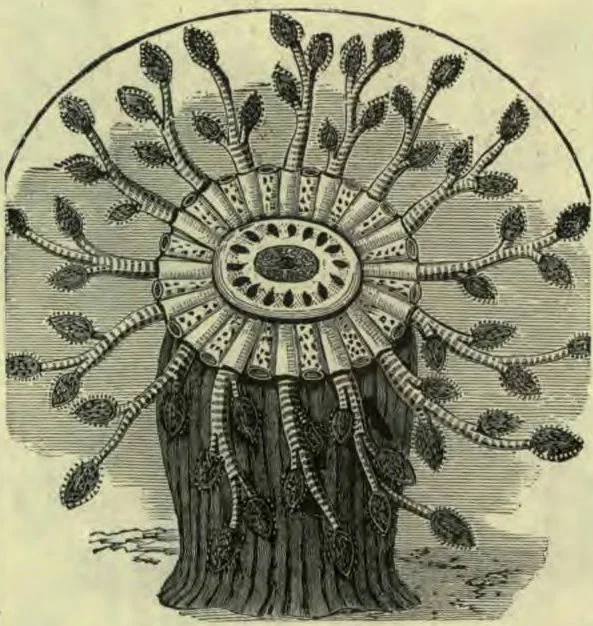
In almost every pool, clinging to a floating stick or to a stone at the bottom, will be found little greenish animals in great numbers, about a quarter of an inch long. Examine one of these, and you will find it looks like a tube with a circlet of fibers at the end, which are waving in the water. This creature is the common fresh-water hydra, and is, in fact, nothing more than a tube fringed at one end with these lassos, and with a sucker at the other end to hold on to the object where it lives. The most remarkable thing is the power which it has of overcoming animals stronger and more active than itself.
Thrusting out its flexible, jelly-like cords, perhaps it touches a water-flea, a water-worm, or even a newly-born fish passing by in the water. Instantly it twists its lasso round its prey. The victim does not struggle, but is at once drawn into this hollow tube, for him a fatal sack.
Now, why does the young fish succumb so quickly? Let us examine the cord, and we will see where the secret of all the hydra’s strength lies. Instead of having a loop at the end of the cord, as does the lasso which the cow-boy throws over the horns of the cattle, the weapon of the hydra, when examined under a microscope, is seen to be crowded with hundreds of clear, transparent cells, each so small that two hundred laid in a row would not be an inch long.
Each of these lasso-cells contains a formidable weapon. Within the cell, lying bathed in a poisonous fluid, is coiled a delicate thread, barbed at the base.
The moment these cells touch an animal, they burst, and these little barbed threads fling themselves out full length. So the victim is pierced by a number of darts, and the poisonous fluid pours into the wounds, paralyzes him at once, and he becomes an easy prey for the hydra. But the hydra does not waste his lasso-cells; for although a cell once used cannot be used again, he grows a new one for each one he exhausts.
The animal develops from a true egg. The creature dies in the early winter, leaving an egg which remains until spring, when it is hatched, producing a new creature to take the place of the parent.
This is the simplest lasso-thrower; the class as a whole is called Coelenterata, and includes a great variety of beautiful creatures. It is divided into two divisions,—Hydrozoa, or water animals, and Actinozoa, or ray-like animals, such as the anemone. But it is sufficient for us to know that, with few exceptions, these all seize their prey by means of a lasso. In another article we will learn something about how they spend their lives.
T. J. ALLEN.